Bike tyre pressure: the right psi for your weight, tyre and bike
Bike tyre pressure by rider weight and tyre width, front and rear, for hybrids, e-bikes, cargo bikes and Bromptons. Sidewall limits, valves, pumps, checks.
By the tyred mechanics
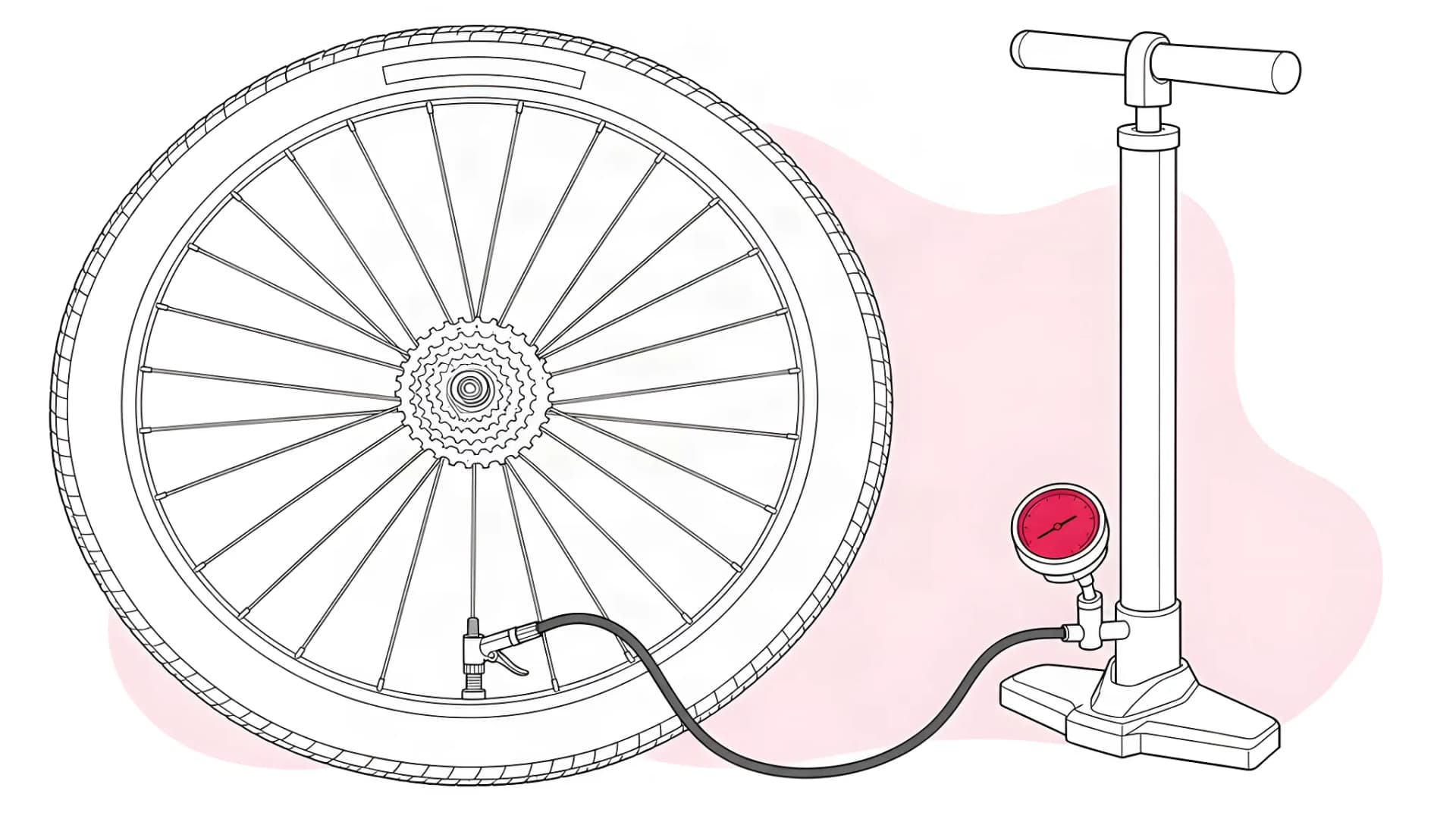
Short answer: bike tyre pressure is a point inside the range printed on the sidewall, set by the load on each wheel and the width of the tyre. A 70 kg rider on a 13 kg hybrid with 32 mm tyres sits at about 46 psi front and 58 psi rear. A 90 kg rider on the same bike needs about 59 and 74 psi. Wider tyres take less, the rear carries more than the front, and a tube loses about 1 bar (15 psi) a month.
What pressure should bike tyres be?
Bike tyres should sit between the minimum and maximum printed on the sidewall. Inside that range the pressure rises with the load on the wheel and falls with the width of the tyre.
The figures below are starting points for the bikes Londoners ride, worked from the method in the next section. Front pressure comes first and rear second. Each line assumes an inner tube, a typical bike weight for the type and no luggage.
- Road bike, 9 kg, 25 mm tyres: 51 / 80 psi for a 60 kg rider, 85 / 130 psi at 100 kg.
- Hybrid, 13 kg, 32 mm: 40 / 50 psi at 60 kg, 65 / 81 psi at 100 kg.
- Hybrid, 13 kg, 35 mm: 33 / 43 psi at 60 kg, 56 / 70 psi at 100 kg.
- Dutch-style upright bike, 16 kg, 40 mm: 19 / 42 psi at 60 kg, 34 / 68 psi at 100 kg.
- E-bike, 23 kg, 50 mm: 18 / 31 psi at 60 kg, 23 / 49 psi at 100 kg.
- Front-loader cargo bike, 35 kg plus 25 kg of load, 55 mm: 26 / 33 psi at 60 kg, 36 / 46 psi at 100 kg.
- Brompton, 12 kg, 16-inch wheels, 35 mm: 65 / 65 psi at 60 kg, 65 / 79 psi at 100 kg.
On upright bikes and e-bikes the front wheel carries so little weight that the method can return a figure below the printed minimum, and the printed minimum then wins.
The road bike figure at 100 kg reaches 130 psi at the rear, so check it against the maximum on your tyre. If it is over, the honest fix is a 28 mm or wider tyre rather than more air.
Mountain bikes are the one case where the tyre-drop method does not apply, because knobbly tyres on narrow rims behave differently. BikeRadar's mountain bike guide starts an 80 kg rider on tubeless 2.4 in tyres at 21 psi front and 23 psi rear, 24 and 26 psi on 2.2 in tyres, and adds 5 psi with inner tubes.
Gravel bikes on 40 to 45 mm tyres follow the hybrid figures with a 10 per cent cut for rough terrain.
Bike tyre pressure by rider weight and tyre width
The pressure that lets a tyre sag by 15 per cent of its width under load gives the best balance of rolling speed, comfort and puncture resistance. The engineer Frank Berto measured 50 road tyres at seven pressures and eight loads to plot that pressure against wheel load and tyre width.
The figures in this guide come from a curve fitted to Berto's chart. The method splits your system weight of rider, bike and luggage between the wheels by bike type, and takes 10 per cent off for tubeless tyres or a rough surface.
The figures below are the same method for a 13 kg hybrid with inner tubes and no luggage, front pressure first and rear second. It uses the 45 per cent front and 55 per cent rear split that the magazine Bicycle Quarterly measured on touring bikes.
- 28 mm tyres: 51 / 63 psi at 60 kg, 59 / 73 at 70 kg, 66 / 83 at 80 kg, 74 / 93 at 90 kg, 82 / 102 at 100 kg.
- 32 mm tyres: 40 / 50 psi at 60 kg, 46 / 58 at 70 kg, 52 / 66 at 80 kg, 59 / 74 at 90 kg, 65 / 81 at 100 kg.
- 35 mm tyres: 33 / 43 psi at 60 kg, 39 / 49 at 70 kg, 45 / 56 at 80 kg, 50 / 63 at 90 kg, 56 / 70 at 100 kg.
- 40 mm tyres: 26 / 33 psi at 60 kg, 30 / 39 at 70 kg, 35 / 44 at 80 kg, 39 / 50 at 90 kg, 44 / 55 at 100 kg.
- 47 mm tyres: 18 / 24 psi at 60 kg, 22 / 28 at 70 kg, 25 / 33 at 80 kg, 29 / 37 at 90 kg, 32 / 41 at 100 kg.
The rear figure is always the higher one, because the rear carries more of you on every bike. Berto's own rule was to take about 10 per cent off the front figure and add about 10 per cent to the rear.
Ten kilograms of rider or luggage moves a 32 mm hybrid tyre by 6 to 8 psi, so add a full pannier or a child seat to your weight before you pick the figure. If a figure falls outside the range printed on your tyre, the printed range wins.
Bike tyre psi and bar: reading the sidewall
The sidewall of a bike tyre carries a minimum and a maximum pressure in psi and bar, and those two figures are the hard limits for that tyre. One bar is 14.5 psi, so a tyre marked 4.5 to 7.5 bar is the same as one marked 65 to 110 psi.
The tyre size sits next to the pressures, and a 700c hybrid tyre reads 32-622 or 700x32c.
The maximum is a tested limit rather than the pressure the tyre wants. Berto describes it as a figure the tyre was inflated well beyond on the correct rim without blowing off. The tyre maker Schwalbe's line is that you should under no circumstances exceed or fall below the limits on the tyre.
Rims carry a limit of their own, and the lower of the two limits applies. Hookless rims, which Rene Herse Cycles describes as common on modern tubeless-ready carbon wheels, have a maximum of 72.5 psi (5 bar) whatever the tyre says. On a hookless rim, cap the figure from the method at that number.
How to pump up a bike tyre
To pump up a bike tyre:
- Identify the valve.
- Open it if it is a Presta.
- Press the pump head on square before locking the lever.
- Pump until the gauge reads your target.
The valve type decides which pump head fits and whether a gauge will read at all.
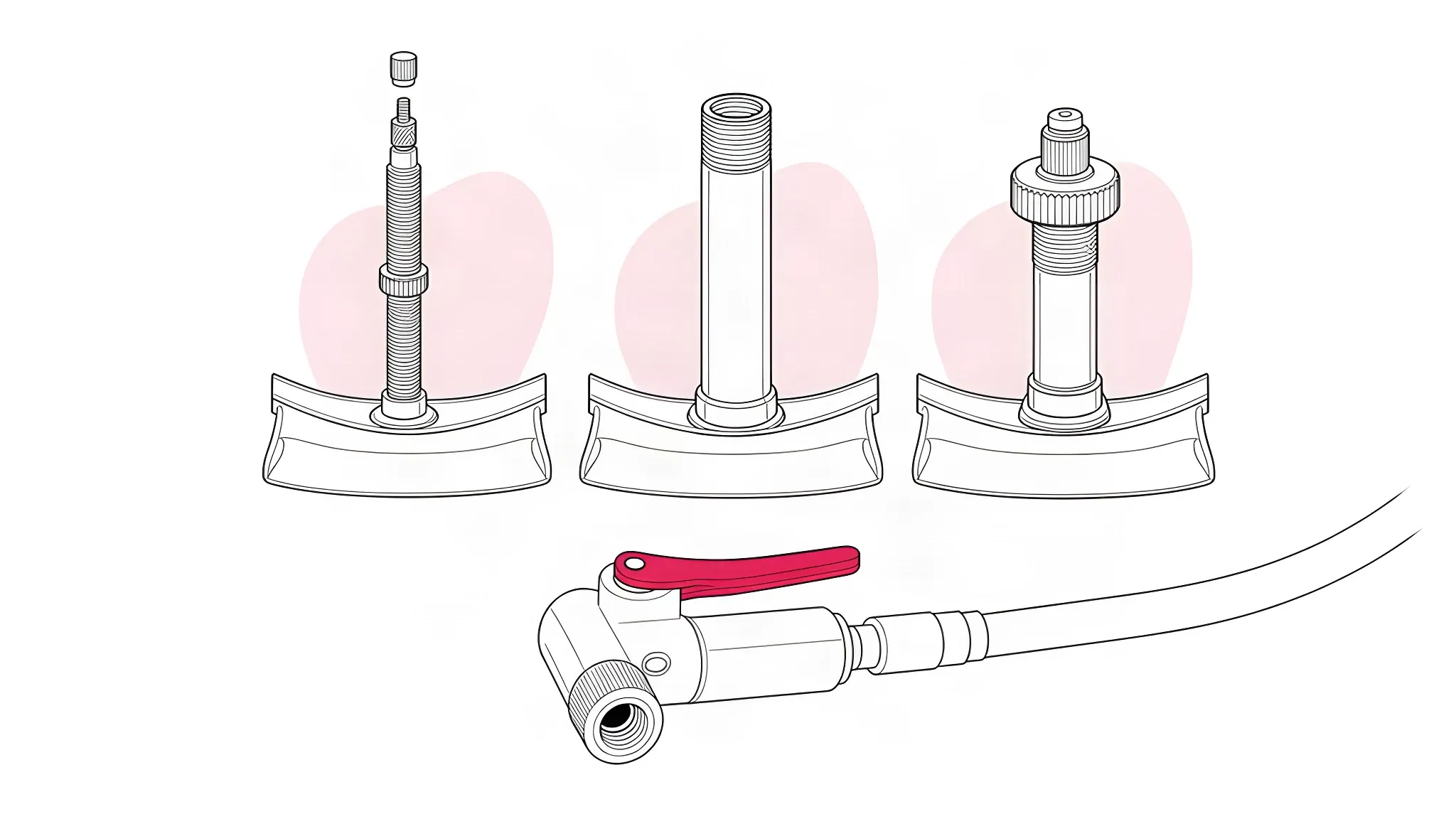
Presta is the slim 6 mm valve with a small knurled nut at the tip. Unscrew that nut anticlockwise until it stops, tap it once to free the seal, then fit the pump head. Hold the head straight, because the stem bends if it goes on at an angle, and screw the nut back down afterwards.
Schrader is the wider 8 mm car-type valve found on cheaper bikes, many hire bikes and some e-bikes. There is nothing to unscrew, so push the head on, lock it and pump. Schwalbe notes that older and simpler bicycle pumps do not fit it.
Woods, also called Dunlop, sits on Dutch-style bikes and older town bikes. It is Schrader-width at the base with a knurled ring nut, and it takes the Presta side of a pump head. Schwalbe's valve guide states that a traditional Woods valve cannot be read with a gauge, so the gauge only shows the pressure while you are pumping.
Whichever valve you have, Continental's advice is to check with the valve at the twelve o'clock position.
Four ways to inflate a tyre, and what to watch for with each:
- Track pump with a gauge. For home, the weekly check and seating a tubeless tyre. A worn gauge reads high: Berto's estimate was 100 psi shown at a true 80 or 90.
- Mini pump. For carrying on the bike. It is hard work at road pressures, and a hose puts less strain on a Presta valve.
- CO2 inflator. For the roadside, one shot. BikeRadar notes that CO2 leaks out overnight, and Stan's says it shortens sealant life.
- Petrol station compressor. For Schrader valves in an emergency. Michelin warns it can rupture an inner tube, so use short bursts and your own gauge.
If the tyre goes soft again within a day, the valve core or the tube is leaking, and our puncture guide covers finding the hole.
How often should you check bike tyre pressure?
Check bike tyre pressure with a gauge at least once a month, and weekly if you commute every day.
A butyl inner tube loses about 1 bar a month with no puncture at all. Schwalbe gives that figure and adds that the loss is faster at high pressures, so a road bike at 100 psi drifts down sooner than a Dutch bike at 45 psi.
Latex tubes are lighter but porous, and Schwalbe's advice is to check them before every ride, with TPU tubes between the two. Continental notes that the air volume tracks the air temperature, which is why a tyre set in a warm flat reads lower on a cold morning.
Tubeless tyres hold pressure through sealant rather than a tube, and sealant dries out. Stan's puts the life of its sealant at two to six months depending on climate and use, and suggests a top-up every three months.
Do not rely on a thumb test to set a number. Schwalbe points out that any tyre feels hard enough from about 2 bar (30 psi), and that the thumb tells you nothing on a Marathon Plus.
Gauges also drift with age, and BikeRadar quotes Silca's Josh Poertner putting a typical floor pump gauge at plus or minus 5 per cent. Berto found gauges reading high as they wear. A separate digital gauge costs less than a tyre and lets you check the pump against it.
Tyre pressure for London commuting: potholes, kerbs and pinch flats
A pinch flat happens when a soft tyre hits a hard edge, bottoms out on the rim, and nips the inner tube between rim and road. It leaves two small holes a few millimetres apart, which is why mechanics call it a snakebite.
Kerbs, sunken drain covers, the ridges around roadworks plates and potholes in bus lanes are the London causes. The rear wheel suffers first because it carries more weight, and pressure is the one variable you control on a fixed route.
Berto's example was a 20 mm and a 32 mm tyre at the same 100 psi under the same wheel load. The narrow tyre sagged 18 per cent of its width and collected snakebites, while the wide one was over-inflated.
Set the rear from the weight figures rather than from the front. If your tyre is 28 mm or narrower and you weigh over 85 kg, those figures are a case for a wider tyre at the next replacement.
In the wet, BikeRadar suggests dropping both tyres by about 2 psi for grip. A puncture-resistant tyre such as a Schwalbe Marathon Plus does not remove the need for pressure, because a soft belted tyre still pinches on a kerb.
E-bikes, cargo bikes, Bromptons, Dutch bikes and hire bikes
E-bikes and cargo bikes
An e-bike weighs about 10 kg more than a hybrid, and a cargo bike with a child on board can double the load a wheel sees. On an upright e-bike the rear takes about 65 per cent of the total.
An 85 kg rider on a 23 kg e-bike with a 3 kg bag and 50 mm tyres comes out at 20 psi front and 44 psi rear. Where that front figure is below the minimum printed on your tyre, the printed minimum applies.
A front-loader cargo bike with an 80 kg rider, a 35 kg bike and 25 kg of children on 55 mm tyres comes out at 31 psi front and 40 psi rear. Heavy bikes bottom a soft tyre out on smaller edges, so check e-bike and cargo tyres weekly.
Bromptons and other 16-inch wheels
Small wheels need higher pressure for the same load, and Schwalbe says so directly for folding bikes. Brompton's standard Schwalbe Marathon tyre in 35-349 is printed 65 to 110 psi (4.5 to 7.5 bar). The bottom of that range is already above what a 35 mm tyre on a full-size wheel would run for the same rider.
For a small wheel, raise the result from the method by 15 per cent and keep it inside the printed range. That puts a 75 kg rider at the 65 psi minimum on both wheels, and a 95 kg rider with a 5 kg bag at 65 and 79 psi.
A Brompton at 40 psi is below its printed minimum and rides like a bike with a slow puncture.
Dutch bikes and Woods valves
A Dutch-style bike on 40 mm tyres carries about 65 per cent of the load on the rear. A 75 kg rider on a 16 kg bike comes out at 25 psi front and 52 psi rear before the printed minimum is applied.
With a traditional Woods valve a gauge cannot read the tyre once the pump comes off, so pump to the target on the gauge and accept that the reading is approximate. Swapping to Schwalbe's gauge-readable Woods valve or to Presta tubes fixes that for good.
Santander, Lime and Forest hire bikes
You cannot set the pressure on a hire bike. TfL asks Santander Cycles riders to check the tyres, brakes and bell before riding off.
If the bike is unsafe, press the Fault button on the docking point within ten seconds of docking it and turn the saddle backwards. A pressed Fault button locks the bike until an operative has checked it, and tyre inflation is on their checklist.
Lime and Forest bikes are reported through the damage report in each app, so end the ride, report it and take another bike.
Is higher tyre pressure better?
No. Above the pressure that gives 15 per cent tyre drop, a bike tyre does not roll faster, and it grips and rides worse. Bicycle Quarterly's coast-down tests found that rolling resistance stops improving at that point, and Berto's drum tests showed cornering force falling as pressure rose.
Three things get confused with the right pressure:
- The sidewall maximum is a tested limit, and Bicycle Quarterly found that inflating to it overinflates wide tyres and underinflates narrow ones.
- The same pressure front and rear is wrong on any bike with a rider on it, because the rear carries more from the moment you sit down.
- Higher pressure does buy a margin against pinch flats on a laden bike, which is why the rear figure in each pair is the one to hold.
When tyre pressure is a job for a mechanic
Pumping a tyre is a two-minute job. Book a mechanic when:
- A tyre goes soft within a day of pumping and you have not found the hole. A leaking valve core, a porous old tube or a cut in the tyre needs finding rather than topping up. Mobile puncture repair starts from £30, at home, work or roadside.
- A tubeless tyre will not seat or will not hold pressure. Seating needs a burst of air from a compressor, and the sealant and rim tape need checking.
- The sidewall shows cracks or a bulge. Schwalbe links sidewall cracking to running low pressure for a long time.
- You have hookless rims or a new tubeless set-up and want the limits checked before the first ride.
- A Brompton, Dutch bike or cargo bike needs tubes with the right valve and size.
A mechanic comes to you 9am to midnight, seven days a week, with a track pump, a gauge and the tubes and tyres for the job. Book a tyre or puncture repair.
Related guides
Sources and further reading
- Frank Berto, All About Tyre Inflation (2006, PDF), tyre drop, snakebites, the front and rear rule, pump gauges.
- Jan Heine, Bicycle Quarterly: optimising your tyre pressure for your weight (PDF), the 15 per cent rule and the front and rear split by bike type.
- Rene Herse Cycles, tyre pressure calculator 3.0, the hookless cap of 72.5 psi (5 bar).
- Schwalbe, inflation pressure, the 1 bar a month loss, latex tubes, the thumb test, small wheels, sidewall limits.
- Schwalbe, bike tyre valves, Presta, Schrader and Woods valves.
- Continental, bicycle tyre FAQ, the twelve o'clock check and pressure loss with temperature.
- BikeRadar: road bike tyre pressure (Simon von Bromley, November 2025), gauge accuracy, the hookless limit, the wet-weather adjustment.
- BikeRadar: how to pump up a bike tyre (Oscar Huckle, June 2023), valve types and CO2.
- Michelin UK: how to pump up a bike tyre, the petrol station compressor warning.
- Stan's NoTubes, sealant support, CO2 with sealant and the refresh interval.
- BikeRadar: mountain bike tyre pressure guide (Tom Marvin, December 2025), starting pressures for an 80 kg rider and the 5 psi addition for inner tubes.
- TfL, Santander Cycles: how it works, the pre-ride check, the Fault button and the saddle signal.
- TfL FOI-1184-2021, what happens after the Fault button and the inflation check by operatives.