How to clean a bike chain and remove rust from it
How to clean a bike chain on the bike or off it, get rust off, choose wet, dry or wax lube for UK weather, and tell when a rusty chain needs replacing.
By the tyred mechanics
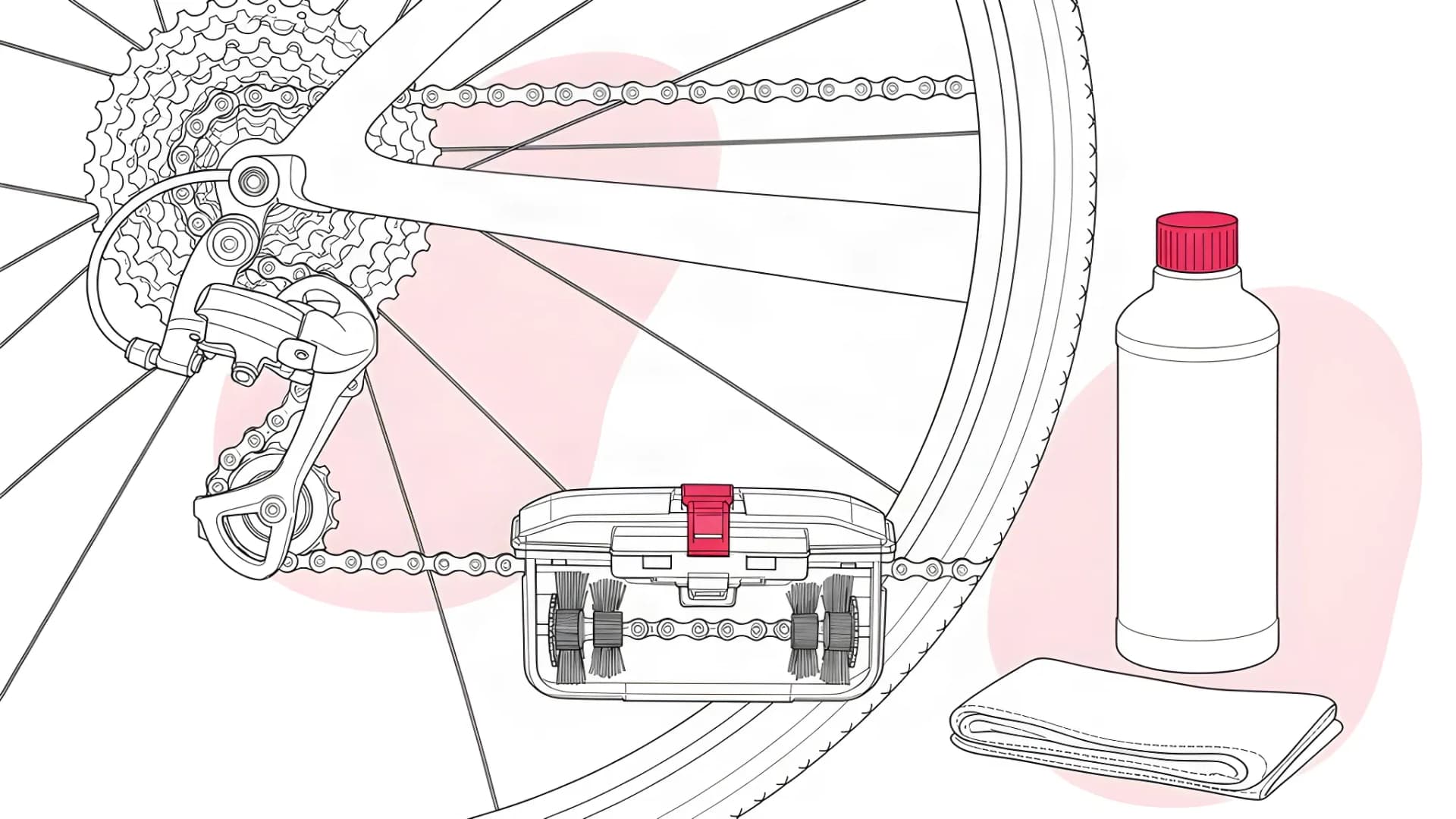
Short answer: how to clean a bike chain is five jobs: degrease, scrub, rinse, dry and lube. Spray a bike degreaser onto the chain, cassette and jockey wheels, and scrub with a stiff brush or a clip-on tool while backpedalling. Rinse, dry the chain through a rag, then put one drop of lube on each roller and wipe it. Light rust comes off the same way. A chain that stays stiff, or measures worn on a chain checker, needs replacing.
Does your chain need a wipe or a degreaser?
Run a clean rag around the lower run of the chain while you turn the cranks backwards. If the rag comes away with a grey film and the chain looks silver underneath, wipe it and add fresh lube.
If the rag comes away with black paste, or you can feel grit in the links, the chain needs a degreaser. That is the whole decision, and it takes thirty seconds at the kerb.
Cyclescheme's chain care guide gives a second test: if you cannot read the maker's name stamped on the side plates, the chain is due a clean.
Canyon puts a commuter's full clean at around once a week. Cycling UK suggests every 160 km on the road and more often through winter. The rag tells you what your own commute is doing.
How to clean a bike chain without taking it off
Cleaning a bike chain on the bike is seven steps: set up, knock off the dirt, degrease, scrub, rinse, dry, then lube and wipe. You need:
- A bike-specific degreaser
- A stiff brush
- An old toothbrush
- Three rags
- A bottle of water or a hose on a gentle flow
Muc-Off Bio Drivetrain Cleaner is one widely stocked degreaser. Warm soapy water shifts light dirt, as Cycling UK allows, but it will not cut old oil.
Add chain lube for the season, gloves and cardboard under the bike. A clip-on chain cleaning tool is quicker and less messy, though Canyon's guide is right that brushes do the same job.
1. Set the bike up
Lean the bike against a wall or put it in a workstand. Shift to the middle chainring, or the single ring, and a sprocket near the middle of the cassette, so the chain runs straight under a little tension.
On a disc-brake bike, cover the rear rotor with a plastic bag, because degreaser on the rotor makes the brake squeal and glazes the pads.
2. Knock off the loose dirt
Brush the chain, cassette and jockey wheels dry, or rinse them with clean water. Muc-Off's first step is a rinse, so the degreaser works on grease rather than on mud.
3. Apply the degreaser
Spray or brush the degreaser along the chain while you turn the cranks backwards. Then do the cassette, the chainrings and both jockey wheels, the two small wheels in the derailleur cage.
Muc-Off says to leave its Bio Drivetrain Cleaner for up to one minute before agitating. Do not let it dry on the chain.
4. Scrub
With a clip-on tool, fill the reservoir, clamp it around the lower run and turn the cranks backwards two or three times. Then press the brush button and keep turning until the chain comes out clean.
Without a tool, hold the stiff brush against the chain from below and from the side while you pedal backwards. Use the toothbrush on the jockey wheels, and pull the edge of a rag between the sprockets.
5. Rinse
Rinse the chain, cassette, chainrings and derailleur with a gentle stream until the degreaser has gone. Muc-Off is specific that all of its formula must be removed. Aim the flow from above and behind the cassette so the run-off misses the rotor.
6. Dry
Spin the cranks backwards to throw water off, then run the chain through a dry rag until the rag stops darkening.
Cycling UK allows five to ten minutes in warm weather for the rollers to dry inside. A squirt of a water-displacing spray such as GT85 speeds that up on a cold evening, and you still lube afterwards.
7. Lube and wipe
Put one drop on each roller of the lower run while you turn the cranks slowly backwards. The LCC guide, written with London Bike Kitchen, says one drop per link and no more than two or three turns of the cranks.
The rollers need oil. The side plates do not, and oil on the outside only collects grit. Run through the gears, wait fifteen minutes, then wipe the outside until the rag comes away almost dry.
Deep clean: taking the chain off and soaking it
Take the chain off when the brush leaves grit inside the rollers, or when you are switching to wax. Split it at the quick link, the removable joining link, with quick-link pliers, covered step by step in our guide to fixing a bike chain.
Road.cc's method drops the chain into an old drinks bottle with a couple of hundred millilitres of degreaser or white spirit. Shake it, then fish the chain out with a spoke. Label the bottle and keep it away from children.
Keep the chain's soak to minutes. KMC says aggressive degreasers loosen the factory grease from the pins, let dirt in and shorten the chain's life. Canyon adds that a long soak can leave the steel prone to cracking. Rinse, dry the chain completely, refit it and lube it before the bike goes back outside.
How to remove rust from a bike chain
Surface rust on a bike chain comes off with a penetrating spray, ten minutes of patience and a wire brush, followed by a normal degrease and lube.
Orange bloom on the side plates after a wet week locked outside is surface rust. Rust inside the rollers, links that will not bend and pitted metal are a different problem, covered in the next section.
With a penetrating spray. WD-40's own guide coats the chain with its Multi-Use Product, leaves it for ten minutes and scrubs with a wire brush until the rust lifts. Repeat on stubborn patches and wipe the flakes away. Flex each stiff link sideways between your fingers until it moves freely.
Then degrease the chain exactly as above, because the spray loosens rust but leaves nothing behind that lubricates. WD-40 states in the same guide that its Multi-Use Product should never be used to lubricate the chain.
With what is in the kitchen. Cleanipedia's rust guide uses a paste of equal parts baking soda and water, left on the rust for 15 minutes and scrubbed off. It also soaks a removed chain in white vinegar for 15 minutes and rinses it straight after, because vinegar keeps corroding metal. Take that with a caution from the chain maker.
KMC says never to use acidic or alkaline cleaners on a chain, because they damage it and in extreme cases lead to breakage. The same warning covers chemical rust removers, which belong on frames and bolts.
If you try a kitchen method on light rust, keep the contact short, rinse straight away and dry the chain fully.
A rusty chain is a dry chain, so the lube step is part of the rust removal. Apply wet lube, wipe the outside, and check the chain again after the next wet ride.
When a rusty chain needs replacing rather than cleaning
Replace the chain when:
- A chain checker drops fully into the links at 0.5 per cent on an 11 to 13-speed chain. On a 6 to 10-speed chain the figure is 0.75 per cent.
- Links stay stiff after cleaning and flexing.
- The rollers are pitted.
The percentages come from BikeRadar's workshop guide to chain wear. SRAM's own tool checks for 0.8 per cent, and SRAM tells owners to replace the chain once wear passes that figure.
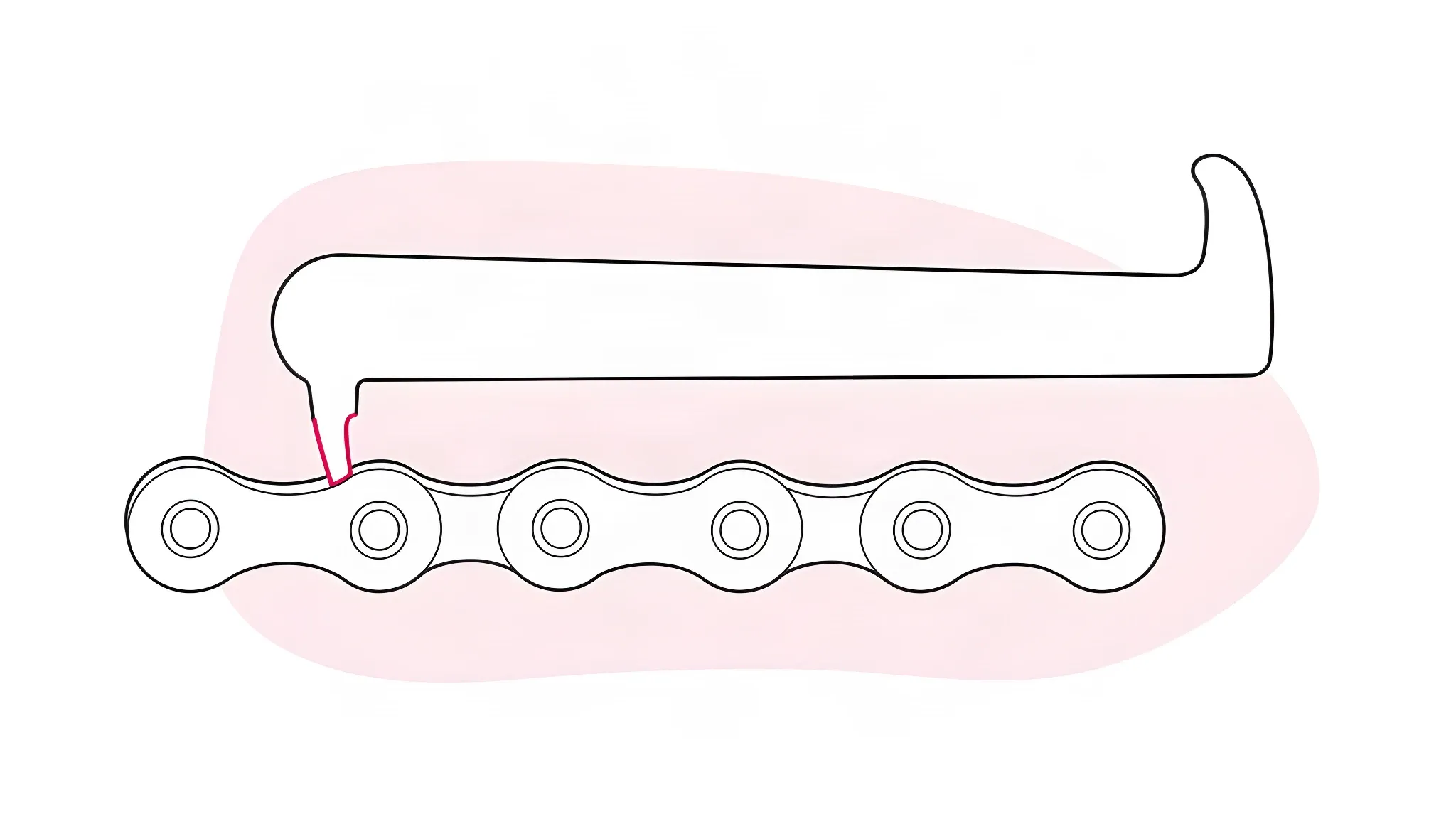
A chain checker costs around £10, in Cyclescheme's figure, and gives a yes or no in seconds. Hook one end into a link and try to drop the other end in.
If the checker sits above the chain, the chain is fine at that mark. If it drops in flush, the chain has reached that wear. BikeRadar recommends measuring at three different places, because chains do not wear evenly.
KMC's no-tool check is to lift the chain away from the big chainring at the front. If it lifts more than half a link, measure it.
The ruler method needs no tool at all:
- Twelve links of a new chain measure exactly 12 inches from pin to pin.
- At 12 1/16 inches the chain is 0.5 per cent worn.
- At 12 1/8 inches it is 1 per cent worn, and BikeRadar says the cassette needs replacing with it.
A stretched chain rides high on the teeth and wears them to match. The symptom is a chain slipping forward under hard pedalling, and our guide to gears skipping or not changing explains why more cable tension will not fix it.
How long a chain lasts depends on load, weather and cleaning, so treat published mileages with suspicion. KMC suggests checking wear every 500 km on dry roads and every 150 km for everyday riding in poor conditions, which describes a London winter.
Which chain lube for UK weather: wet, dry or wax
Use wet lube for commuting between autumn and spring and on any wet or salted road. Use dry lube in dry summer weeks, and wax if you will strip the chain fully first. The notes below take the manufacturers' own words.
- Wet lube. For rain, road spray and salted winter roads; Muc-Off says it "will not wash off easily". The downside is that it picks up dust and grit and is harder to clean off, as Muc-Off and Cycling UK both note. Finish Line's instructions are one drop per roller on a clean, dry chain, wipe off the excess and let it dry for five minutes. UK examples are Muc-Off Wet Chain Lube and Finish Line Wet, sold for "wet, salty and coastal roads".
- Dry lube. For dry summer roads and dusty paths; it dries to a finish that does not attract dirt. Muc-Off's own caveat is that it is "prone to washing off of your chain in the rain". Muc-Off's method is to clean the chain, let it dry completely, apply to the inside of the chain, wipe, and wait 10 to 15 minutes before riding. UK examples are Muc-Off Dry Chain Lube and Finish Line Dry.
- Wax. For a clean, quiet chain in dry weather. It needs a fully degreased chain, KMC says never to mix wax with an oil-based lube, and hot-melt wax needs the chain off the bike. KMC GO WAX goes on a dry chain, one complete turn on the inside of the chain, with the excess left on, and it must dry fully before you ride. UK examples are KMC GO WAX drip, or hot-melt wax as described by road.cc.
- All-weather lube. For mixed weeks when you do not want to switch. It costs more per bottle and goes on like a wet lube. The UK example is Muc-Off Hydrodynamic, rated by Muc-Off for up to 200 miles.
Whatever you choose, the lube goes on the rollers of a clean, dry chain, and the excess comes off. Finish Line's wet lube instructions say to reapply after extreme wet weather, every 100 to 250 miles, and whenever the drivetrain gets noisy.
How often to lube a bike chain
Lube the chain when it squeaks or the rag test finds it dry, and on a schedule in between:
- Cycling UK suggests every 160 km on the road and once a month for occasional riders.
- Canyon puts a commuter's clean and lube at about once a week.
- KMC's care page says after 100 km at the latest for all-weather riders.
In a London winter, a drop of wet lube after each soaking ride plus a full clean at the weekend keeps the chain silver until spring.
Winter commuting in London: road salt and the chain
London's boroughs and Transport for London spread salt on main roads and red routes when road temperatures are forecast at or below freezing. Bromley council's gritting page states plainly that what the gritters spread is salt, and that TfL is responsible for the red routes. On any morning after a freezing forecast, your chain is running through salt water.
Salt left on a chain starts rust faster than plain water. When you get home after a gritted ride:
- Rinse the chain, cassette and chainrings with cold water from a bottle.
- Dry the chain through a rag.
- Put a drop of wet lube on the rollers.
Cyclescheme's guide notes that rain washes oil off the chain and the chain then starts to rust, and salt makes that worse.
Do the full clean once a week through winter, and store the bike under a cover or indoors. Rust prevention comes down to keeping the bike clean, dry and lubricated, and a dry hallway does more for the chain than any product.
Hub gears, Brompton, belt drives and e-bikes
Hub gears and single-speed chains. The cleaning steps are the same, with no jockey wheels or cassette to scrub.
Chains for hub-gear and single-speed bikes come in two widths, 1/8 inch and 3/32 inch, and KMC's hub-gear range has a Z1 Wide and a Z1 Narrow to match. Brompton moved to the 3/32 inch chain in 2002, and earlier bikes used 1/8 inch.
A Dutch-style bike with a full chaincase needs the inspection flap opened. The case keeps salt off the chain, so a wipe and a few drops of lube through the flap go a long way.
Belt drives. A Gates Carbon Drive belt has nothing to degrease or oil. The Gates owner's manual gives two instructions: "Wash with water to remove debris" and "Do not lubricate." Tern's support page adds that the belt never needs lubricant and cannot rust. A squeak from a belt points at tension, which is a dealer job.
E-bikes. Canyon's guide states that motor assistance puts higher loads on the drivetrain and wears the chain faster. Check wear with a chain checker more often than on a pedal bike.
Keep degreaser, water and lube away from the motor casing, the battery contacts and the display, and wipe around the motor rather than rinsing it. A worn chain wears the motor's chainring along with the cassette.
What not to do
- Do not use a pressure washer. Cycling UK's guide says never, because high-pressure water forces water past the seals into bearings.
- Do not leave the chain soaking in degreaser. KMC says aggressive degreasers strip the factory grease from the pins. Minutes in a bottle, then rinse and dry.
- Do not use WD-40 Multi-Use Product as chain lube. WD-40 UK's own page says it should never be used to lubricate a bike chain. Free rust and displace water with it, then apply a chain lube.
- Do not leave vinegar, cola or a chemical rust remover on the chain. KMC warns that acidic and alkaline cleaners damage the chain and can lead to breakage.
- Do not clean the chain with petrol, paraffin or kerosene. They are a fire risk indoors, they strip the rollers like a long soak, and Richmond's recycling centre will not even take old petrol.
- Do not put the chain in the dishwasher or the oven. A dishwasher leaves water inside the rollers and no oil, which is how rust starts. An oven is only for melting wax in a dedicated pan.
- Do not lube a dirty chain, and do not drench a clean one. Oil on grit makes a grinding paste, and Canyon lists over-lubrication as a common mistake because it attracts dirt.
- Do not let degreaser reach the disc rotor. Muc-Off's instructions warn about it, and our brake squeal guide explains what it does to the pads.
Disposing of used degreaser and rags
Used degreaser, white spirit and the black sludge from a chain cleaning tool go to a household waste recycling centre. Thames Water's guidance is to take chemicals, solvents, engine oil and paint to your local refuse or recycling site. None of it goes down the sink or the road drain.
Pour the used liquid back into its original container, or a labelled bottle with a lid. GOV.UK's postcode finder, "Find a local hazardous waste disposal service", shows what your council offers.
Councils set their own rules. Richmond, as one London example, accepts household cleaning chemicals and motoring oils at its Townmead Road site. It asks for products in their original containers, and states that hazardous waste must never go into general waste or recycling.
A cleaner sold as biodegradable, such as Muc-Off's, is carrying chain oil once it has done its job, so the same rule applies. Let oily rags dry outdoors, then bin them with the general waste.
When it is a job for a mechanic
- Links that stay stiff after a rust treatment and a full clean. The chain needs replacing, and the cassette and chainrings need checking for matching wear.
- A chain checker that drops in, or a chain that slips forward under load. Chain and cassette are measured together and replaced together when the cassette has worn to the old chain.
- A hub-gear bike with a full chaincase, where the case has to come off and the hub cable is reset afterwards.
- An e-bike drivetrain, where the chain, chainring and cassette wear as a set and the motor chainring needs the right tool.
A mechanic comes to you with a fully stocked workshop, 9am to midnight, seven days a week, across London. Every repair carries a 30-day satisfaction guarantee.
Book a chain or drivetrain repair · About mobile bike repair →
Related guides
Sources and further reading
- BikeRadar: bicycle chain wear explained (David Rome and Oscar Huckle, January 2023), the 0.5 and 0.75 per cent thresholds, the ruler method and measuring at three points.
- SRAM Apex welcome guide: maintenance, replace the chain when wear is greater than 0.8 per cent; the SRAM chain wear indicator TL-CNTL-WEAR-A1 checks for the same figure.
- KMC: technical maintenance and KMC: care of oiled chains, the lift-the-chain check, the 500 km and 150 km inspection intervals, and the warnings on aggressive degreasers and acidic or alkaline cleaners.
- Cycling UK: a beginners' guide to cleaning your bike (Rebecca Armstrong), frequency, wet and dry lube, drying time and the pressure washer warning.
- London Cycling Campaign: how to clean a bicycle chain (Jenni Gwiazdowski, London Bike Kitchen, March 2022), one drop per link and the fifteen-minute wait.
- Canyon: how to clean and maintain your bike chain (Claudia Krug, updated March 2026), cleaning frequency by riding type, common mistakes and the e-bike note.
- Muc-Off Bio Drivetrain Cleaner directions and Muc-Off's guide to chain lube, the wet, dry and all-weather descriptions quoted above.
- Finish Line Wet Chain Lubricant, application and reapplication intervals.
- KMC: care of waxed chains, the GO WAX application steps.
- WD-40 UK: how to remove bike chain rust, the ten-minute penetrating method and the statement that the Multi-Use Product is not a chain lubricant.
- Cleanipedia: how to remove rust from a bike (September 2023), the baking soda paste and vinegar soak, and the note that vinegar keeps corroding metal if it is not rinsed off.
- Cyclescheme: how to take care of your bike chain (May 2021), the stamped-name test, the £10 chain gauge and the gritted roads section.
- road.cc: how to clean your bike chain (Jamie Williams, June 2024), the bottle soak and the hot-melt wax method.
- Gates Carbon Drive owner's manual, "Wash with water to remove debris. Do not lubricate."
- Brompton replacement chain, 3/32 inch, the 2002 change from 1/8 inch.
- GOV.UK: find a local hazardous waste disposal service, Richmond council: household hazardous waste and Thames Water: bin it, where used solvents and oils go.
- Bromley council: road gritting, salt on the roads at or below freezing and TfL's responsibility for red routes.