E-bike battery storage and charging regulations in the UK: what buildings and fleets must do
Who is responsible under the Fire Safety Order, what fire service and government guidance asks for, and what a landlord, office or fleet should do this quarter.

Written by Conor DonoghueCargo bike mechanic
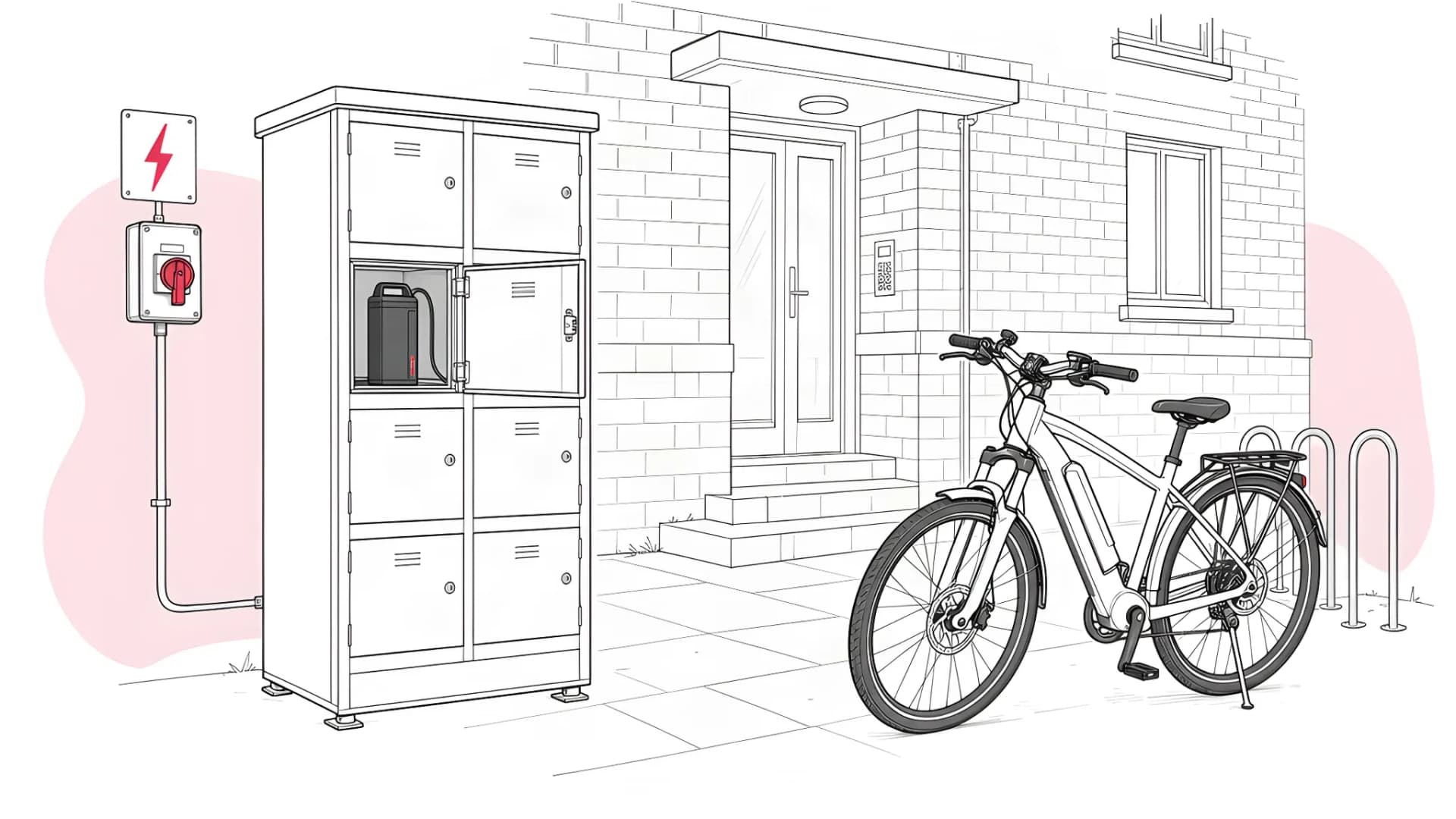
Short answer: there is no single UK law that says where an e-bike battery may be charged. In a block of flats, an office, a depot or any other non-domestic premises, the duty sits with the responsible person under the Regulatory Reform (Fire Safety) Order 2005. Read together, the published guidance asks that person for five things: charge outside where possible, at access level with direct external access, never in common areas, escape routes or on balconies, one battery per compartment, and a power supply that can be isolated.
The fire services, the Department for Transport and the fire engineers have each published what they expect. This guide goes through the documents one by one, then turns them into a checklist for a landlord, an office or a fleet. Checked 30 October 2026.
Who is responsible, and under which law
The Regulatory Reform (Fire Safety) Order 2005 applies to every non-domestic premises in England and Wales and to the common parts of blocks of flats. It names a responsible person, usually the employer, the owner or the managing agent, who must carry out a fire risk assessment, act on it and keep it up to date.
The Fire Safety Act 2021 confirmed that the assessment covers the structure, the external walls and the flat entrance doors of a residential building, and the Fire Safety (England) Regulations 2022 added duties for high-rise residential buildings.
Scotland and Northern Ireland have their own fire safety legislation with the same shape: a duty holder, an assessment, and a requirement to manage the risk.
None of this mentions e-bikes by name. It does not need to. A lithium-ion battery on charge in a corridor is a fire risk in a common part, and the responsible person is required to identify it, remove it or control it, and record what they did.
That is why every fire service document below is addressed to the responsible person, and why a fire risk assessment that does not mention lithium-ion batteries is now a gap an assessor will flag.
The numbers behind the guidance
UK fire brigades now respond to a lithium-ion battery fire every five hours. QBE's analysis of fire service data, published in May 2026, counted 1,760 lithium-ion battery fires in 2025, up 147% over three years.
E-bikes are the fastest-growing share: 520 e-bike fires in 2025 against 149 in 2022, which is where the figure "e-bike fires are up 250% in three years" comes from. Nearly half of all the lithium-ion fires happened at home.
London carries the largest share. London Fire Brigade attended 206 e-bike and e-scooter fires in 2025, the highest annual total on record, and 171 of them involved an e-bike. Two people died in 2025, five since 2023.
The Brigade's January 2026 statement found that battery failures, conversion kits and chargers are often the cause, and that items bought online that do not meet UK safety standards, new or second-hand, are particularly prone to fire. It encouraged landlords, housing associations and universities to provide safe storage or charging where possible.
What each document says
- Regulatory Reform (Fire Safety) Order 2005. Law in England and Wales, amended in 2021 and 2022, for non-domestic premises and the common parts of blocks of flats. It asks for a fire risk assessment by the responsible person, kept up to date, that now has to cover e-bike storage and charging.
- GN103, Charging and storage for electric powered personal vehicles. London Fire Brigade, Rev 1, 29 October 2025, for residential buildings and offices. It asks for a dedicated external location where possible, storage or charging at access level with direct external access, nothing in common areas, escape routes or on balconies, and external electrical isolation with signage.
- E-cycle and e-scooter batteries: managing fire risk for premises. Department for Transport, 1 February 2024, for premises where e-bikes are stored or charged. It asks for separate, secure storage and charging such as purpose-designed metal lockers, ideally outside, 45 cm between batteries on charge unless fireproof separators are used, ground-level access for firefighters and external power isolation.
- E-bikes and e-scooters fire safety guidance. National Fire Chiefs Council, current, for responsible persons across the UK. It asks for no storing or charging on escape routes or in communal areas, a look at the risk in bike stores and mobility scooter rooms, and advice to residents on safe use, storage and charging.
- Fire safety guidance for e-bikes in offices. SFPE UK, May 2026, for office cycle stores, new build and existing. It treats a store with e-bikes as a place of special fire hazard under BS 9999, warns that sprinklers may not control the fire growth, suggests lockers for individual batteries and asks for stores over 50 e-bikes to be subdivided.
- Statutory guidelines on lithium-ion battery safety for e-bikes. Office for Product Safety and Standards, 12 December 2024, for manufacturers, importers and distributors of batteries and conversion kits. It asks for a safety mechanism capable of preventing thermal runaway; it is an offence to place an unsafe battery on the market.
London Fire Brigade GN103
GN103 is the most detailed document on the subject. Revision 1 of 29 October 2025 says that where possible e-bikes should be stored and charged in a dedicated external location.
If that is not possible, any storage or charging space should be on the access level with direct external access, enclosed with fire resistance so that the escape routes stay usable, and never linked directly into the means of escape.
Where several charging points are provided, there should be a way to isolate the electrical supply to the whole room from outside it, with signage so that firefighters can find it.
The list of places where e-bikes must not be stored or charged is specific: corridors, stair enclosures, riser cupboards, any other common area or escape route, and external balconies. Buildings that are waiting for remediation of their external walls should not store e-bikes at all.
GN103 also asks the fire risk assessor to bring any bike found in a common part to the responsible person for immediate rectification, so "we have nowhere to put them" is not a defence.
Department for Transport premises guidance
The Department for Transport guidance of 1 February 2024 is written for owners and managers of premises and is the source of the locker recommendation. It asks for separate, safe and secure battery storage and charging facilities, "such as purpose-designed metal lockers", ideally located outside.
Where batteries charge in the open, it asks for 45 cm between them unless fireproof separators are used, for ground-level access so that firefighters can reach the facility, and for a means of isolating the power from outside.
NFCC guidance
The National Fire Chiefs Council guidance is the national baseline. It tells responsible persons to avoid storing or charging e-bikes and e-scooters on escape routes or in the communal areas of a multi-occupied building.
The NFCC also asks responsible persons to consider the risk where bikes are charged or left in bike stores and mobility scooter charging rooms, and to offer residents advice on safe use, storage and charging. For garages and kitchens where charging happens, it recommends heat alarms rather than smoke detectors.
SFPE UK office guidance
The SFPE UK guidance of May 2026, written by The Fire Surgery, is the office and workplace argument in one document. A cycle store that holds e-bikes should be treated as a place of special fire hazard under BS 9999, which changes the fire resistance, detection and ventilation the store needs.
The fire growth rate of an e-bike battery may not be controlled by sprinklers, so sprinklers alone are not the answer. The guidance suggests dedicated charging lockers designed to hold individual battery units, with fire safety measures, ventilation and electrical protection.
SFPE UK asks designers of large stores, over 50 e-bikes, to subdivide them with at least 60 minutes of fire resistance. Basement stores get a further set of ventilation questions, and the guidance asks that e-bike storerooms be included in the annual fire risk assessment.
OPSS statutory guidelines and the Product Regulation and Metrology Act
The Office for Product Safety and Standards published statutory guidelines on lithium-ion battery safety for e-bikes on 12 December 2024. They apply to manufacturers, importers and distributors rather than to buildings, but they set the standard a building can point to.
A battery intended for an e-bike must include a safety mechanism capable of preventing thermal runaway, it must resist external damage, and it must come with the information needed to match it to a charger. It is an offence to place an unsafe battery on the market.
The Product Regulation and Metrology Act 2025, which received Royal Assent on 21 July 2025, gives ministers the power to tighten these rules and to reach products sold through online marketplaces.
Transport for London
Since 31 March 2025 Transport for London has banned non-folding e-bikes from most of its network because of the fire risk. The ban does not apply to buildings, but it changed where delivery riders charge.
A rider who cannot take the bike on the train charges the battery at home or at the depot, and both of those places now need a policy.
The five things every document asks for
- Outside, at access level. A dedicated external location, or a space on the access level with direct external access. Never an internal corridor, a stair enclosure, a riser cupboard or a balcony.
- One battery per compartment. Batteries on charge separated from each other, by 45 cm in the open or by a fire-resisting divider. A locker with a compartment per battery does this by design.
- Power that can be isolated. An external isolation switch, signed for firefighters, and a cut-off inside the equipment when a battery overheats.
- Detection and ventilation. Heat or gas detection and a way for the gases to leave. Outdoors the location does this on its own; indoors it means extraction and an alarm.
- A written policy. Where residents and staff may charge, who checks it, and what happens when a battery is found in a hallway. The fire risk assessment records the policy and reviews it every year.
A charging arrangement that provides all five is what a fire risk assessor will sign off and what an insurer will accept. Anything short of the five is a compromise that has to be justified in the assessment.
What it means for your building or fleet
Residential blocks. The landlord or managing agent is the responsible person for the common parts. GN103 is the reference, and it leaves no room: nothing in corridors, stairs or riser cupboards, and no charging on balconies.
A block that bans e-bikes from the common parts without giving residents anywhere else to charge will find batteries charging in flats, and homes are where nearly half of lithium-ion battery fires happen. Providing a charging point outside the building is the practical answer, and it is what London Fire Brigade encouraged landlords to do in January 2026.
Offices and campuses. SFPE UK treats a cycle store with e-bikes as a place of special fire hazard. If the store is in a basement, the sprinkler and ventilation questions get harder and more expensive.
Moving the charging out of the store into lockers outside keeps the store a store, and gives the facilities team one place to check instead of a socket under every desk.
Delivery and cargo fleets. Riders charge at the depot or at home. A locker in the yard, with a compartment per spare battery and a cut-off per compartment, takes the charging out of the rider's flat and out of the depot's fire load.
A locker also gives the operator a record of which batteries were charged where, which is what an insurer asks for after an incident.
Hotels, universities and public sites. Guests, students and visitors bring their own bikes and their own chargers, and the building cannot vet every battery. A battery-agnostic locker outside the building serves all of them, and the fire risk assessment gets a documented charging point instead of a policy that nobody follows.
A charging policy for residents and staff
The written policy is the cheapest of the five things. It does not need to be long. It needs to say:
- Where charging is allowed and where it is not: the locker, the designated external space, or nothing in the building. Name the corridors, stores and balconies that are off limits.
- Which batteries are allowed. Certified batteries and the charger supplied with them. No conversion kits, no chargers bought separately online, no batteries with visible damage.
- How charging is done. Only in the designated place, never overnight in a flat or an office, and never while the building is unoccupied unless the equipment cuts the power on its own.
- What happens when a battery is found in a common part: who removes it, where it goes and who is told.
- Who checks and how often. A weekly walk of the common parts by the caretaker or facilities team, recorded.
Put the policy on the noticeboard and in the tenant handbook, and put signage at the charging point and at the places where people used to charge. Signage is not decoration: GN103 asks for it at the isolation switch, and the assessor will look for it.
A fire risk assessment checklist for e-bikes
Use this to update the assessment before the next review, or to check the one your assessor sends back.
- Lithium-ion batteries are named as a hazard, with the number of e-bikes on site and where they are kept.
- Every common part, escape route, riser cupboard and balcony is recorded as a no-charging area, and the last walk-round is dated.
- The designated charging location is described: outside, or at access level with direct external access, with the fire resistance of any enclosure recorded.
- Batteries on charge are separated, by distance or by compartment.
- The electrical isolation switch is outside the charging space, signed, and shown on the plan for firefighters.
- Detection is appropriate to the location: heat or gas detection indoors, an alarm that someone will hear.
- The policy exists, has been issued to residents or staff, and the signage is in place.
- If the building is waiting for external wall remediation, e-bikes are not stored on the premises at all.
- The insurer has been sent the assessment and the charging arrangement, and the policy wording has been checked for conditions on battery charging.
- The assessment is dated and has a review date within twelve months.
What to do this quarter
- Update the fire risk assessment. Name lithium-ion batteries, where they are stored and charged, and who checks.
- Pick the location. Outside if you can, at access level if you cannot. Not in an escape route.
- Choose the equipment. A compartment per battery, a cut-off per compartment, an isolation switch outside.
- Write the policy and put up the signs. Residents and staff need to know where charging is allowed and where it is not.
- Tell your insurer. Send them the assessment and the charging arrangement before renewal.
Locker, cabinet or charging room
Three kinds of equipment come up in the guidance and in the search results, and they are not interchangeable.
A charging room is an existing store fitted out for e-bikes: fire-resisting construction, detection, ventilation, an isolation switch, and often sprinklers. It is the SFPE UK route for a large office store, and it is the most expensive option because the building work scales with the room.
A charging cabinet is a fire-rated steel cupboard that stands indoors, usually in a plant room or workshop. It slows a fire but keeps the batteries, and the gases they release, inside the building. It suits a supervised depot with trained staff and a fire strategy that already covers lithium-ion.
A charging locker is a weatherproof unit for outside the building with a compartment, a socket and a sensor per battery. It matches the external location that London Fire Brigade and the Department for Transport ask for, residents or riders open their own door, and it needs a power supply and an electrician rather than building work.
For residential blocks, offices, campuses and public sites, this is the option the guidance points to. Tyred is PowerShelter's exclusive UK partner and supplies its charging lockers, with a compartment per battery and circuit breakers on every model; the models, safety features and installation are on the charging lockers page.
Whichever you choose, the site check comes first. Position, number of batteries, the power supply and the route firefighters would take decide the equipment, not the other way round.
Related guides
- How long does an e-bike battery last? Charging, storage and care, including how to charge safely in a London flat and what the conversion kit rules mean for a rider.
- E-bike battery charging lockers for buildings and fleets, the equipment side of this guide.
- Tyred for Business: fleet maintenance, leasing, insurance and charging from one partner.
Sources and further reading
- London Fire Brigade: Fire Safety Guidance Note GN103 (Rev 1, 29 October 2025), the storage and charging recommendations for residential buildings and offices.
- London Fire Brigade: record number of e-bike and e-scooter fires across London in 2025 (28 January 2026), the 206 fires, 171 e-bikes and two deaths quoted above.
- Department for Transport: e-cycle and e-scooter batteries, managing fire risk for premises (1 February 2024), the locker, 45 cm and isolation recommendations.
- National Fire Chiefs Council: e-bikes and e-scooters fire safety guidance.
- SFPE UK: fire safety guidance for e-bikes in offices (May 2026, developed by The Fire Surgery), the cycle store classification, lockers and subdivision.
- Office for Product Safety and Standards: statutory guidelines on lithium-ion battery safety for e-bikes (12 December 2024).
- Product Regulation and Metrology Act 2025 (Royal Assent 21 July 2025).
- QBE: UK brigades tackling a lithium-ion battery fire every five hours (11 May 2026), the 1,760 fires, 520 e-bike fires and the share at home.
This guide summarises published guidance for building and fleet managers. It is not legal advice and does not replace a fire risk assessment by a competent person.