How long does an e-bike battery last? Charging, storage and care
Lifespan, charging and winter storage figures from Bosch, Shimano STEPS and Brompton, fire-safety rules for a London flat, a faults checklist and where to recycle.
By the tyred mechanics
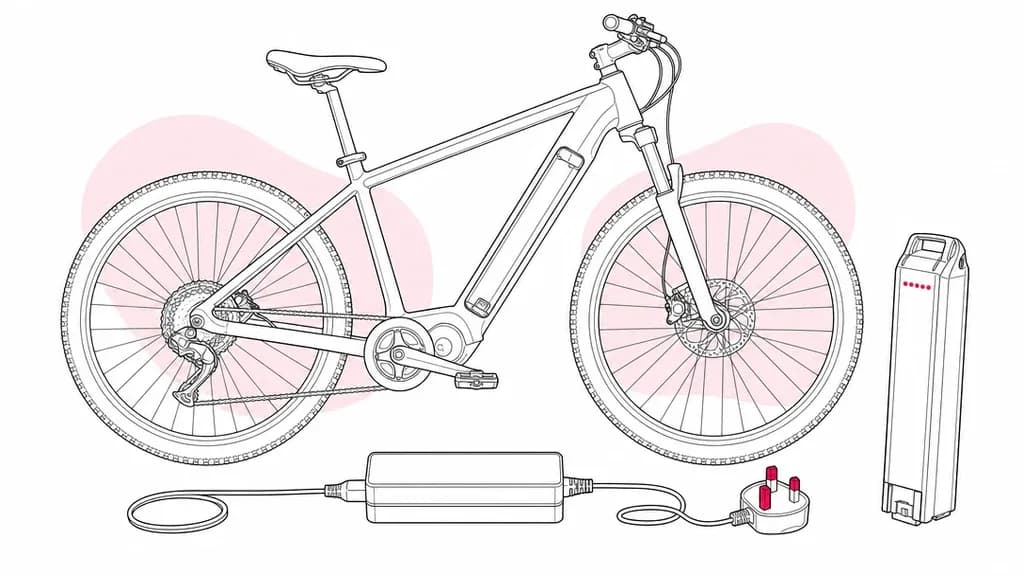
Short answer: an e-bike battery is a wearing part, and your charging and storage habits set its lifespan. Shimano rates its STEPS packs at 60% of original capacity after up to 1,000 charges; Bosch says heat, full or empty storage and heavy loads shorten life. Charge indoors between 0°C and 40°C with the original charger, unplug when it finishes, and never charge in a hallway or while you sleep. For winter, store the pack at part charge in a room at 10–20°C.
How long does an e-bike battery last?
A lithium-ion e-bike battery loses capacity in two ways, and both are normal. Bosch calls them calendar ageing, which happens even while the battery sits unused, and cyclical ageing, which comes from charging and discharging.
The only published cycle figure among the big systems is Shimano's: the STEPS FAQ states that the battery retains 60% of its original capacity with 1,000 or fewer charges. Bosch and Brompton give no number and describe the battery as a wearing part whose service life depends on use.
What you control is the rate of ageing. Bosch lists the factors that shorten service life as:
- Heavy-load use.
- Storage above 30°C.
- Prolonged storage fully charged or fully discharged.
- Parking the bike in direct sunlight.
The factors that extend service life are the mirror image:
- Light loads.
- Storage at 10–20°C.
- Storage at roughly 30–60% charge.
- Parking in the shade.
Shimano adds that repeatedly topping up when the indicator already shows 80–100% can degrade the cells.
Ageing shows up as range, and there is no home test that gives a capacity figure. Compare how far a full charge takes you on the same commute each spring, and ask a dealer with the manufacturer's diagnostic software for a state-of-health reading.
How to charge an e-bike battery
Charge the battery indoors, at room temperature, with the charger that came with the bike, and unplug it when the light says it is done. Those four habits cover what Bosch and Brompton ask for, and they match the London Fire Brigade's charging advice.
Temperature matters because the battery's own electronics enforce it. Bosch batteries carry a temperature monitor that only allows charging between 0°C and 40°C, and Brompton sets the same floor with a 45°C ceiling.
A battery that has just come in from a cold ride sits below that floor. Brompton asks for at least an hour indoors before you connect the charger, and Cycling UK suggests a couple of hours. If the charger light stays off on a winter evening, suspect this first.
Charge level needs no daily management. Lithium-ion cells have no memory effect, and Bosch confirms that you can charge from any level and interrupt charging without harm.
For longevity, Bosch suggests keeping the pack between 20% and 80% where you can, and Brompton advises against regularly running it flat. Charging to 100% before a long day out is fine.
Charging an e-bike battery safely in a London flat
London Fire Brigade attended 206 e-bike and e-scooter fires in 2025, an average of 17 a month, and 171 of them involved an e-bike. Two people died in these fires in 2025, bringing the total to five since 2023.
The Brigade's investigations point to lithium-ion battery failure, conversion kits and chargers as frequent causes, and to products bought online that do not meet UK safety standards. Lewisham and Southwark had the most fires with 16 each, followed by Tower Hamlets, Lambeth and Westminster.
The Brigade says most of these fires start while the battery is charging, so its #ChargeSafe advice is about where and when you plug in.
- Never charge or store the battery on your escape route. The Brigade's wording is to keep it away from a main through-route or exit and never to block your escape route with an e-bike. A hallway by the front door is the wrong place. If the battery cannot live in a shed or garage, keep it in a room where you can shut the door.
- Charge on a hard, flat surface where heat can escape. Bedding, a sofa and carpet all hold heat in.
- Charge while you are awake and at home. The Brigade says never to leave a battery charging unattended or while you are asleep, and GOV.UK repeats it: charge when you are awake and present.
- Unplug when charging finishes. Electrical Safety First lists overcharging and leaving items on charge overnight among the main causes of lithium-ion fires.
- Fit a smoke alarm in the room where you charge, and agree an escape plan with everyone in the flat.
- Use the charger supplied with the battery or one the manufacturer recommends. The Brigade says the wrong charger can overload the battery, and GOV.UK notes that not all batteries and chargers are safe together.
- Buy from a trusted seller and look for the UKCA or CE mark, which UK product safety regulations require. Electrical Safety First warns against chargers and batteries from market stalls, social media and third-party marketplace sellers, and calls second-hand batteries and chargers a serious fire risk.
- Never open, modify or tamper with the battery. GOV.UK's fifth rule is exactly that.
What are the warning signs?
The Brigade lists these warning signs:
- A swollen or misshapen casing.
- Lumps, leaking or physical damage.
- A battery that is extremely hot to the touch.
- Hissing or cracking sounds.
- Strong chemical smells.
If you see any of these, turn the device off and unplug it at once, contact the manufacturer or retailer, and report the battery to Trading Standards. TfL adds a practical step for a swollen, leaking or overheating pack: keep it outside in a plastic container until it can be recycled safely.
If a battery starts to smoke or catches fire, get out immediately, raise the alarm, call 999 and do not try to tackle it yourself. These fires spread fast and the smoke is toxic.
Bosch, Shimano STEPS and Brompton Electric: the care figures
The figures below come from each manufacturer's own battery guidance. Follow your system's numbers rather than a generic average, because the three do not agree on storage charge.
- Charge level for long storage. Bosch eBike Systems: 30–60%, shown as 2 to 3 lit indicators. Shimano STEPS: approx. 70%. Brompton Electric: 28–47%, shown as 2 lights.
- Storage temperature. Bosch: 0–20°C in a ventilated room with a smoke detector, never below −10°C or above 60°C. Shimano: approx. 10–20°C in a cool, dry indoor place out of direct sunlight. Brompton: above 0°C and below 20°C, optimum 10°C.
- Charging temperature. Bosch: 0–40°C, enforced by the battery's temperature monitor. Shimano: not stated in the FAQ. Brompton: 0–45°C, and never charge a cold battery.
- Everyday charge habit. Bosch: keep between 20% and 80% where possible and avoid emptying it. Shimano: avoid repeated top-ups from 80–100% and never leave it fully flat. Brompton: charge at least once a month and avoid regular full discharge.
- Published lifespan. Bosch: none, a wearing part subject to calendar and cyclical ageing. Shimano: 60% of original capacity with 1,000 or fewer charges. Brompton: none, capacity reduces over time.
- After long storage. Bosch: low self-discharge, so it can be used without recharging. Shimano: recharge regularly in storage and charge fully before the first ride. Brompton: charge to full, then run it flat once.
- Repair. Bosch: faulty, old or worn batteries must not be repaired, refreshed or opened. Shimano: contact your place of purchase. Brompton: non-user-serviceable, authorised dealer only.
Other systems publish their own figures. Cowboy, for example, asks for storage at room temperature with a full recharge each month and says its battery will not charge below 0°C. Check the manual for Bafang, Gocycle, Yamaha and Fazua bikes before you assume the Bosch numbers apply.
How to store an e-bike battery for winter
Winter storage has three parts:
- Take the battery off the bike.
- Bring it to the storage charge your manufacturer gives.
- Keep it indoors at 10–20°C in a room that is not your escape route.
Each of the three parts covers a different failure. Removing the battery matters even if the bike stays indoors. A pack left on a bike in an unheated shed or on a balcony spends the winter below the 10–20°C band that Bosch and Shimano give as ideal, and well under Brompton's 10°C optimum.
Bosch says never to store below −10°C, and Cycling UK's advice is simply to bring the battery into a warm, dry room.
The charge level is where people go wrong in both directions. Storing at 100% and storing at 0% both load the cells, in Bosch's words. Shimano warns that a battery left completely discharged can degrade until it can no longer be charged or discharged.
Use the indicator lights as your gauge:
- Two to three on a Bosch pack.
- Two on a Brompton.
- Roughly 70% on a Shimano display.
Check the battery once a month, as Brompton asks, and top it back up to the storage level if it has dropped. Shimano and Brompton both want a full charge before the first ride of spring.
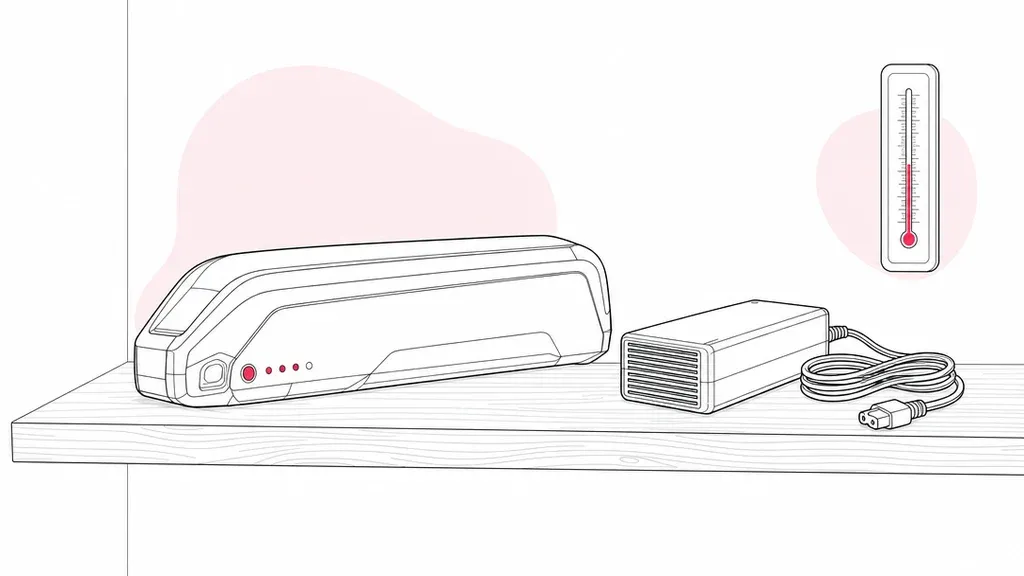
A shelf in a spare room, a bedroom cupboard away from radiators, or a dry cellar all work. A hallway, an airing cupboard and a sunny windowsill do not. Keep the charger unplugged until you need it.
Why e-bike range drops in winter
Cold raises the electrical resistance inside the cells, so a cold battery delivers less power and less range even though it has not lost capacity. That is Bosch's explanation, and Brompton says the same in plainer terms: efficiency falls at low temperatures, and the optimum operating temperature is around 20°C.
Cycling UK puts the effect at 5°C and below, with power falling by as much as one-third below freezing. The Electric Bike Shop, a UK retailer, quotes up to 30% less range below 0°C. The loss is temporary, and range returns with the weather. To limit it:
- Keep the battery indoors until you leave. Bosch's winter advice is to charge and store the pack at room temperature and fit it to the bike immediately before riding.
- Start on a low assist level. Cycling UK suggests around 20 minutes on lower assistance before you turn it up, which lets the cells warm through under a light load.
- Do not run it to empty in the cold. The Electric Bike Shop advises finishing a winter ride with 20–30% left.
- Use a thermal cover on long cold rides. Bosch recommends them for longer journeys in cold conditions.
- Check tyre pressure. Bosch lists correct tyre pressure as the way to minimise rolling resistance, and a soft tyre costs range in any weather.
E-bike battery not charging: symptom, cause and what to do
Work through the cheap checks before you assume the battery is dead. Several of the symptoms below have a five-minute fix, and the manufacturers' own troubleshooting starts with the same steps.
- The charger light stays off and nothing happens. No mains, a plug not seated, or a charger fault. Try another mains socket. Shimano's first step is to unplug the charger and plug it back in, then reseat both ends of the lead. A Brompton charger flashing red has a fault: unplug, retry, and stop using it if the flashing continues. Workshop job: charger test and replacement.
- The battery refuses to take charge. Too cold or too hot for the temperature monitor, dirty contacts, or deep discharge. Bring it indoors for at least an hour, then retry. Clean the contacts with a dry cloth, or as Shimano suggests a cotton bud with a little ethanol. Workshop job: a BMS diagnostic; Shimano says a pack that still refuses may be at the end of its service life.
- The bars drop quickly and range shrinks. Cold, age, or cells out of balance. Keep the pack indoors until you ride, and compare range with a mild day before judging it. Workshop job: a capacity read-out with the dealer's software, and a replacement quote.
- Assist cuts out on hills or under load. The battery is not latched in its mount, the contacts are corroded or loose, or the cells are weak. Remove and refit the battery until it clicks, clean the contacts, and check the lock. Workshop job: mount, contacts and connector inspection, and a battery test.
- An error code on the display. A system or battery fault; on a Brompton, Error B is the battery and Error C the controller. Turn off, remove and refit the battery, note the code and look it up in the manual. Workshop job: dealer diagnostic software; both Brompton errors are non-user-serviceable.
- The battery or charger is hot while charging. Charging in heat or several packs back to back, or a failing pack. Shimano says stop charging, let it cool and retry, and charge batteries at intervals. Workshop job: a pack that stays hot after charging or is deformed is not normal, so stop using it and contact the manufacturer.
- It will not wake after months in storage. It was left fully discharged. Charge it now and let it run the full cycle. Workshop job: replacement if the BMS will not accept charge.
None of the steps above involve opening the battery case. The pack itself goes back to the manufacturer or a dealer.
Can an e-bike battery be repaired?
The manufacturers say no. Bosch's guidance is that faulty, old or worn-out batteries should not be repaired or refreshed, because any repair interferes with the safety mechanisms, and it adds that the battery must not be opened.
Brompton describes its battery as non-user-serviceable and directs you to an authorised dealer. GOV.UK's consumer advice ends with the same rule: never attempt to modify or tamper with your battery.
Re-celling shops do exist in the UK, and the Office for Product Safety and Standards asks people to seek professional help when converting or repairing. A re-celled pack sits outside the manufacturer's warranty, so ask what cells are used, what testing is done and what warranty is offered before you commit.
For a Bosch, Shimano or Brompton system, the manufacturer's replacement pack is the route the manufacturer supports. The Electric Bike Shop puts a typical replacement at £450 to £700 as of December 2025, which is why the storage rules above are worth the effort.
Conversion kits, the law and the Tube
A converted bike is legal in Great Britain only if it meets the EAPC rules on GOV.UK:
- The motor has a continuous rated power of no more than 250 watts.
- Assistance stops above 15.5 mph.
- The bike has pedals that propel it.
- The rider is 14 or over.
A bike outside those limits is classed as a motorcycle or moped, with registration, tax, a driving licence, a motorcycle helmet and insurance to match. The rules say nothing about volts, so check a 48V, 52V or 72V kit sold on its top speed against those two numbers first.
TfL adds that if you fit a kit yourself you take on legal responsibility for the converted bike's safety. It asks you to buy kits only from a reputable UK-based supplier.
The fire risk is separate from the law. London Fire Brigade names conversion kits among the frequent causes of e-bike fires, and TfL's own analysis found converted cycles pose a greater fire risk than purpose-built e-bikes. GOV.UK asks that only a competent professional converts a pedal bike.
If you already own a conversion, buy the battery and charger as a matched pair from the kit's maker and follow the charging rules above.
On TfL services since 31 March 2025:
- Non-folding e-bikes are not allowed on the Tube, Overground, Elizabeth line or DLR, and the rule includes standard cycles converted with a kit.
- Folded e-bikes can travel anywhere at any time on almost all TfL services; a bus driver can refuse a bike when it is busy.
- No e-bike, folded or not, goes on the cable car.
- Non-folding e-bikes are still allowed on the Woolwich Ferry, on the Silvertown Tunnel cycle shuttle, and on some river and coach services if you check with the operator.
How to recycle a dead e-bike battery
Never put an e-bike battery in a household bin. Recycle Your Electricals reports that binned batteries and electricals containing batteries caused more than 1,200 fires in the UK over the last year. The South London Waste Partnership classes e-bike and e-scooter batteries as hazardous waste that must stay out of general rubbish. You have four routes.
- The manufacturer's dealer. Bosch says specialist dealers accept old or defective batteries free of charge, and Brompton asks you to return the pack to an authorised dealer.
- Retailer take-back. Any large shop that sells electricals must take your old item when you buy a new one from them, within 28 days of the purchase. The item only has to be broadly similar.
- Your council's recycling centre. The South London Waste Partnership, covering Croydon, Kingston, Merton and Sutton, accepts e-bike batteries at its household reuse and recycling centres and points residents to retailer take-back schemes as well. Check your own borough's page first.
- The Recycling Locator at Recycle Your Electricals takes a postcode and lists nearby battery drop-off points.
A damaged, swollen or leaking battery needs different handling. TfL advises keeping it outside in a plastic container until it can be collected safely, and the London Fire Brigade asks you to unplug it and contact the manufacturer or retailer first.
What not to do
Every item below comes from the manufacturers' guidance or the London Fire Brigade's advice.
- Do not use a charger from another bike or a marketplace listing. Bosch, Brompton, the London Fire Brigade and GOV.UK all say the same thing, because a mismatched charger can overload the pack.
- Do not charge overnight, while you are out, or in the hallway. Charge when you are awake, in a room with a door you can close.
- Do not charge a cold battery. Wait for it to reach room temperature. Brompton says at least an hour, and the charger will refuse below 0°C in any case.
- Do not store it flat or full for months. Both shorten life according to Bosch, and Shimano warns a fully discharged pack can become impossible to charge.
- Do not jet-wash the bike with the battery on, or put the pack down on a wet floor. Bosch and Brompton both prohibit pressure washing, and Brompton warns that water on the connector can cause overheating or ignition.
- Do not open the case, replace cells yourself or reset the BMS. Bosch states the battery must not be opened, and GOV.UK's rule is never to modify or tamper with it.
- Do not ride on a battery that has been dropped, dented or is bulging. The Brigade says a dropped or damaged battery should not be used, and Electrical Safety First asks you to stop using and charging a battery with dents or deformities.
When it is a job for a mechanic
The checks above cover everything you can do without opening the battery. The following belong with a mechanic or a dealer.
- Assist that cuts out under load after you have cleaned the contacts and refitted the pack, which points at the mount, the connector or the cells.
- A persistent error code, since Bosch and Shimano read codes with dealer software and Brompton calls its errors non-user-serviceable.
- A charger that has failed its swap test, and any pack that is hot, swollen or refusing charge at room temperature.
- A rear puncture on a hub-motor e-bike, where the motor cable and torque arm make wheel removal a job in itself. Our puncture guide explains why.
- Anything on a cargo bike, whose battery, wiring and weight all differ from a commuter e-bike. Cargo bike repair is a separate service for that reason.
A Tyred mechanic comes to you 9am to midnight, seven days a week, anywhere inside the M25, with a fully stocked workshop. E-bike repair is a core Tyred service, and every job carries a 30-day satisfaction guarantee. Battery packs themselves go back to the manufacturer or an authorised dealer, and the mechanic will say so before you spend anything.
Book an e-bike repair · About mobile e-bike repair →
Related guides
Sources and further reading
- London Fire Brigade: record number of e-bike and e-scooter fires across London in 2025 (28 January 2026), the 206 fires, 171 e-bikes, two deaths and borough figures quoted above.
- London Fire Brigade: how to charge e-bikes and e-scooters safely, the #ChargeSafe rules on escape routes, unattended charging, chargers and smoke alarms, with the warning signs page.
- GOV.UK: Buy Safe, Be Safe, avoid e-bike and e-scooter fires (24 October 2024) and the OPSS five-step safety message (6 December 2023).
- GOV.UK: electric bike rules, the EAPC limits of 250 W continuous rated power and 15.5 mph.
- TfL: cycles on public transport, the rules on folded and non-folding e-bikes, and TfL: e-bike safety on conversion kits and damaged batteries.
- Bosch eBike Systems: tips for handling Bosch eBike batteries (UK edition) and the Bosch eBike Battery Guide (July 2024), the charging window, storage and ageing figures.
- Shimano STEPS FAQ, entries S-6100 (service life), S-6540 (storage), S-6710 and S-6721 (not charging) and S-6730 (hot battery).
- Brompton Electric: battery charging and use, with the Battery Care, Storage and Temperature sections of the Brompton Electric owner's manual.
- Electrical Safety First: e-bikes, buying, charging and damage checks.
- Cycling UK: how to maintain and keep riding your e-cycle over winter (Rebecca Armstrong), the cold-weather range and warm-up advice.
- Recycle Your Electricals: Recycling Locator, with its retailer take-back rules, and South London Waste Partnership: e-bike and e-scooter batteries.