How to lock your bike: technique, Sold Secure ratings and where to park in London
The locking technique step by step, Sold Secure Bronze to Diamond explained with a rating for each situation, where to park in London and what insurers require.
By the tyred mechanics
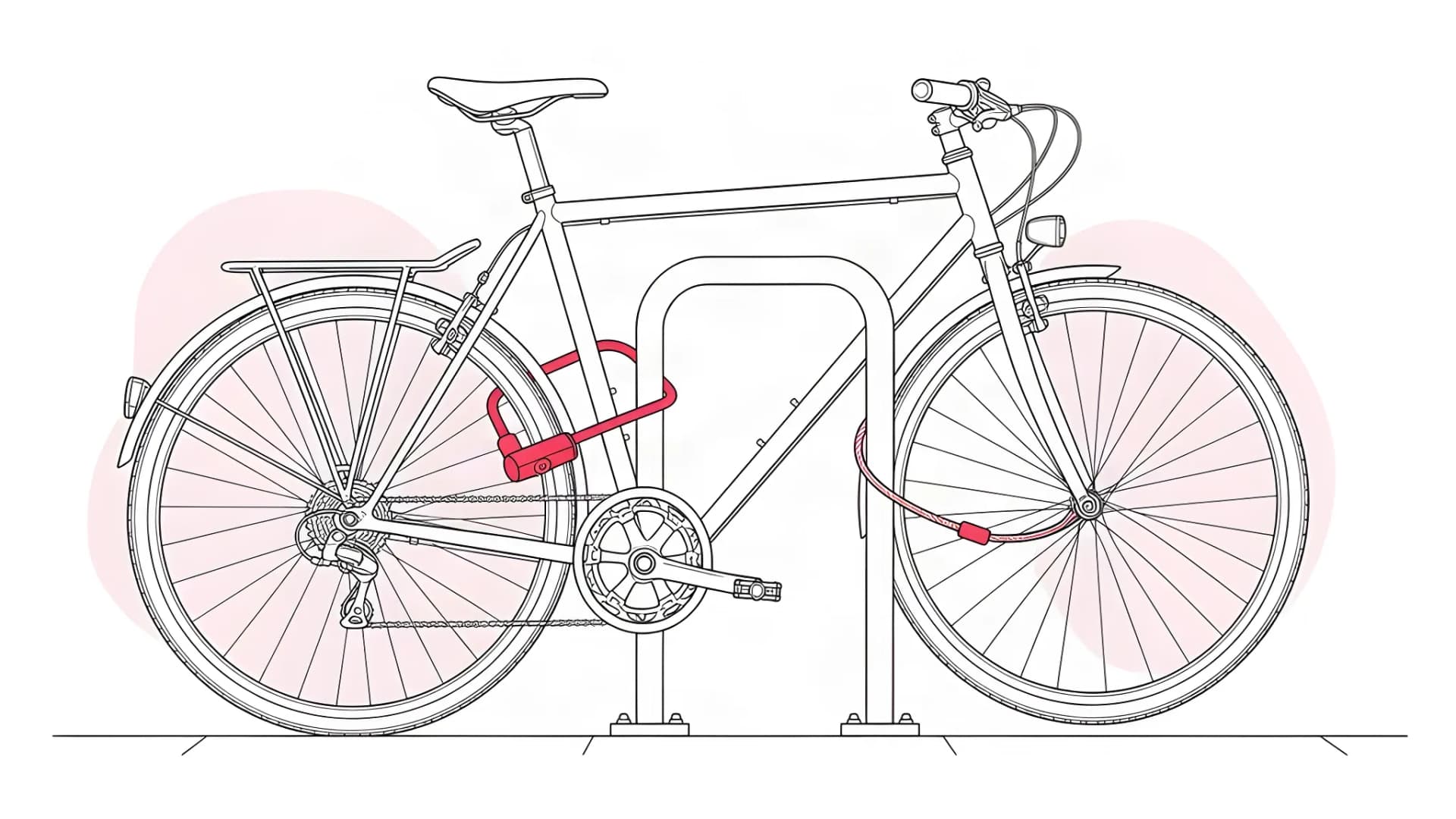
Short answer: lock the frame and rear wheel to a Sheffield stand with a Sold Secure Gold D-lock, with the shackle inside the rear triangle so it holds the seat tube and the rim. Add a second lock or a cable through the front wheel. Keep the lock off the ground, keyhole facing down, and fill the shackle so there is no room for a lever. In central London, Gold is the floor, and an e-bike needs a Powered Cycle rated lock.
How to lock a bike correctly
A bike is locked correctly when the lock passes through the main frame and the rear wheel. The object it is locked to must be one that cannot be cut, lifted or unbolted.
The steps follow the published advice of Cycling UK, Secured by Design (the police security initiative) and the lock maker Kryptonite. They work with any D-lock, which some shops still list as a U-lock.
- Choose the object first. A Sheffield stand, the inverted U of steel tube set into the pavement, is the standard. Push it: it should not wobble, and the bike must not lift off the top. Check the tube and base for saw cuts, sometimes hidden under tape.
- Put the D-lock through the rear triangle. Pass the shackle around the stand tube and inside the rear triangle, so it captures the seat tube and the rear rim in one loop. Cycling UK's minimum is frame, rear wheel and the object in a single lock.
- Fill the shackle. Cycling UK's wording is to fill the shackle "with as much bike and street furniture as will fit". The aim is "as little daylight in the lock as possible", because room inside is room for a tool. A shackle that swings loose around a thin stand is the wrong size.
- Keyhole down, lock off the ground. Turn the body so the keyhole faces the pavement, which makes it awkward to pick. Keep the lock clear of the ground. BikeRegister's advice is that a lock touching the ground "is easy for a thief to sledgehammer off".
- Secure the front wheel. Cycling UK's preferred method adds a second lock through the front wheel, the frame and the stand. Two different lock types mean a thief needs two sets of tools. A cable looped through the front wheel and back to the D-lock is the light version, and it is never the lock for the frame.
- Take what lifts off. Lights, bags, a quick-release saddle and a removable e-bike battery go with you.
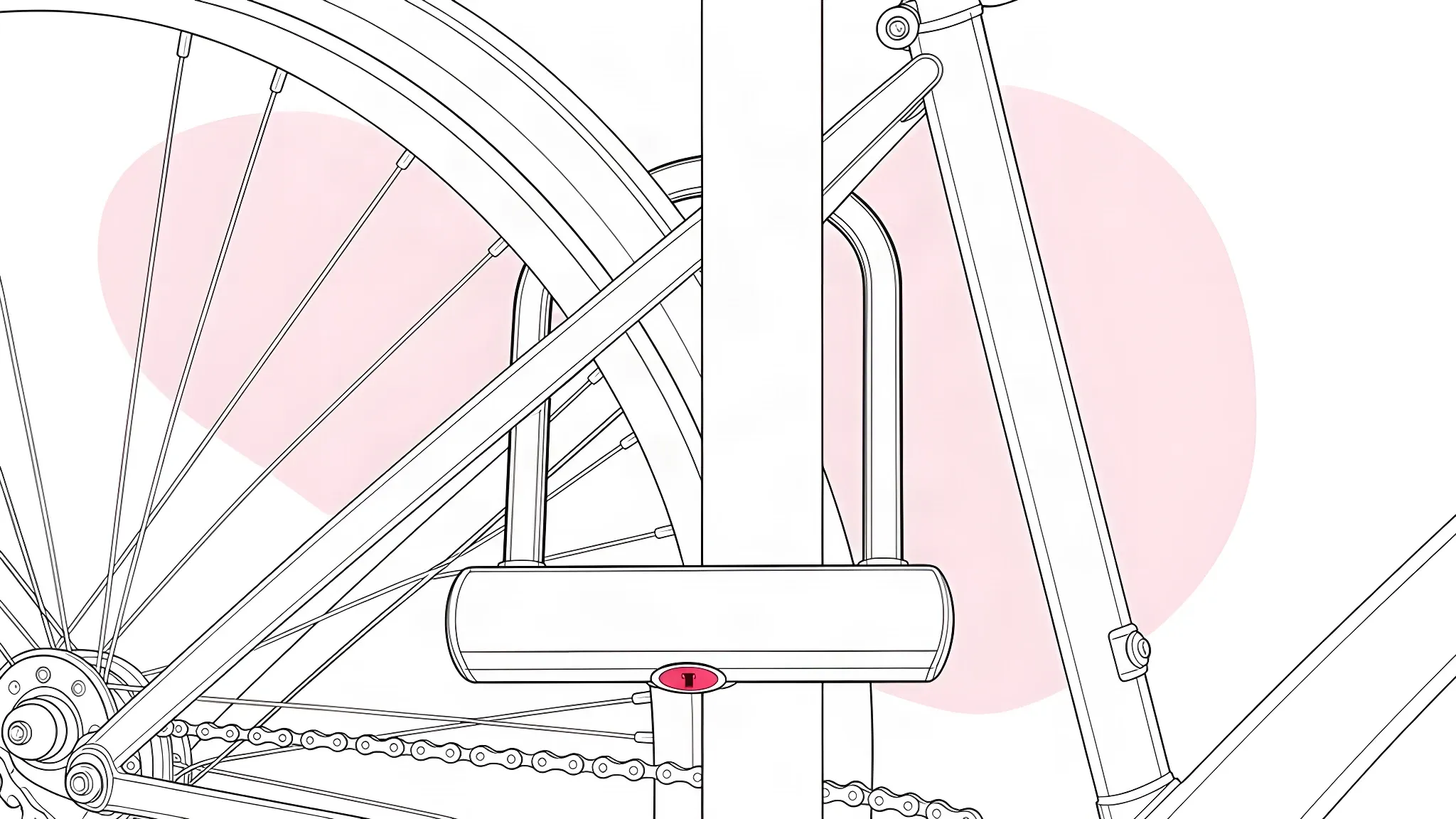
Kryptonite's rule settles the order when you cannot do everything: "lock according to value, frame first, then back wheel, and finally front wheel". With one lock and a short stop, the frame and rear wheel to the stand is the loop that matters.
What a locked bike is not
- A cable through the frame is not a locked bike. A cable belongs on the front wheel, on top of a D-lock.
- A D-lock through the front wheel alone holds a wheel. The rest of the bike lifts away.
- A lock around the top tube holds the frame but hands a thief a long tube to twist against.
Should you lock the front or back wheel?
Lock the rear wheel with the frame first, because it carries the gears and the hub and costs more to replace. The front wheel takes a second lock or a cable.
Quick-release levers are the weak point, on wheels and on seat clamps. The London Cycling Campaign's fix is to replace the levers with bolts. Security skewers from Pinhead, Pitlock or Hexlox do the same job with their own key. A bolted seat clamp costs a few pounds and ends the saddle problem.
A mechanic can swap the skewers during a service. Book a mechanic: a mechanic comes to you 9am to midnight, seven days a week, across London.
Sold Secure ratings explained: Bronze, Silver, Gold and Diamond
Sold Secure is the lock testing scheme run by the Master Locksmiths Association. Its four grades describe how long a lock resisted a set list of tools, with Diamond at the top, then Gold, Silver and Bronze.
Sold Secure does not publish the minutes; each grade "is tested against tools for a specific amount of time". The descriptions below are its published Pedal Cycle definitions.
- Bronze. "Good level of resistance against the opportunist thief". For a short time in a low risk area like a cafe or shop. Tested against a single, easily concealed hand tool.
- Silver. "Greater level of resistance against the more determined thief". For lower value bikes left in a medium risk area like a local town centre. Tested against an enhanced tool list, for longer than Bronze.
- Gold. "Very good level of resistance against the dedicated thief". For a high value bike and/or a high-risk area like a big city or university town. Tested against an extended attack with heavy duty tools.
- Diamond. "Top level of resistance against the most determined thief". For very high value bikes kept in very high risk areas. Tested against heavier duty tools, including some power tools and machine-based testing.
Two details on the Sold Secure site change which grade you should read. E-bikes are tested under the Powered Cycle category, which covers "motorcycles, scooters & e-bikes". The categories also overlap by design.
In Sold Secure's words, "Powered Cycle Gold and Pedal Cycle Diamond offer the same level of security". Both are tested with the same tools, methods and time limits.
Which rating you need, by where you leave the bike and for how long
The list below matches Sold Secure's environment descriptions and Cycling UK's guidance to London situations. Cycling UK puts Gold at cities and campuses and at stays of an hour or more, and does not recommend Bronze. Stolenride's London advice is two Gold locks. Insurers set their own conditions, covered below.
- Cafe or shop, bike in view, under an hour: Silver. One D-lock through the frame and rear wheel.
- Sheffield stand in central London, a working day: Gold. Two locks of different types.
- Station stands, every day, a working day at a time: Gold, or a card-entry cycle hub. Two locks.
- Street overnight, anywhere in London: Diamond, and a hangar if you can get one. Two locks.
- Shed, garage or garden, permanently: Gold, to a Sold Secure rated ground or wall anchor. One lock through the frame to the anchor.
- Communal hallway or cycle hangar, permanently: Gold. One lock through the frame to the rack.
- E-bike or cargo bike, anywhere outside, for any length of time: Powered Cycle Gold, or Powered Cycle Diamond in central London. Two locks, with the battery removed.
Do angle grinder resistant locks work?
Yes, within limits that the published tests describe. In its Powered Cycle category, Sold Secure says, "Diamond-rated products are tested against angle grinder attacks". The Gold test "does not include angle grinders", so the grinder is what separates the two grades.
Cycling UK put six Diamond-rated locks against a cordless angle grinder in a group test by Guy Kesteven, published in its winter 2025 issue. The method was a five-minute limit per lock, with discs changed as they wore. Weight and price are as tested, and the result is how far the grinder got in five minutes.
- Kryptonite New York Diamond Standard, 2,418 g, £269.99: under a millimetre into the inner layer after three discs.
- Litelok X3, 2,222 g, £249.99: about a quarter of the way through one side.
- Abus Granit Super Extreme 2500, 2,187 g, £270: about a quarter to a third through one side.
- Hiplok D1000, 1,917 g, £249.99: halfway through one side after three discs.
- Litelok X1, 1,734 g, £149.99: through one side in 158 seconds.
- OnGuard Rocksolid 8950, 1,428 g, £199.99: through one side in 66 seconds and one disc.
Read the manufacturers' claims as claims. Litelok's X3 page lists Pedal Cycle Diamond and Powered Cycle Diamond. It calls the armour "at least 20 times more angle grinder resistant than the current leading D-locks". Its FAQ adds that "all locks can be cut with the right tools and enough time".
Hiplok's D1000 page lists Powered Cycle Diamond, a 92 by 155 mm locking area and £249.99. The cost of this class is weight, 1.4 to 2.4 kg in the test above.
Where to lock your bike in London
Use a Sheffield stand on a busy, lit street, a card-entry cycle hub at a station, or a residential cycle hangar. Transport for London counts more than 150,000 on-street cycle parking spaces and more than 20,000 at stations.
Sheffield stands. Secured by Design's rule is a well-lit, overlooked spot, preferably under CCTV. The London Cycling Campaign adds a check: avoid a stand surrounded by cut locks, abandoned frames or lone wheels. The ward list in our bike theft in London guide shows where a full day at a stand carries the highest risk.
Station cycle hubs are card-entry compounds, which the London Cycling Campaign calls the most secure shared option outdoors. TfL lists hubs at Enfield Town, Edmonton Green, Finsbury Park, Hammersmith, Heathrow and several Waltham Forest stations. Theft at a station is reported to British Transport Police.
Residential cycle hangars are the lockable boxes on residential streets. TfL counts more than 40,000 secure residential spaces. You register interest through your borough council or through the providers Cyclehoop and Falco. The London Cycling Campaign warns that waiting lists in some boroughs run to years, so register now.
In the centre, the City of London runs free, 24-hour secure cycle parking in its car parks. Tyred's mechanics work across all 33 boroughs; the London page lists the areas covered.
What not to lock to in London
- Sign posts and "sucker poles". Secured by Design's example of an open-ended structure is a signpost: the bike lifts over the top. Stolenride's term covers the pavement sign poles that lift out of their sockets.
- Scaffolding. It is built to come apart with a spanner.
- Trees, wooden posts, thin aluminium posts and chain-link fencing. All of them cut faster than your lock.
- Wheel-bender racks. The low "toast rack" holds the front wheel and nothing else.
- Railings with a notice. If the notice says bikes will be removed, park elsewhere.
- A stand that has been cut. Check the tube and base every time.
Register and mark the bike
Register the frame number on BikeRegister before anything happens, because a registered number is how a recovered bike finds its way back to you. BikeRegister is free and says every police force in the UK uses its database to check recovered bikes. At the time of writing it lists 1,571,215 bikes registered.
Stolenride's frame number guide puts the number on the bottom bracket in the typical case, or on a sticker on some carbon frames. It is six to ten letters and numbers; a code beginning BS or EN is a safety standard mark and can be ignored. Photograph the number and the whole bike, and keep the receipt.
BikeRegister's marking kits cost £12.99 for a QR label, £19.99 for a permanent etched mark and £29.99 for UV microdots. The first-hour checklist for a stolen bike is in the theft guide.
What insurers require for theft cover
Cycle insurers commonly require a Sold Secure rated lock, and the policy wording sets out how and where the bike must be locked for theft cover to apply. Read the lock clause before you buy the lock, because the conditions differ from one policy to the next.
Sold Secure's own site says "many insurance companies state that a Sold Secure rated lock must be used", and that providers "will often specify the Sold Secure grade they require you to use". Check these points in your policy before you need them:
- Minimum lock grade. The grade the policy names, and whether it depends on the bike's value. Secured by Design's advice for an e-bike is Gold or Diamond.
- Away from home. What the lock must pass through, and what the policy counts as an immovable object.
- Time limit away from home. Whether there is a maximum time the bike can be left unattended.
- Cable accessories. Whether a thin cable supplied with the lock counts towards the lock rating.
- At home. What applies inside a locked home, in a shed or garage, and in a communal area or cycle hangar. Secured by Design's advice for a shed is a purpose-made shed shackle or a ground anchor with a security rated lock.
Keep the lock's receipt with the bike's, and photograph the lock in use. Cycling UK's guide also suggests a photo of how the bike is normally locked in your shed or garage.
If you hold a policy with Tyred, the conditions that apply are in your policy documents, set out on Tyred's bicycle insurance page.
Locking an e-bike or cargo bike
Lock an e-bike with a Powered Cycle rated lock, take the battery with you, and plan on a ground anchor at home. Sold Secure places e-bikes under Powered Cycle, explained in the ratings section above. Secured by Design's advice for an e-bike left in public is to remove the battery and to mark both battery and frame.
A cargo bike's long frame does not fit inside a standard D-lock with the stand. The D-lock goes through the rear triangle and rear wheel as before, and a Sold Secure rated chain takes the front end to the stand.
At home the chain runs to a Sold Secure rated ground anchor set in concrete, which Secured by Design recommends for e-bikes in garages.
Storing and charging an e-bike in a flat
Storage in a flat brings a second question, unrelated to theft. The London Fire Brigade's advice is never to block your escape route with an e-bike. Charge on a hard, flat surface away from an exit, with the charger supplied, and never while unattended or asleep.
The London Fire Brigade's ChargeSafe page says that on average there is a fire from a lithium-ion battery in an e-bike or e-scooter every two days in London. Battery handling is covered in our e-bike battery care guide.
What not to do when locking a bike
- Do not rely on a cable. A thin cable supplied with a D-lock may not count towards the lock rating in your policy, so check the wording.
- Do not leave slack in the shackle. Space inside the lock is space for a tool.
- Do not leave the lock on the ground or the keyhole facing up.
- Do not trust a stand you have not pushed. Wobble, cuts and tape are the three signs.
- Do not lock to sign posts, scaffolding, trees or wheel-bender racks.
- Do not leave the battery, saddle or lights on the bike.
- Do not park in the same spot at the same time every day.
- Do not buy the lock before reading the policy. The insurer's lock clause names the grade.
Related guides
Sources and further reading
- Sold Secure: ratings explained, Pedal Cycle ratings and Powered Cycle ratings, the grade definitions and angle grinder statement quoted above (checked 9 September 2026).
- Secured by Design: bike security, the police initiative's advice on locks off the ground, open-ended structures, e-bike batteries and ground anchors.
- Transport for London: cycle parking, the parking counts and the list of cycle hubs.
- London Fire Brigade: how to charge e-bikes and e-scooters safely and ChargeSafe.
- Cycling UK: guide to locking your bike (Lauren Brooks, August 2024) and Cycle magazine: group test of grinder-resistant locks (Guy Kesteven, December 2025/January 2026 issue).
- London Cycling Campaign: stop your bike getting stolen (March 2024).
- Kryptonite: bicycle lock-up, the value order quoted above.
- Stolenride: how to lock your bike correctly and where to find your frame number.
- BikeRegister and its top tips; count and kit prices checked 9 September 2026.
- Litelok X3 and Hiplok D1000 manufacturer pages.
- The Best Bike Lock: how to lock your bike properly (Carl Ellis, August 2025), the objects to avoid and the sabotaged-stand check.