How to remove rust from a bike and stop it coming back
How to remove rust from a bike by material and severity: painted steel, chrome, bolts, chain, the signs that mean inspection not cleaning, and prevention.
By the tyred mechanics
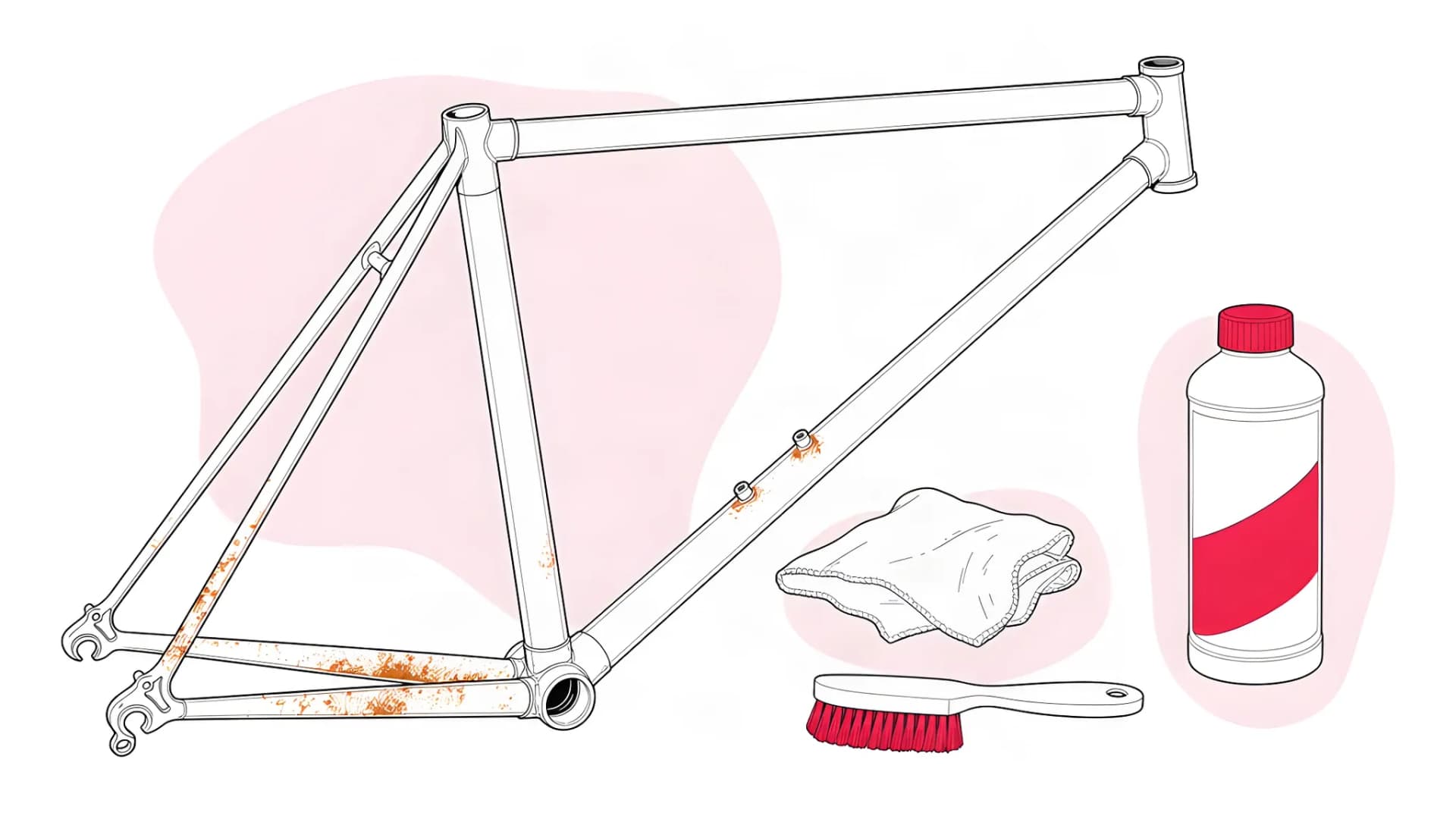
Short answer: how to remove rust from a bike depends on the material and the depth of the rust: identify the metal and check for damage first. Light staining on painted steel, chrome or bolts comes off with a cleaner, polish or soak, then a protective coat. Bubbling paint, pitting, cracks or a seized post need an inspection before cleaning.
Which parts of a bike can rust, and which cannot
Rust is iron oxide, so only iron and steel rust. On a bike that means steel frames and forks, chrome-plated steel parts, most bolts, spokes and nipples, brake and gear cables, the chain and the cassette.
Aluminium does not rust. Specialized's owner's manual puts it plainly: "Steel must be protected or rust will attack it." Aluminium and titanium, it says, quickly form an oxide film that protects the metal, though aluminium needs particular care where it touches other metals, because galvanic corrosion can occur there. Aluminium corrosion looks dull white or grey, not orange.
Carbon fibre does not corrode at all; Specialized describes carbon composites as "very corrosion resistant, much more so than most metals". A carbon frame still carries steel bolts, a metal seatpost, metal bearings and a steel chain, and those rust or corrode in the usual way.
If you are not sure what your frame is made of, read the tubing sticker on the seat tube or down tube, then try a fridge magnet. A magnet grips a steel frame and slides off aluminium, titanium and carbon.
Orange rust on an aluminium or carbon frame comes from somewhere else, because the frame itself cannot rust: a steel fitting running down the tube, or a stain transferred from a rusty rack or lock. Wipe it off and look for the steel part above it.
Is it surface rust or damage that needs inspection?
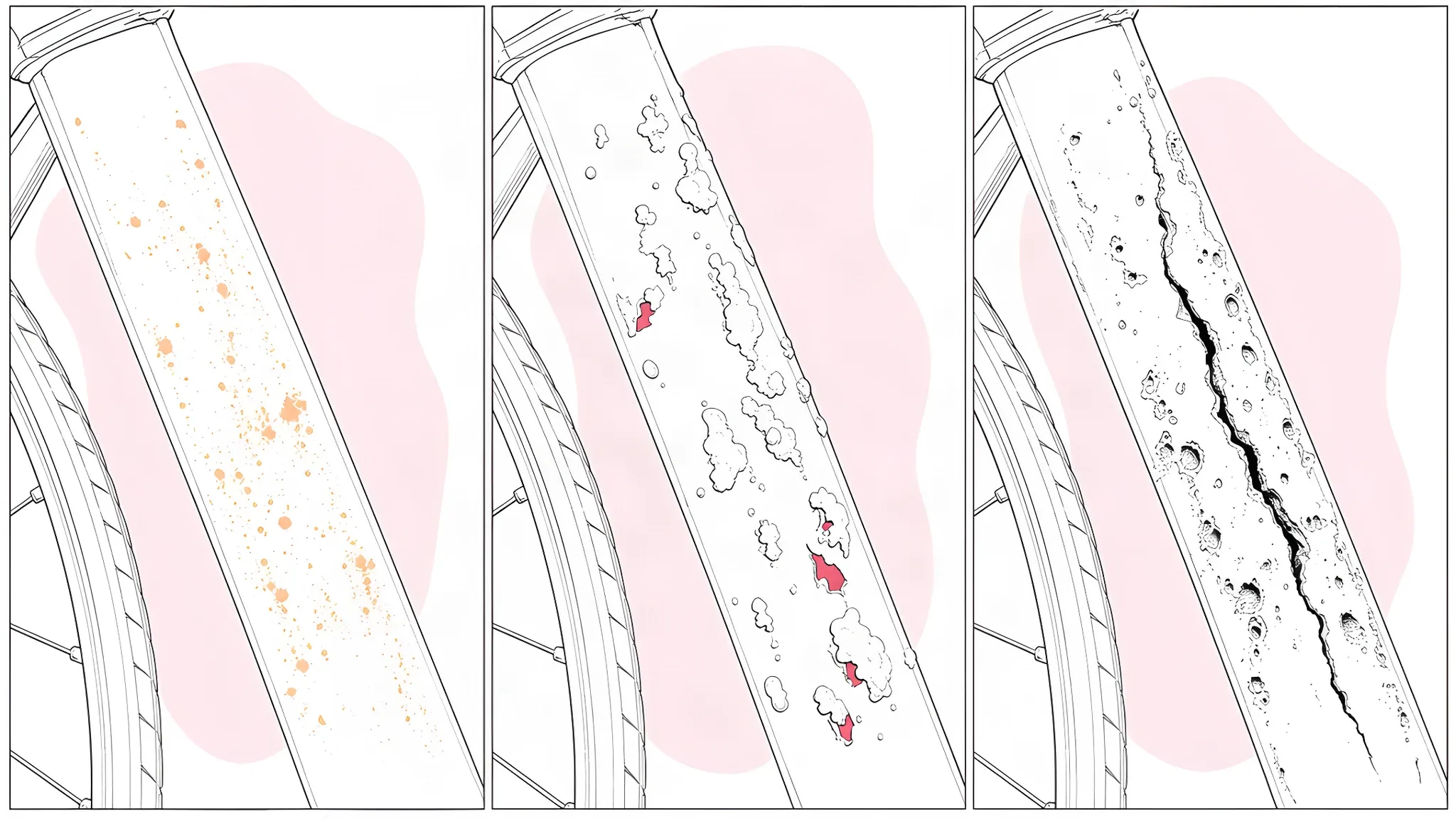
Surface rust is orange staining that sits on the metal without lifting the paint or eating into it. Rust that has changed the shape of the surface is damage, and the bike needs an inspection before its next ride.
Check the frame, fork, handlebar, stem and seatpost for these signs:
- Bubbling or lifting paint with rust underneath, which means the metal has been corroding beneath the finish for a while.
- Flaking, where layers of rust come away and leave rough metal.
- Pitting you can feel with a fingernail, or a pit that holds water.
- Cracks at welds, lug edges, the head tube, the bottom bracket shell and the dropouts.
- Rust weeping from inside a steel tube, out of a vent hole, a bottle boss or the seat tube, which points to rust inside the frame where you cannot see it.
- A seized seatpost, stem or handlebar that will not move when its bolt is loose.
- A rusty fork steerer, handlebar or stem, the parts that hold you up.
- Rusty cables. Specialized's owner's manual, in its check after every long or hard ride or every 10 to 20 hours of riding, asks: "Any rust? Kinks? Fraying? If so, have your dealer replace them."
Specialized's manual is direct: "Do not ride a bicycle or component with any crack, bulge or dent, even a small one. Riding a cracked frame, fork or component could lead to complete failure, with risk of serious injury or death."
Appearance is not enough because rust removal shows you the surface, not the wall thickness underneath it. A tube rusting from the inside can look fine once the outside is polished, which is why Specialized asks owners to have the bike checked periodically for cracks, deformation, corrosion, peeling paint and dents.
What to use to remove rust from a bike, part by part
The right product depends on the material and the finish under the rust. Each method below follows the maker's own instructions, and each has a limit where cleaning stops and replacement starts.
- Painted steel frame or fork. Work only on the bare rust with a fine nylon pad or the finest grade of wire wool, keeping off the paint. Treat the spot with a rust converter such as Hammerite Kurust and finish with touch-up paint. Paint lifting around the spot needs a repair of the finish rather than a polish.
- Chrome-plated steel (forks, handlebars, cranks and rims on older bikes). Use a metal polish made for chrome on sound plating, following its directions. Polish removes rust; it cannot put plating back, so pitted or peeling chrome stays pitted. A chrome rim's braking track is off limits.
- Bolts, nuts, washers and small steel parts. Take them off the bike and soak them in a rust remover made for soaking, such as Evapo-Rust or WD-40 Specialist Rust Remover Soak, for the time on the label. A bolt with damaged threads or a pitted shank is replaced.
- Aluminium and carbon parts. Establish whether the mark is aluminium corrosion, a transferred stain or rust from a steel fitting. Clean with a bike cleaner and a wax or polish approved for the finish. Steel rust recipes, acids and abrasives are not for these surfaces.
- Chain and cassette. Light rust responds to a penetrating spray, a brush, a degrease and fresh lube. Chain makers ban acidic and alkaline rust removers. The assessment is summarised below.
- Braking surfaces and suspension stanchions. Excluded from every method here. Shimano's disc brake manual says not to let any oil or grease onto the rotor or pads, and a cracked or deformed rotor is replaced. Pitted stanchions need a fork service.
How to remove rust from a bike frame without damaging the paint
Removing light rust from a painted steel frame is six steps: wash, inspect, protect the rest of the bike, treat the spot, convert what remains, then seal and dry. You need:
- A mild bike cleaner and two soft cloths
- A nylon brush or fine nylon pad
- A rust converter such as Hammerite Kurust and a small brush
- Touch-up paint or clear lacquer to match the frame
- The gloves and eye protection the product labels ask for
1. Wash and dry the area
Wash the whole bike first, so you are looking at rust rather than road film. Cycling UK's cleaning guide says never to use a pressure washer, and asks you to dry areas that hold water, such as boltheads and the drivetrain.
2. Inspect before you treat
Run a fingernail across the rusty patch. If it catches on a pit, or the paint at the edge lifts when you press it, stop and go back to the inspection list above. Hammerite's own preparation step is to remove all loose paint and rust, dirt, grease and salt, rinse with clean water and let the surface dry.
3. Protect the parts nearby
Lean the bike against a wall or put it in a stand. Cover the disc rotor or the rim braking track with a plastic bag, and keep anything oily or abrasive away from bearings, seals, tyres and e-bike electrics. Work on one spot with a small brush; do not spray the assembled bike.
4. Test, then treat the bare rust only
WD-40 UK's rust guide advises testing a rust remover on an isolated area of the metal first. Work the nylon pad or wire wool on the orange metal in small strokes, and stop at the edge of sound paint. If the surface underneath is rough or pitted, do not escalate to a wire brush, sandpaper or a drill attachment.
5. Convert what remains
Brush Hammerite Kurust directly onto the rusty area, working into any pitting, corners and edges. Hammerite says to avoid coating painted areas, that the product turns blue or black as it reacts with rust, and to re-apply if it has not changed colour within an hour.
6. Seal, dry and reassess
Hammerite states the surface can be topcoated after three hours, so apply touch-up paint or lacquer then, and let it dry fully before the bike goes outside. Squeeze both brakes before riding. A converted, painted spot is a cosmetic repair; it does not restore metal that pitting has removed.
How to remove rust from bolts, spokes and small parts
Small steel parts come off the bike and go into a soak, which reaches the threads and corners no cloth can. Two soak products publish clear directions:
- Evapo-Rust. CRC's directions are to cover the object completely, soak for 30 minutes for light rust or overnight for heavy rust, rinse, and dip the part back into clean solution before air-drying, which holds off rust for up to two weeks. Its data sheet says it contains no acids or alkalis and will not harm aluminium, plastic or rubber.
- WD-40 Specialist Rust Remover Soak. WD-40's directions are to submerge the part for at least 30 minutes for light rust, overnight for medium rust and up to 24 hours for heavy rust, at room temperature or above. WD-40's page says not to use it on painted metal or on bluing and other oxide coatings, which it strips.
After the soak, dry each part fully and grease the threads before you refit it. Bolts that matter for safety, such as stem, seat clamp, brake and rotor bolts, are replaced when they show pitting or damaged threads. A spoke that has rusted where it enters the nipple is replaced by a mechanic, who then trues the wheel.
Rust on a bike chain: a short assessment
Surface rust on the side plates comes off with a penetrating spray, a wait and a stiff brush, then a normal degrease and lube. WD-40 UK's chain rust guide coats the chain with its Multi-Use Product, waits around ten minutes and scrubs with a wire brush, and states the product should never be used to lubricate the chain afterwards.
Chain makers exclude the acid and alkali methods used on frames. Shimano's chain dealer manual tells mechanics never to use alkali- or acid-based solvents such as rust cleaners, because the chain or quick link might then break and cause serious injury.
Links that stay stiff after cleaning, pitted rollers, or a chain that measures worn on a chain checker mean the chain is replaced rather than rescued. Our guide to cleaning a bike chain and removing rust from it has the step-by-step method, the lube choice for UK weather and the wear figures.
Do vinegar, baking soda, cola or WD-40 remove rust from a bike?
They can shift light surface rust on bare steel, and each one damages something else on a bike. Vinegar is a weak acid, cola gets its tartness from phosphoric acid, which Coca-Cola lists as an acidity regulator, and baking soda paste works as a mild alkali and a mild abrasive.
Contact time and rinsing decide the outcome. An acid keeps working on the metal after the rust is gone, and it keeps working inside a bolt thread or a chain roller where you cannot rinse it out, so the rust comes back.
The kitchen methods are wrong on three surfaces:
- Paint and lacquer. Acids dull and stain a painted finish, and baking soda rubbed with a cloth scratches it.
- Aluminium and anodised parts. Aluminium and anodised finishes react with acids and alkalis, and Shimano's chain manual specifies a neutral detergent for washing the gears and chain.
- Chains and quick links. KMC's care guide says: "Never use acidic or alkaline cleaners (rust remover). These will damage the chain and in extreme cases can lead to breakage."
WD-40 Multi-Use Product is a separate case. WD-40 UK's product page describes it as drying quickly and leaving a thin, clear coating to protect or lubricate a surface, and its chain guide says it "helps break down the bond between metal or chrome and rust".
WD-40 does not describe the Multi-Use Product as a soak-type rust remover, and it says the same product should never be used as chain lube.
Can you still ride a bike with rust on it?
Yes, if the rust is surface staining on parts that are not structural, and no, if any of the inspection signs above are present. The decision depends on which part is rusty rather than on how orange it looks:
- Ride it: orange bloom on a chain that still bends freely, stained bolt heads, spotted chrome, a rust-flecked rack or mudguard stay, and a light film of rust on a rotor after a wet night, which clears on the first brake applications.
- Fix it first: a rusty chain with stiff links, rusty cables, a rusty rim braking track, a pitted or scaled rotor, seized pedals or a stuck seatpost.
- Do not ride it: bubbling or flaking rust on the frame, fork, steerer, handlebar or stem, rust weeping from inside a tube, any crack, or a broken spoke.
Whether a rusty bike is worth saving comes down to the frame, because rusty parts can be cleaned or replaced. A steel frame with surface rust and sound paint cleans up. A frame with pitting at the welds, rust inside the tubes or a seized post is a mechanic's assessment, and sometimes the frame is finished.
How to protect a bike from rust in London
Rust needs water and time, and London gives a bike both: gritted winter roads, outdoor storage in a shared hallway or garden, and sweat from a turbo trainer in a small flat. The routine below does more than any single product.
- Rinse after gritted rides. Bromley council's gritting page states that what its gritters spread is salt, that it goes down when road temperatures are forecast at or below freezing, and that TfL grits the red routes. Cycling UK's winter guide says salt speeds up corrosion and rusting, so rinse and dry the bike after a gritted ride.
- Dry before storing. Cycling UK asks for a dry cloth over the whole bike after washing, with attention to the drivetrain and boltheads; our guide to cleaning a bike covers the wash and dry routine. Water sitting on a bolt head starts the rust you will see next week.
- Keep it under a roof. Cycling UK's winter guide says keeping the bike indoors, even in a shed, prevents rusting and aluminium corrosion. If the bike lives outside, a cover keeps rain off but does not dry a bike that went under it wet, so dry it first.
- Grease the seatpost and stem. Park Tool's guide explains that an ungreased aluminium post bonds to a steel or carbon frame through an exchange of ions, and that some posts become permanently bonded. BikeRadar's maintenance guide suggests removing the seatpost twice a year to clean it, with anti-seize on metal-to-metal fits.
- Protect against sweat indoors. BikeRadar's turbo trainer guide reports mechanic Will Smith's warning that sweat finds its way into headset bearings, shift levers and bar tape, and that its salt corrodes them. A towel over the bars and a wash after every third session are his fixes.
- Use a protectant that stays off the brakes. A spray such as Muc-Off Bike Protect drives out moisture and leaves a coating; Muc-Off's directions are to cover disc brakes first and keep it off braking surfaces and tyre treads.
- Touch up stone chips. BikeRadar notes that steel frames, unless stainless, must be painted to stop external corrosion and can be coated inside the tubes too.
Where the bike lives decides most of this; our guide to locking a bike covers outdoor and hallway storage.
What not to do
- Do not use a wire brush, sandpaper or a drill attachment on paint. Hammerite's preparation is to remove loose rust and paint, not sound paint, and its instruction is to avoid coating painted areas.
- Do not soak an assembled bike or a whole chain in vinegar, cola or a rust remover. KMC and Shimano both warn that acidic or alkaline rust cleaners can break a chain.
- Do not put a rust-removal soak on painted or coated parts. WD-40's directions for its Specialist soak say not to use it on painted metal or on metals with bluing or other oxide coatings, because it strips those coatings.
- Do not let oil, polish or protectant near the brakes. Shimano's disc brake manual warns that oil or grease on the rotor or pads may prevent the brakes from operating; Muc-Off says to cover disc brakes before spraying.
- Do not pressure wash rust off. Cycling UK's guide says never, because high-pressure water gets into bearings, where it starts the next rust.
- Do not force a seized seatpost or stem. Park Tool warns that some posts are bonded permanently, and that levering against the frame can bend it.
When it is a job for a mechanic
- Bubbling or flaking rust on the frame, fork, steerer, handlebar or stem, or rust weeping from inside a tube, where the metal has to be assessed before the bike is ridden.
- A seized seatpost, stem or handlebar, which needs controlled force and may need a replacement part.
- Rusty or frayed cables and housings, which are replaced and the brakes and gears reset.
- A chain with stiff links or measured wear, replaced together with a worn cassette and chainrings.
- A rusty rim braking track, a pitted or scaled rotor or rusty brake pads, which are inspected and replaced, never polished, and rusted spokes, which a mechanic replaces before truing the wheel.
A mechanic comes to you with a fully stocked workshop, 9am to midnight, seven days a week, across London.
Book a bike inspection or repair · About mobile bike repair →
Related guides
Sources and further reading
- Specialized Bicycle Owner's Manual (9th edition, revised 2014), the corrosion notes on steel, aluminium, titanium and carbon, the "crack, bulge or dent" warning, the periodic inspection list and the cable check.
- Hammerite Kurust, surface preparation, application, the blue-black colour change, the one-hour re-apply rule and the three-hour topcoat time.
- Evapo-Rust: rust-free in a snap and the Evapo-Rust technical data sheet (CRC), soak times, rinsing, the two-week dip and the list of materials it does not harm.
- WD-40 Specialist Rust Remover Soak, the 30-minute, overnight and 24-hour soak times and the warning about paint and oxide coatings.
- WD-40 UK: Multi-Use Product, WD-40 UK: how to remove bike chain rust and WD-40 UK: how to remove rust from metal, what the Multi-Use Product does, the ten-minute chain method, the statement that it is not a chain lubricant and the advice to test on an isolated area.
- KMC: care of oiled chains, the warning against acidic and alkaline cleaners and aggressive degreasers.
- Shimano chain dealer's manual (DM-CN0002): to ensure safety, the rust cleaner warning and the neutral detergent note, and Shimano hydraulic disc brake dealer's manual (DM-LADBR01): to ensure safety, oil or grease on the rotor and pads, cracked rotors and cleaning with soapy water.
- Park Tool: seized seatposts and stems, why posts bond to frames, grease and anti-seize, and the warning about permanently bonded posts.
- BikeRadar: common bike maintenance mistakes (Oscar Huckle, June 2025), removing the seatpost twice a year and anti-seize on metal fits.
- BikeRadar: using your bike on a turbo trainer (Paul Norman, November 2023), sweat corrosion and the towel and washing advice from mechanic Will Smith.
- BikeRadar: bike frame materials compared (Paul Norman, January 2024), steel needing paint and internal coating, and titanium not corroding.
- Cycling UK: a beginners' guide to cleaning your bike (Rebecca Armstrong), the pressure washer rule, drying boltheads and the drivetrain, and cleaning rotors with soapy water.
- Cycling UK: making your bike winter ready (Christina Bengston), salt speeding up corrosion and indoor storage preventing rust and aluminium corrosion.
- Muc-Off Bike Protect, directions to cover disc brakes and keep the spray off braking surfaces and tyre treads.
- Bromley council: road gritting and TfL: TfL and London boroughs join forces to keep London moving (January 2024), salt on the roads at or below freezing, TfL's red routes and the gritter fleet.
- Coca-Cola: what's in Coca-Cola, phosphoric acid listed as an acidity regulator.