Loose bike crank or stuck pedal: can you ride, how to tighten it, and when the part is finished
What to do when a bike crank arm is loose or a pedal is stuck: the safety rule, a three-step test, tightening by crank type and when the arm is finished.

Written by Conor DonoghueCargo bike mechanic
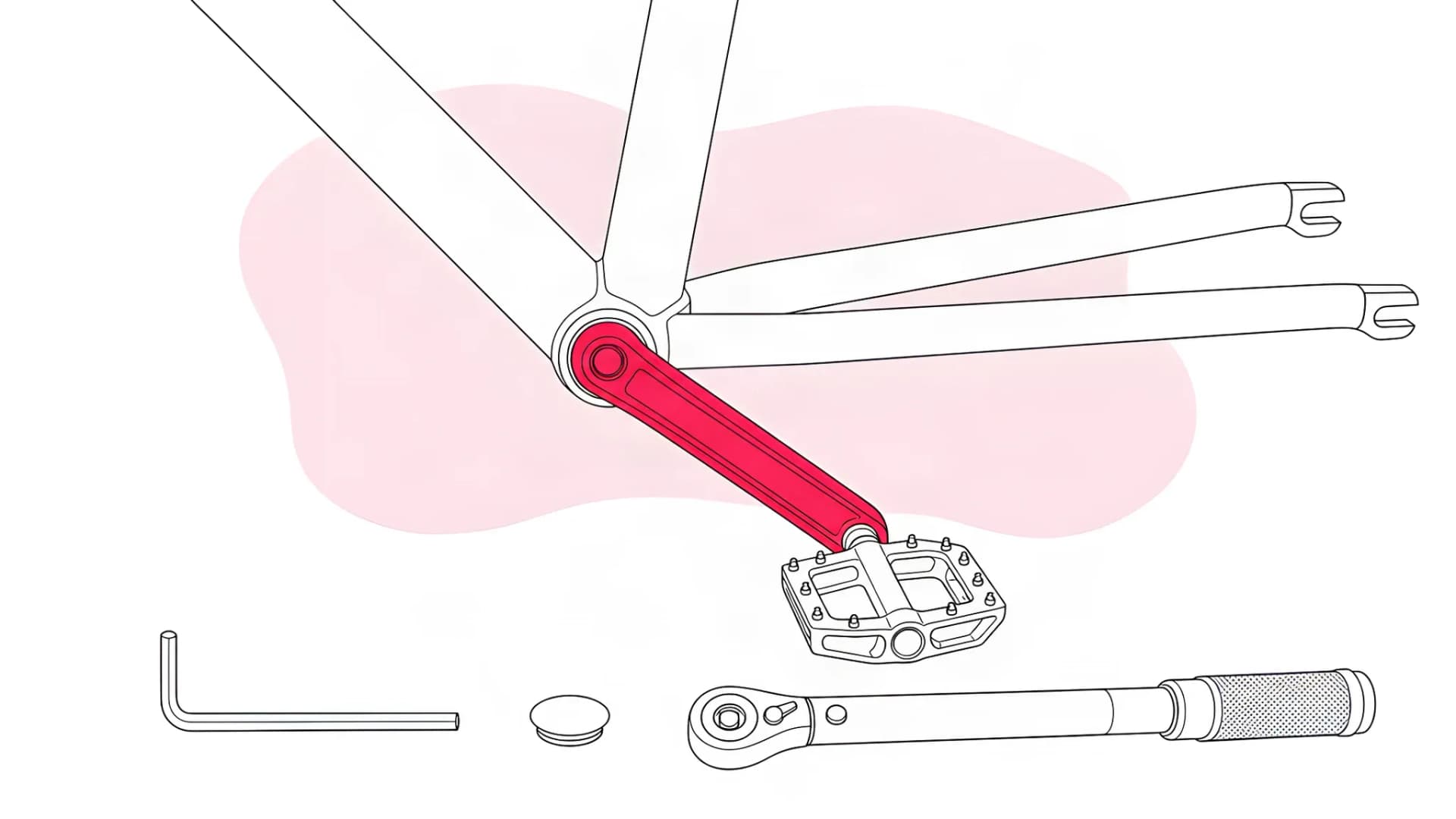
Short answer: a loose bike crank should not be ridden. SRAM's manual says never ride with loose bolts, and Park Tool says a square taper crank ridden loose wears its square hole until the arm needs replacing. Find what moves first: the pedal, the arm or the axle. Tighten the right bolt for your crank type to the maker's figure, and book a mechanic if it loosens again or the play is in the axle.
Can you ride with a loose crank arm?
No. Walk the bike, or tighten the bolt where you stand and ride home gently. SRAM's DUB crankset manual says to check the crank bolt and preload adjuster routinely and never to ride with loose bolts.
Park Tool explains that a square taper crank is pressed onto a tapered spindle and held there by the crank bolt. Ridden loose, the arm wears its square hole on the steel spindle. Once the spindle end is no longer recessed inside that hole, the bolt cannot clamp the arm, and the crank needs replacing.
Bicycling magazine adds that a crank bolt that backs out can let the arm fall off while you ride.
Which part is loose: the pedal, the crank arm or the axle?
Three hand checks, in this order, tell you which part moves.
1. Rock the pedal against the crank arm
Hold the crank arm and rock the pedal. If the pedal axle shifts where it screws into the arm, the pedal is loose in its thread. Park Tool warns that a pedal ridden loose moves in the crank's threads and can ruin them, so tighten it before you ride.
If the axle is solid but the pedal body rocks on it, the play is in the pedal bearings. Park Tool says their service is best left to a mechanic.
2. Rock one crank arm while you hold the other
Hold the left arm and push the right one sideways, then swap hands. Movement between the arm and the end of the axle means the crank bolt is loose or the arm's fitting is worn.
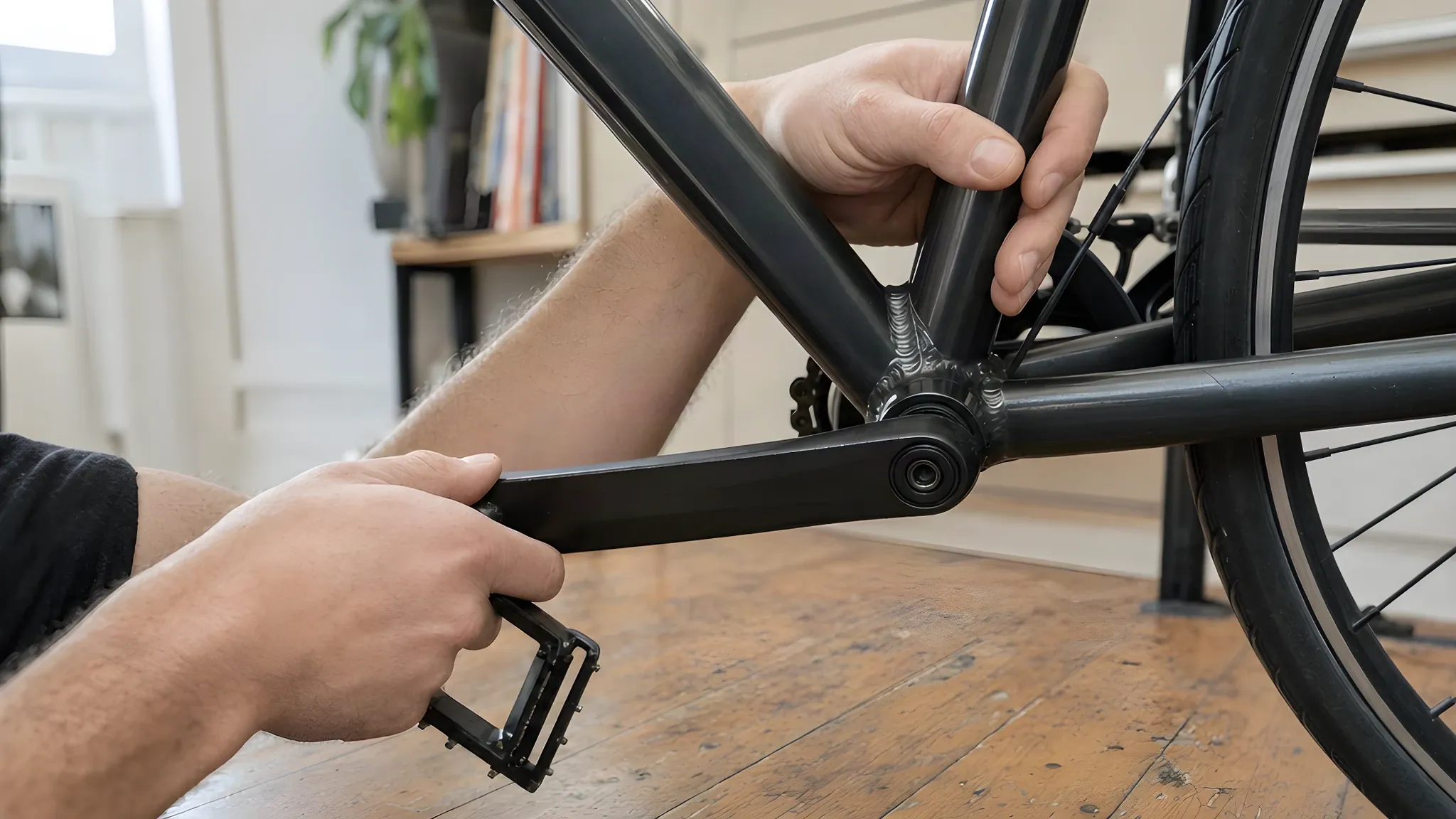
3. Check whether both arms move together
If both arms move as one piece, the play is in the bearings the axle turns in. Tyred's bottom bracket replacement page gives the sign: movement you can feel at the crank, with the pedal still, means the bearing is gone.
To confirm, lift the chain off the chainring and spin the cranks: the same page says a gritty, notchy or stiff turn is worn bearings. Afterwards, put the chain back on the chainring. On a crank with a preload cap or ring, set the preload as described below before you blame the bearing.
Check 2 is the crank push test in a home service. If nothing moves and the crank only creaks, a creak without play is a different fault.
How do you tighten a loose crank arm?
Identify the crank type first, because the bolt, the tool and the torque figure differ. Look at the left crank arm:
- One bolt in the centre, sometimes behind a dust cap. A square taper, ISIS or Octalink crank.
- A slot in the arm with two small pinch bolts across it. Shimano Hollowtech II or a similar two-piece crank.
- One large 8 mm hex bolt, with a thin ring and a small bolt on the axle behind the arm. SRAM DUB or RaceFace Cinch.
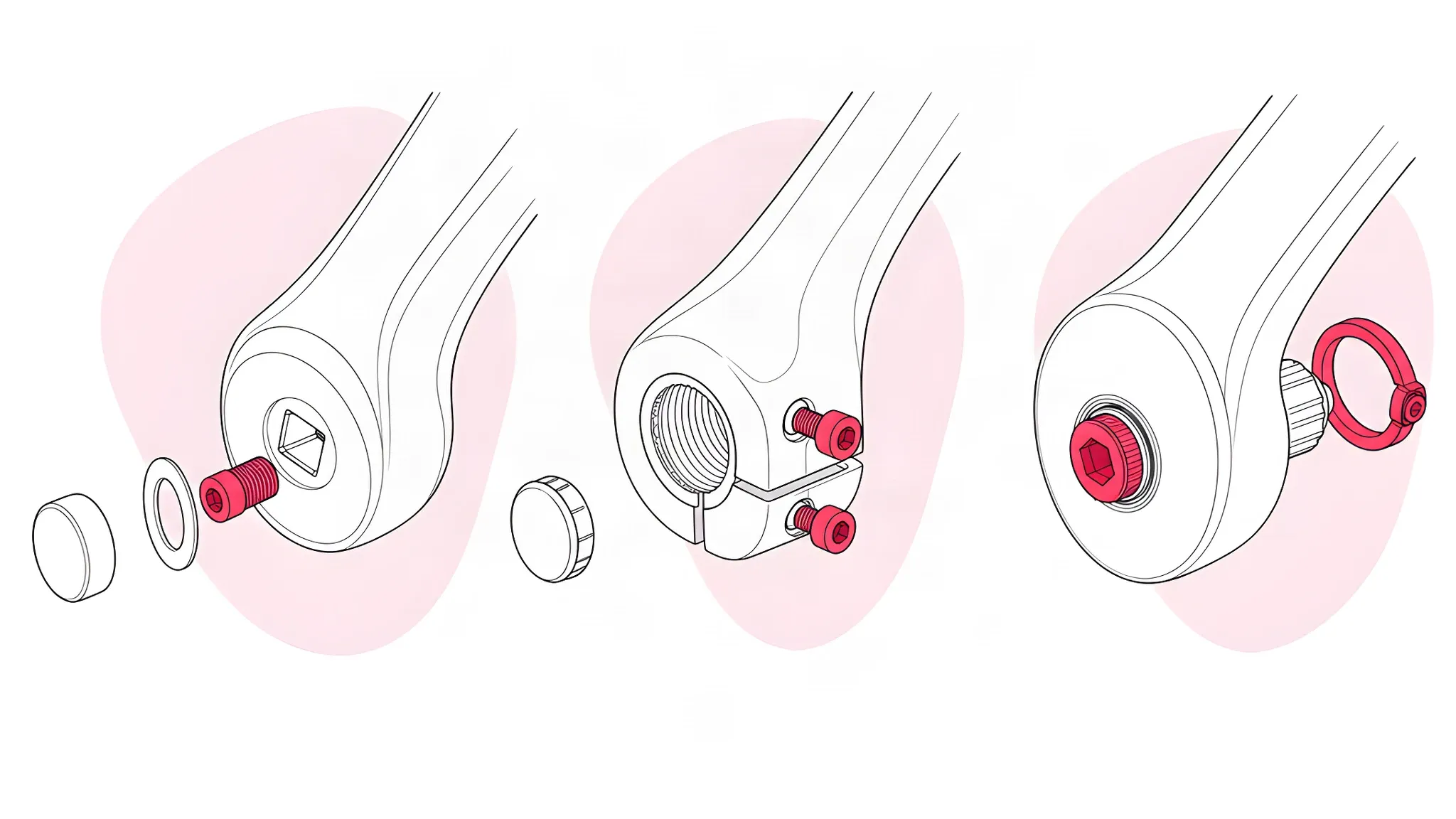
The parts of a bike guide names each part of the chainset.
Square taper, ISIS and Octalink: one central bolt
- Lever or unscrew the dust cap. A ring with pin holes or a large hex, with the bolt under it, is a self-extracting ring. Leave it in place and go to step 4: Park Tool says undoing that bolt pushes the arm off.
- Undo the bolt and keep any washer that sat under it.
- Grease the bolt threads and under its head. Park Tool says leave a square taper spindle clean of grease, unless it creaks at full torque, and grease the splines of an ISIS or Octalink spindle.
- Tighten with a torque wrench and an 8 mm hex bit or a 14 mm socket to suit the bolt head; Park Tool's crank bolt wrench carries both. Park Tool gives 34 to 50 Nm depending on the brand, and Shimano's dealer manual 35 to 50 Nm for its square taper and Octalink cranks.
- Ride round the block and repeat the rocking test.
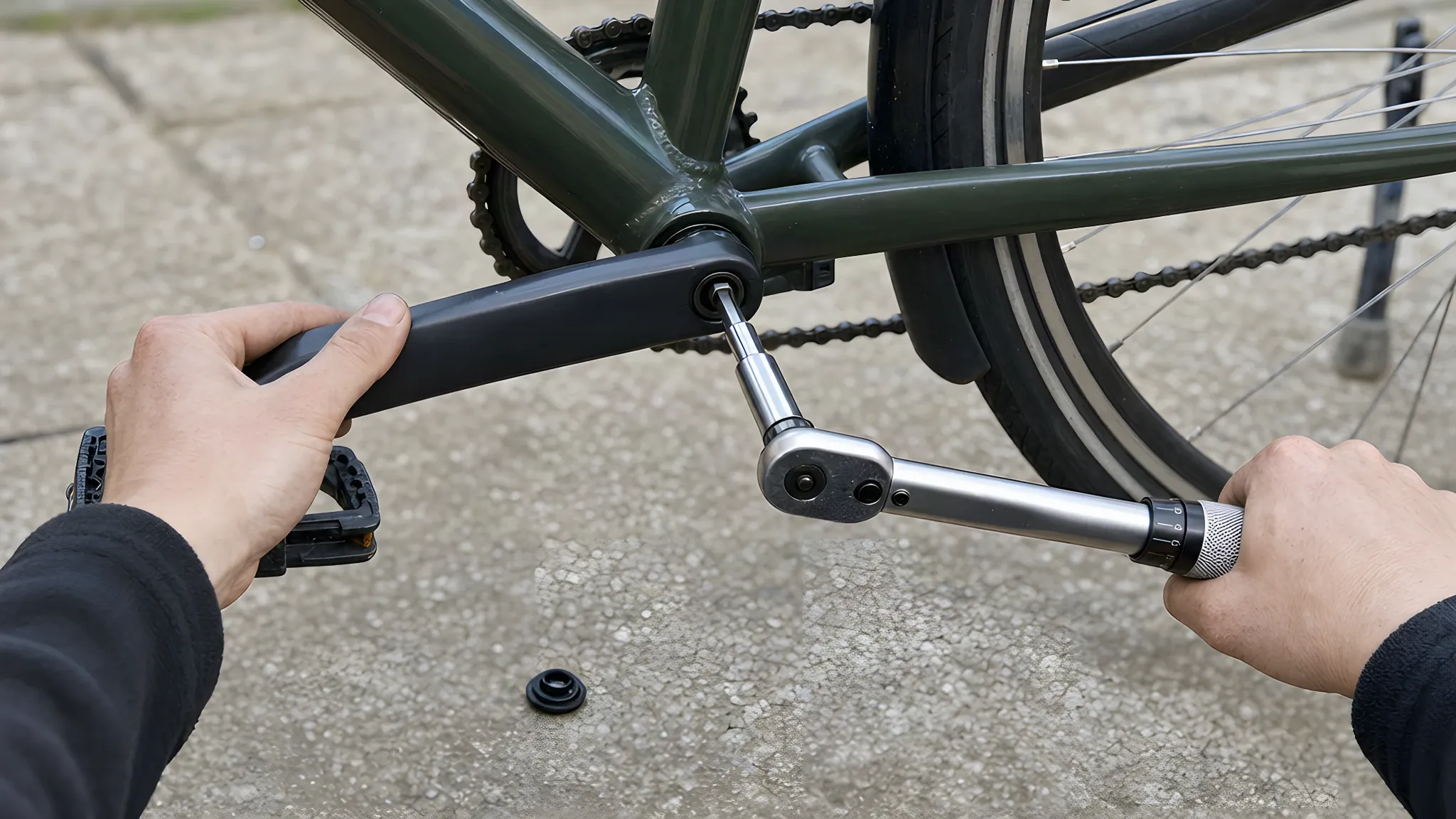
Stop here if the end of the spindle sits flush with the face of the arm. Park Tool says the bolt can then no longer hold the arm tight, and the crank needs replacing.
Shimano Hollowtech II: cap first, then the pinch bolts
- Loosen both pinch bolts on the left arm.
- Thread the cap in gently with the eight-point cap tool until the play is gone. Park Tool says the cap pulls the arm towards the bearing; Shimano's dealer manual gives 0.7 to 1.5 Nm.
- Check that the stop plate in the slot sits over the pinch bolt threads.
- Tighten the pinch bolts alternately, half a turn at a time, to the 12 to 14 Nm in Shimano's dealer manual. Shimano warns that the left arm may come off if they are too loose or not tightened alternately, and says to recheck them after about 100 km.
- Rock the arms again to check for play.
SRAM DUB and RaceFace Cinch: the bolt, then the preload ring
- Loosen the small bolt on the preload ring with a 2 mm Allen key and back the ring off, as RaceFace's chainring guide does.
- Tighten the crank bolt with a torque wrench and an 8 mm hex bit. SRAM's manual gives 54 Nm. RaceFace's guide gives 50 Nm for a Cinch arm and Park Tool's table 54 Nm, so use your crank's manual.
- Turn the preload adjuster towards the "+" sign until it stops, then tighten its small bolt until the adjuster's edges touch. SRAM warns against a ball-end key and overtightening, which could damage the bearing. RaceFace sets its collar bolt to 1.5 Nm.
- Rock the crank arms back and forth to check for play.
If play remains, SRAM's fix is to remove the arms, grease the spindle and repeat the installation.
Why does the crank bolt keep coming loose?
Park Tool's torque guide names lack of tension at assembly as the common cause of bolts working loose. By its figure, a fully tightened crank bolt can hold the arm with over 14,000 newtons. The causes, each with a test:
- The bolt was tightened by feel. Park Tool's worked example puts about 34 Nm at roughly 23 kg of push with the hand 15 cm from the bolt. Test: retighten to the maker's figure with a torque wrench.
- The square hole or the taper is worn. Park Tool says riding loose wears the fit between them. Test: with the bolt out, check whether the spindle end sits flush.
- The preload has backed off. SRAM lists the preload adjuster among the parts to check routinely. Test: reset the cap or ring as above.
- The thread is damaged. Park Tool notes that a cross-threaded bolt will not tighten properly even with a torque wrench. Test: a bolt that turns without getting tighter needs a mechanic.
- The play is in the bottom bracket. Both arms move together, and no crank bolt cures it. Test: check 3 above.
My pedal is stuck in the crank: what now?
This guide does not teach pedal removal; two facts from Park Tool decide whether you try once or book. The left pedal has a left-hand thread and comes off clockwise, so turning it the wrong way only tightens it.
Park Tool also calls correct mechanical advantage critical on an overly tight pedal. Keep the spanner and the crank arm at 90 degrees or less, and hold the opposite crank as a second lever. Pedals without spanner flats typically take an 8 mm hex key in the back of the axle, Park Tool says.
Stop and book if the spanner slips, the flats start to round or the thread in the arm starts to give. The arm is the part to protect.
The pedal thread is stripped: insert or new crank arm?
A stripped pedal thread is a workshop repair or a new arm. Park Tool says a tap aligns damaged threads but will not restore metal that is gone. With no threads left, a mechanic fits a pedal bushing kit.
- Pedal bushing kit. Oversized taps recut the arm to 5/8 in x 20 TPI for a bushing that takes the standard 9/16 in pedal. Park Tool says it works best on solid aluminium arms and is not recommended for hollow or carbon ones.
- Cost of the kit. Park Tool, which does not make the kits, calls them expensive and says arm replacement is the better option for most cranks.
- Helicoil-type wire insert. BIKE magazine reported in 2011 that Böllhoff makes Helicoil inserts in the 9/16 in pedal size.
- A new crank arm. The answer for a hollow, carbon or cracked arm, or one worn at the spindle as well.
What not to do
- Do not pull an arm with a crank puller that is only partly threaded in. Park Tool warns that the arm's threads may be damaged.
- Do not treat threadlocker or a drinks-can shim as the repair. Park Tool's rule is that a worn crank needs replacing.
- Do not force a pedal into the arm. Park Tool starts each pedal by hand, and a pedal that is hard to thread in needs the crank thread chased with a tap.
When it is a job for a mechanic
- The arm loosens again after one correct tightening. The fitting is worn, and Park Tool's answer is a new crank.
- The spindle end sits flush with the arm face. The bolt can no longer clamp the arm.
- Both arms move together, or the cranks turn gritty with the chain off. That is the bottom bracket. Tyred's bottom bracket page lists £15.00 labour for a worn square taper unit, the new unit priced before it is fitted.
- A pedal that will not move with a long spanner, or a stripped pedal thread. More force at home risks the arm, and an insert needs workshop taps.
- A loose crank on a mid-drive e-bike. The cranks turn in the motor. Tyred's e-bike repair page says motor faults are diagnosed and referred to an authorised service centre if the repair is outside Tyred's scope.
For a worn bottom bracket, Tyred's page lists the cranks and pedals removed, the new unit fitted and torqued, the cranks refitted and the bike test ridden. New cranks or pedals are priced before they are fitted.
A mechanic comes to you with a fully stocked workshop, across London.
Book a repair · Mobile bike repair in London →
Related guides
- How to service a bike at home: a seven-step DIY guide
- Bike noises: what each creak, click and knock means, and how to find it
- How to remove rust from a bike and stop it coming back
Sources and further reading
- Park Tool: three-piece crank removal and installation (13 August 2015), square taper, ISIS and Octalink cranks, wear from a loose bolt and the flush spindle end, washers under the bolt, grease on the bolt and splines but not on a square spindle, the creak exception, 34 to 50 Nm by brand, a puller fully threaded in.
- Park Tool: crank removal and installation, two-piece compression slotted (14 August 2015), the Hollowtech II cap that pulls the arm towards the bearing, the eight-point cap tool, the stop plate, pinch bolts tightened alternately every half-turn, the play check.
- Park Tool: crank removal and installation, self-extracting (13 August 2015), rings that look like dust caps, leaving the retaining ring in place, the ring pushing the arm off the spindle.
- Park Tool: torque specifications and concepts (25 August 2015), lack of tension as the cause of loosening, the 14,000 newton figure, cross-threaded bolts, the perceived-effort example, and the table's 54 Nm for Race Face crank bolts.
- Park Tool: pedal installation and removal (21 August 2015), left-hand and right-hand pedal threads, mechanical advantage and the opposite crank as a lever, 8 mm hex pedals, threading by hand, the tap and the bushing kit, pedal bearing service.
- Park Tool: pedal bushing repair kit procedure (6 August 2015), a loose pedal ruining crank threads, the 5/8 in bushing for 9/16 in pedals, solid aluminium arms only, the cost note and not over-tightening.
- Park Tool: CCW-5 crank bolt wrench, the 14 mm socket and 8 mm hex for three-piece crank bolts.
- Shimano: dealer's manual, crankset (DM-FC0002-17) (PDF, May 2022), 35 to 50 Nm for square taper and Octalink crank bolts, the Hollowtech II cap at 0.7 to 1.5 Nm, the pinch bolts at 12 to 14 Nm tightened alternately in stages, the 100 km recheck and the warning that the left arm may come off.
- SRAM: DUB cranksets and bottom brackets user manual (online, undated), the 54 Nm crank bolt with an 8 mm hex bit, the preload adjuster and its 2 mm bolt, no ball-end key and no overtightening, rocking the arms for play, the reverse-threaded non-drive pedal bore, never riding with loose bolts.
- RaceFace: how to swap Race Face CINCH chainrings (undated), backing off the preload collar with a 2 mm key, the crank arm at 50 Nm and the collar bolt at 1.5 Nm.
- Bicycling: how to diagnose and fix common bike noises (Tara Seplavy, published 26 October 2026), a crank bolt that backs out letting the arm fall off.
- BIKE magazine: repair destroyed pedal threads with helicoil (Sebastian Brust, 18 May 2011), Böllhoff's Helicoil inserts for 9/16 in x 20 pedal threads.