Parts of a bike: every part named, what it does and what wears
The parts of a bike in British English, system by system, with a numbered diagram, what each part does, what wears and the guide that covers the fix.

Written by Conor DonoghueCargo bike mechanic
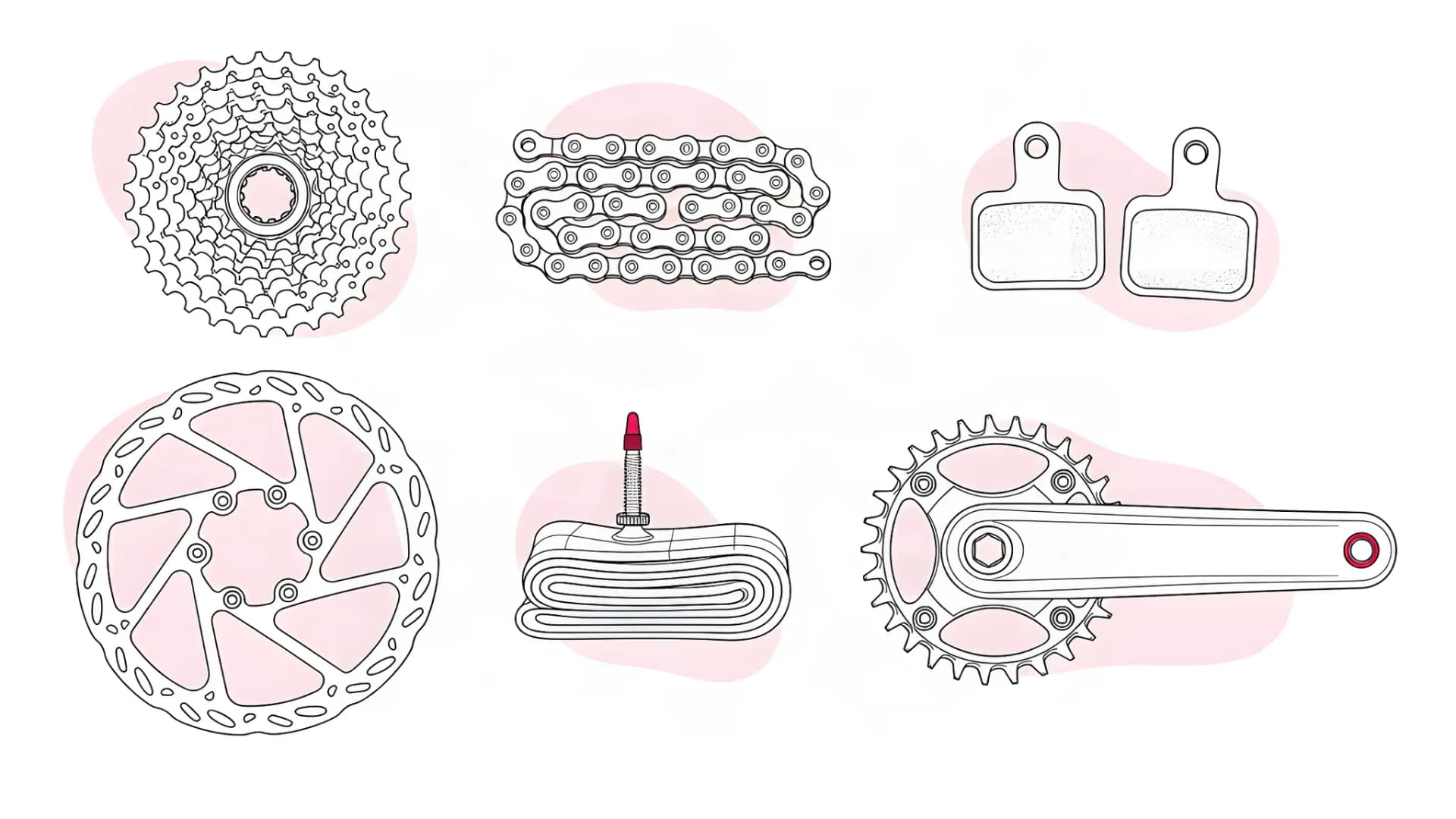
Short answer: the parts of a bike fall into seven groups: the frame, the steering, the wheels and tyres, the drivetrain, the brakes, the contact points and fittings, and on an e-bike the motor system. Each entry gives the British name, what the part does, what wears or fails and the symptom you notice, and the Tyred guide or service that covers the fix.
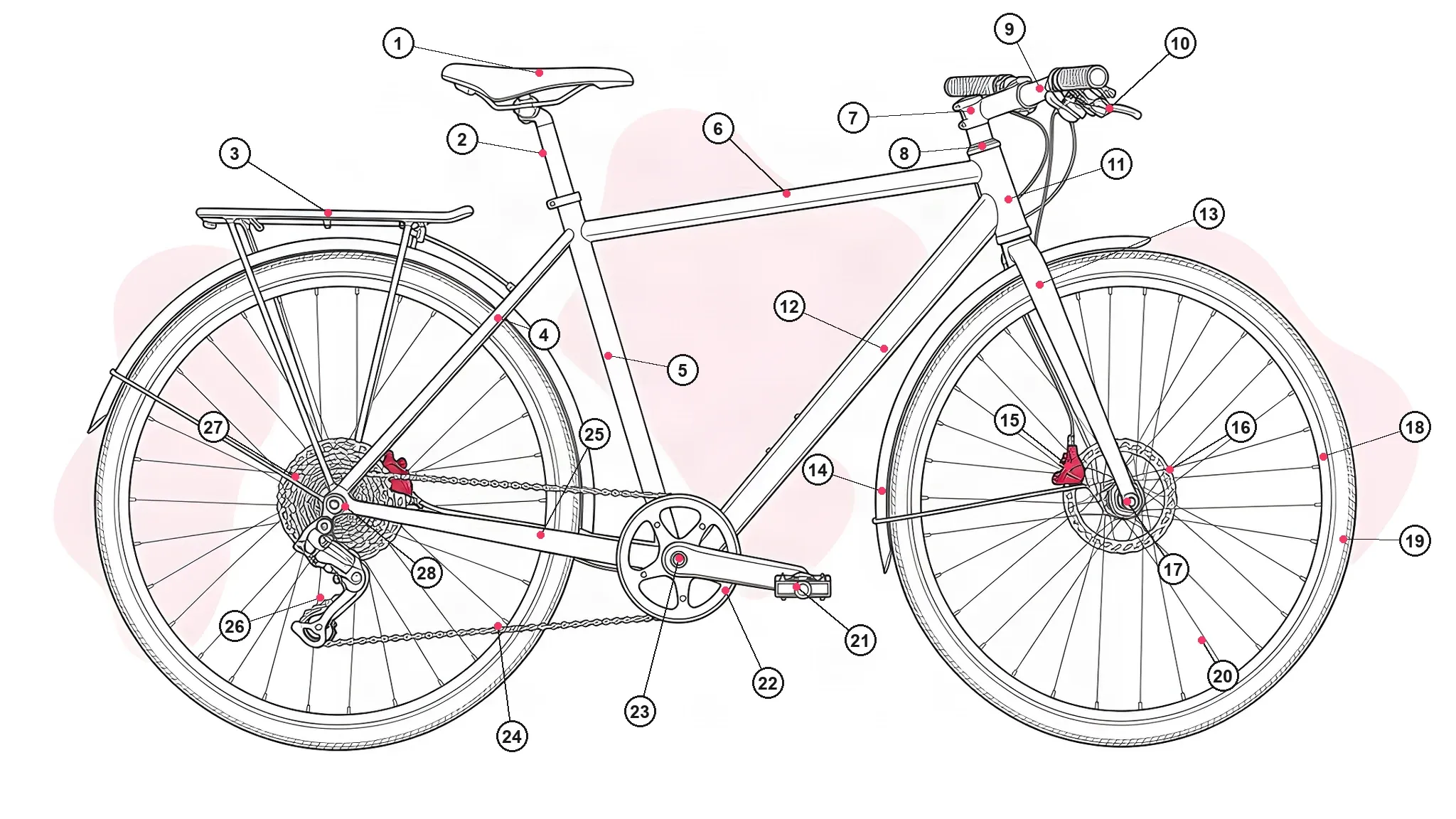
Parts of a bike diagram
The diagram shows a London commuter's city hybrid with flat bars, disc brakes, one chainring, mudguards and a rack.
- Saddle
- Seatpost
- Rack
- Seat stay
- Seat tube
- Top tube
- Stem
- Headset
- Handlebars
- Brake lever
- Head tube
- Down tube
- Fork
- Mudguard
- Calliper
- Disc rotor
- Hub
- Rim
- Tyre
- Spokes
- Pedal
- Chainset
- Bottom bracket
- Chain
- Chain stay
- Rear derailleur
- Cassette
- Rear dropout
Parts of a bike frame
A bike frame is a front triangle of top tube (lowered or left out on a step-through frame), down tube, seat tube and head tube, and a rear triangle of seat stays and chain stays. Makers measure frame size in different ways, so use the maker's chart or our bike size calculator.
Specialized's owner's manual says to replace any cracked part and never to ride a frame with a crack, bulge or dent, even a small one; our rust and damage guide lists where to look for cracks.
Head tube
The head tube is the short front tube that holds the headset bearings and the fork's steerer. After a front-on hit from a kerb or a car, check its joints for cracked paint or rippled metal, part of the crack check in our rust guide.
Seat tube
The seat tube runs from the bottom bracket to the saddle and holds the seatpost. Rust weeping from its top, or a post stuck fast with the clamp loose, is on the inspection list in our rust guide.
Seat stays and chain stays
The seat stays run from the top of the seat tube to the rear dropouts and the chain stays from the bottom bracket; a rear rim brake bolts between the seat stays. Chain slap chips the drive-side chain stay, and the dropouts are on the crack checklist in our rust and damage guide.
Dropouts
Dropouts are the slotted plates at the fork ends and rear stays that hold the wheel axles. A bike without derailleurs has horizontal rear dropouts so the axle can slide back to tension the chain, Sheldon Brown explains; if the wheel creeps forward, our chain guide shows the reset.
Mounts and bosses
Bike mounts are braze-ons, Sheldon Brown's term for small fittings fixed to the frame such as bottle cage mounts and brake bosses; threaded rack and mudguard mounts are also called eyelets. A rack that sways has loose bolts, a rusty bolt comes out for a soak as in our rust guide, and one snapped off inside needs a mechanic.
Steering: fork, headset, stem and handlebars
Fork
The fork holds the front wheel: two blades meet at the crown, and the steerer rises through the head tube. A fork bent, cracked or dented in a crash is replaced before the next ride, and the inspection list in our rust guide adds a rusty steerer.
Headset
The headset is the pair of bearings at the top and bottom of the head tube that let the fork turn. Worn or loose, it knocks when you rock the bike on the front brake, or catches at straight ahead; play that returns after adjustment means new bearings, and Tyred's full servicing includes a bearing check.
Stem and handlebars
The stem clamps the handlebars to the steerer: round the outside on a threadless stem, wedged inside on a quill stem, whose minimum insertion mark Specialized says must not show above the headset. Bars twisted out of line mean slipped stem bolts, and a bar bent in a fall is replaced; Tyred's full servicing ends with everything torqued.
Parts of a bike wheel and tyre
A wheel is a hub, spokes and a rim, with a tyre and an inner tube or tubeless sealant. Tyred's puncture repair is from £30 with the tube repaired or replaced, and the mechanic carries tubes, patches, tyre levers and a track pump.
Hub
The hub is the centre of the wheel: a shell turning on bearings around the axle, with flanges for the spokes. Worn bearings knock when you rock the rim sideways or feel gritty when you spin the wheel, and our truing guide separates hub play from a buckle.
Quick release and thru-axle
A wheel is held by a quick-release skewer with a cam lever, a thru-axle screwed through the fork or frame, or axle nuts on hub-gear bikes. A wheel that shifts when you thump the tyre is not seated or closed; the puncture guide covers taking the wheel out and refitting it.
Freehub
The freehub is the ratchet body on the rear hub that the cassette slides onto; a freewheel instead carries its own ratchet and screws onto the hub. A worn freehub slips when you pedal, or drags so the chain goes slack when you coast; it is a hub repair to book with a mechanic.
Spokes
Spokes are the wires tensioned between the hub flanges and the rim. A snapped or slack spoke lets the rim wobble, and Tyred's bike repair page lists loose spokes and buckled rims among jobs sorted on the spot.
Nipples
Nipples are the small nuts at the rim end of each spoke, turned to change the tension and pull the rim sideways. Sheldon Brown notes that the thread is right-hand but seen from behind, so the direction feels reversed; our truing guide shows which way to turn.
Rim
The rim is the hoop the tyre seats on, and on a rim-brake bike its sides are the braking track. road.cc explains that braking wears the track concave, that many rims carry a wear groove or hole that disappears when the rim is due, and that a thin rim can fail under tyre pressure.
Hooked and hookless rims take different tyres: see our tyre sizes guide.
Rim tape
Rim tape covers the spoke holes in the rim bed. Tape that has slipped or split causes repeat punctures on the rim side of the tube. Tyred's puncture page says the mechanic checks the rim tape, and our puncture guide shows how to spot it.
Tyre
The tyre (tire in American English) is a casing of fabric cords between two wire or Kevlar beads, with rubber thickest at the tread. Replace it when the tread is worn flat, a cut shows the casing, or the sidewall cracks or bulges. Our tyre sizes guide decodes the size on the sidewall.
Inner tube
The inner tube holds the air in a tyre that is not tubeless, sized by diameter, width and valve as in what size inner tube you need. Two small holes a few millimetres apart are a pinch flat from a soft tyre hitting a kerb; see our tyre pressure guide.
Valve
Sheldon Brown lists three valve types: Presta, the narrow one with a knurled nut you open before pumping; Schrader, the car-type valve on children's and utility bikes; and Woods (Dunlop), once popular in Britain, which takes a Presta pump. A slow flat over days can be a leaking valve: our puncture guide says to check the valve core is tight.
Tubeless sealant and tape
A tubeless setup has airtight tape over the spoke holes, a tubeless valve and liquid sealant that plugs small holes as you ride. Sealant dries out at rates the makers state differently, listed in our tubeless maintenance guide; Tyred's mechanic carries sealant and plugs.
Drivetrain parts
The drivetrain is the chainset, bottom bracket, pedals, chain, cassette and derailleurs, or a hub gear or belt. Tyred's gear repair covers adjustment and cables.
Chainset
The chainset (crankset in American English) is the crank arms plus the chainrings bolted to the drive-side arm's spider. Chainring teeth wear with the chain. A loose crank or chainring bolt creaks in time with your pedalling, one of the creaks Tyred's bottom bracket page says the mechanic checks first.
Bottom bracket
The bottom bracket is the bearing the cranks turn on, threaded or, on many carbon frames, pressed into the frame's shell (BikeRadar). A worn one creaks under load, has side-to-side play at the cranks and turns gritty with the chain off: the signs on Tyred's bottom bracket replacement page.
Pedals
Flat pedals take any shoe; clipless pedals lock onto a cleat bolted to a cycling shoe. A pedal that wobbles or turns roughly has worn bearings, and a worn cleat releases too early or too late. Tyred's bottom bracket page lists pedals among the parts that creak in time with pedalling and are checked first.
Chain
The chain is a loop of plates joined by pins and rollers, closed on many chains by a quick link. Park Tool explains that the pins and rollers wear, which looks like stretch, and that an overworn chain wears out the cassette and chainrings; our chain guide shows how to measure it.
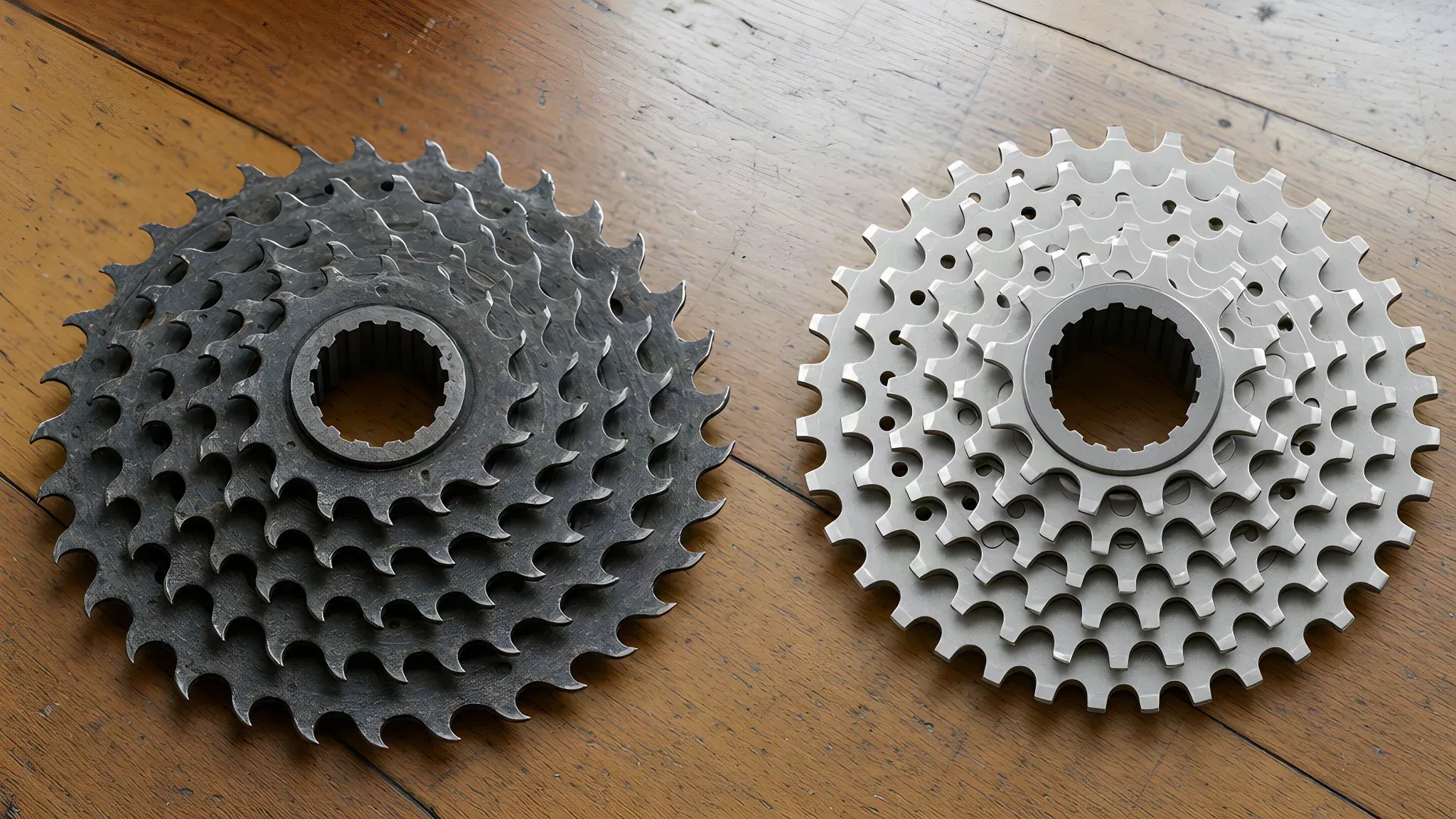
Cassette
The cassette is the stack of rear sprockets on the freehub, held on by a lockring. Its teeth wear with the chain into a hooked shape, and the symptom is a new chain skipping on the worn sprockets. Our gears guide has the check.
Front derailleur
The front derailleur moves the chain between two or three chainrings. A chain that rubs its cage needs the derailleur trimmed or its cable tension set, part of a Tyred gear adjustment. Rub only in the extreme gears is cross-chaining, and a chain dropping off the rings points to the limit screws, as our gears guide explains.
Rear derailleur
The rear derailleur moves the chain across the cassette and keeps it taut with a sprung cage; two limit screws stop it throwing the chain off either end. If it will not reach the biggest or smallest sprocket, Tyred's gear repair page names a limit screw or the cable; our gears guide says when to touch the limit screws.
Jockey wheels
The jockey wheels are the two small pulleys in the rear derailleur cage: the upper one guides the chain onto each sprocket and the lower one takes up tension. Worn, their teeth turn to points or their bearings squeal. Cleaning them is part of our chain cleaning guide.
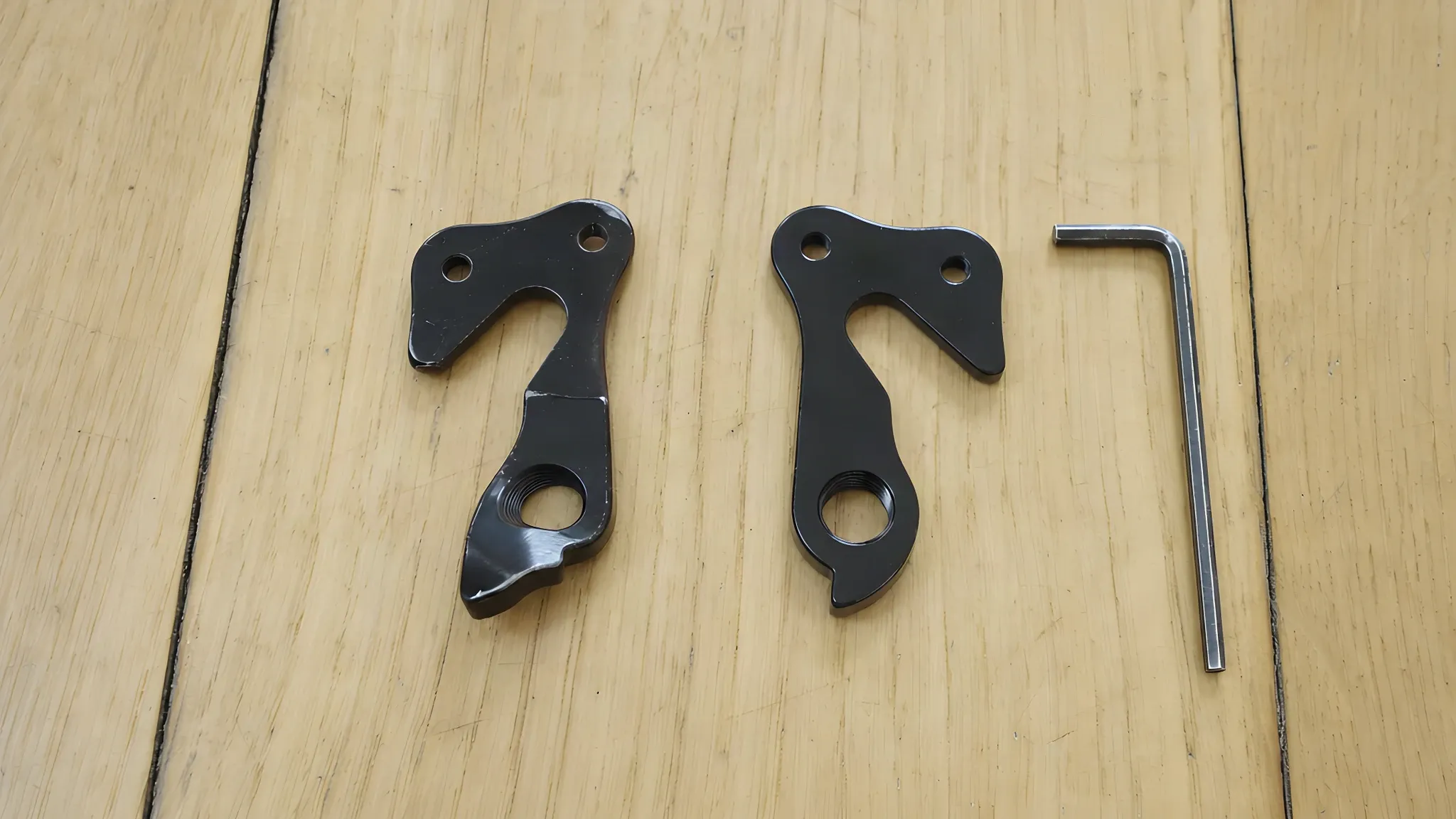
Derailleur hanger
The derailleur hanger is the part of the rear dropout the derailleur bolts to, built in or bolted on. BikeRadar describes it as designed to bend on impact to protect the frame and derailleur. Bent, it tilts the derailleur, so shifting goes vague and the derailleur can catch the spokes; our gears guide has the check.
Shifters and gear cables
Shifters pull and release a gear cable, a steel wire inside an outer casing with ferrules on its ends. A frayed or corroded wire drags in its casing and makes the shifter stiff or notchy, the sign Tyred's gear repair page gives for a new cable. The Essential package on our prices page renews brake and gear cables.
Barrel adjuster
The barrel adjuster is the threaded barrel where a cable enters a shifter, derailleur or brake lever, and turning it changes the tension in small steps. On a cable brake it takes up pad wear until it runs out of thread. Our gears guide has the barrel-adjuster fix step by step.
Hub gears
Hub gears sit sealed inside the rear hub, as on a Shimano Nexus or a 3-speed Brompton. A cable shifts them through a cassette joint on Shimano hubs of more than three speeds, or an indicator chain on Sturmey-Archer and Brompton hubs. If one slips, check the cable adjustment first; our gears guide shows how it is set.
Chain tensioner
On a Brompton, the chain tensioner on the rear frame keeps the chain tight and lets the bike fold, and Brompton says it can show wear after heavy use. A chain that keeps coming off starts here; our chain guide has the check.
Belt drive
A belt drive replaces the chain with a toothed belt. Gates' owner's manual says to wash it with water and never to lubricate, crimp, twist or backbend it, and that too little tension makes it skip. Our e-bike maintenance guide leaves the tension to a mechanic with a gauge.
Parts of a bike brake
A rim or disc brake is a lever, a cable or hydraulic hose, and a calliper pressing pads onto the rim or a rotor; some Dutch-style bikes use a roller brake inside the hub instead. Our brake adjustment guide helps you tell which you have.
Brake levers and cables
The brake lever pulls a cable or pushes fluid to the calliper. On a cable brake, pad wear and a stretching cable bring the lever closer to the bar; on a hydraulic brake, a spongy lever means air in the line. Tyred's hydraulic brake bleed page says a lever that reaches the bar is not safe to ride.
Calliper
The calliper (caliper in American English) carries the pads and squeezes them onto the rim or rotor. Rim brakes use side-pull callipers (a Brompton has dual-pivot ones), V-brakes or cantilevers, and a disc calliper holds pistons. An off-centre calliper rubs on one side, and our brake adjustment guide covers re-centring it.
Brake pads
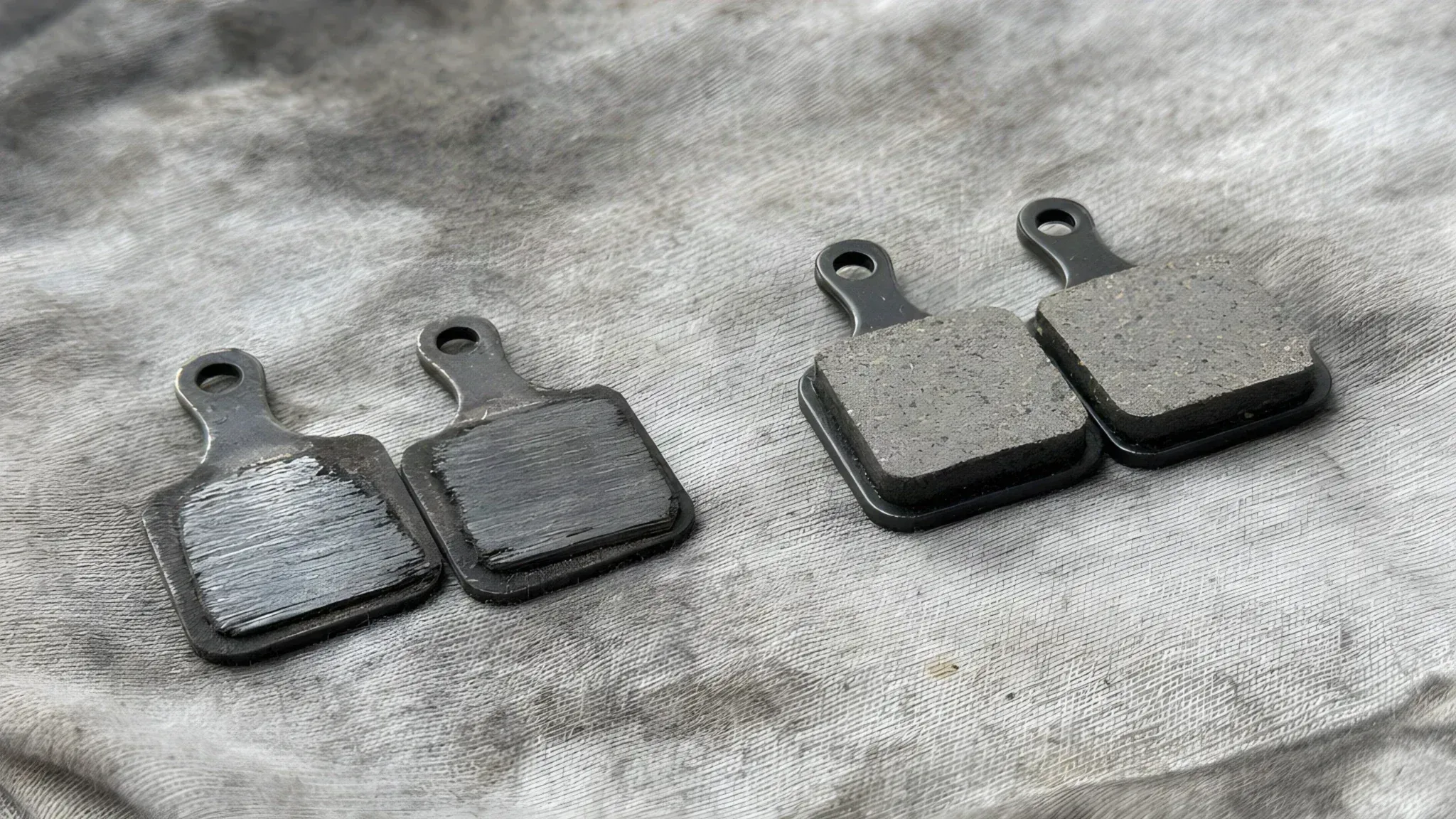
Rim pads are finished when their wear grooves have gone. SRAM's brake service guide says to replace disc pads when pad and backing plate together measure 3 mm or less. Grinding or a metallic sound means the plate is wearing the rotor or rim: stop and book a brake pad replacement.
Rotor
The rotor is the steel disc fixed to the hub by six bolts or the Centerlock system, as BikeRadar describes. SRAM says to replace it once it measures less than the minimum thickness marked on it. A bent rotor ticks once per wheel turn; see the rotor check in our brake adjustment guide.
Hydraulic hose and fluid
A hydraulic brake's sealed hose carries fluid from the lever to the calliper pistons. Tyred's brake bleed page says the fluid is mineral oil or DOT, printed on the lever or reservoir cap, and that the wrong one damages the seals.
SRAM recommends a bleed at least once a year for DOT brakes and every two years for mineral oil brakes. Fluid at a lever or calliper is a leak: stop riding.
Contact points and fittings
Saddle and seatpost
The seatpost slides into the seat tube under a clamp, and the saddle's rails clamp into its head; a saddle that tilts or slips back has a loose bolt. Specialized marks a minimum insertion line that must stay inside the frame, and our rust guide explains why the post should be greased.
Mudguards
Mudguards (fenders in American English) cover the wheels on wire stays. Stays rattle loose, a knocked guard rubs the tyre, and a stay bent into the spokes can stop the wheel. A wider tyre needs clearance under the guard; see our tyre sizes guide.
Parts of an electric bike
An e-bike adds a motor, battery, controller, display and sensors. Tyred's e-bike repair covers the mechanical work on the spot on Bosch, Shimano STEPS, Fazua, Brose and other systems. Motor, battery and controller faults are diagnosed first and referred to an authorised specialist if the repair is outside Tyred's scope.
Motor
The motor, or drive unit, sits at the bottom bracket on a mid-drive or inside a wheel on a hub motor. Bosch allows only identical or approved chainrings, cranks and pedals on its drive units, to protect them from overload. A rear hub motor adds a cable and torque settings to a flat (see our puncture guide).
Battery
The battery mounts on the frame, on the rack or inside the frame, the three types Bosch lists; our battery care guide covers charging faults. Stop using a battery at once if it shows the London Fire Brigade's warning signs: extreme heat, swelling, hissing or cracking sounds, or a strong chemical smell.
Controller and display
The controller turns sensor signals into motor power, and the display shows assistance, speed, charge and error codes. An error code tells you which part of the system found the fault, so note it with the bike's make and model before you book, as our e-bike maintenance guide advises.
Speed sensor
The speed sensor reads a magnet on a spoke or on the rotor's Centerlock mount. Bosch's Performance Line CX manual sets the gap at 2 mm to 15 mm and warns against damaging the sensor when the rear wheel comes out. A magnet knocked out of line stops the speed reading; see our e-bike checks.
Torque sensor
A torque sensor measures how hard you pedal and a cadence sensor only how fast; ebiketips says mid-drives tend to be sold with torque sensors. Shimano's W013 warning means sensor initialisation failed, and our e-bike maintenance guide gives Shimano's fix: switch off, then on again with your feet off the pedals.
British and American names for bike parts
British names first, then the American ones you meet in manuals and online:
- Tyre: tire.
- Chainset: crankset.
- Calliper: caliper.
- Mudguard: fender.
- Jockey wheel: pulley wheel.
- Quick link: master link.
- Allen key: hex key.
- Spanner: wrench.
Which parts of a bike wear out, and the order to check them
Parts that rub or carry load wear by design. Check them in this order, because the first checks take seconds and cover the parts that stop you:
- Tyres. Tread, cuts, sidewall cracks, then pressure.
- Brakes. Pad grooves or pad thickness, and the rim braking track.
- Chain. A chain checker, before the wear spreads to the cassette.
- Cables. Frayed ends, rust, a stiff lever or shifter.
- Bearings. Rock each wheel sideways, rock the bike on the front brake, and push a crank sideways, the test on Tyred's bottom bracket page.
- E-bike extras. Battery contacts and the speed sensor magnet.
When it is a job for a mechanic
- Play at the headset, hub or cranks that returns after adjustment. The bearings need pressing out and replacing with tools a home kit lacks.
- A hanger bent for the second time, or a chain jammed behind the cassette. Straightening a hanger again risks snapping it, and forcing the chain out damages spokes.
- A bent rotor, fluid at a lever or calliper, or a lever that reaches the bar. The brake needs a rotor, a bleed or seals before the next ride.
- Any crack in the frame, fork, handlebars or stem. Specialized's rule is to replace the part.
- A hub-motor wheel that has to come out, or an e-bike error that keeps returning. Tyred's e-bike rear puncture price includes motor-wheel handling. E-bike repair diagnoses electrical faults first and refers them to an authorised centre when needed.
A mechanic comes to you with a fully stocked workshop, 9am to midnight, seven days a week, across London.
Book a repair · About mobile bike repair →
Related guides
- Bike gears skipping or not changing: causes and fixes
- How to adjust bike brakes (rim and disc)
- How to fix a bike chain: put it back on, remove it or replace it
- How to service a bike at home: a seven-step DIY guide
Sources and further reading
- BikeRadar: bike components explained, a jargon buster (Nick Clark, March 2025), the double-diamond frame, headset, hub shell and flanges, thru-axles, threaded and pressfit bottom brackets, quick links, pedals, the derailleur hanger designed to bend, side-pull callipers and six-bolt or Centerlock rotors.
- Sheldon Brown's bicycle glossary, the naming reference for freehub, freewheel, fork, frame size, ferrule and fender, dropouts, bosses, braze-ons and the brake bridge, mudguard, derailleur hanger, chainset, chain stays and chain widths, spider and speeds, cassette and cassette joint, lockring, internal gearing, the indicator spindle and the jockey pulley, Presta valve and pulleys, valve types, the Woods valve, tyre construction, nipples, steerer and stem, seatpost and seat stays and groupsets.
- Specialized owner's manual, replacing any cracked part, not riding with a crack, bulge or dent, and the minimum insertion marks on seatposts and quill stems.
- Park Tool: when to replace a chain, pin and roller wear that looks like stretch, and a worn chain wearing out the cogs and chainrings.
- road.cc: how to tell when your wheel rims have worn out (David Arthur, February 2020), wear grooves and holes, the concave braking track and rim failure under pressure.
- SRAM brake service guide, the 3 mm pad limit, the minimum rotor thickness marked on the rotor and bleed intervals for DOT and mineral oil brakes.
- Bosch eBike Systems: Performance Line CX drive unit manual, the spoke and Centerlock speed sensor magnets, the 2 to 15 mm gap, care with the sensor during wheel removal, and approved chainrings, cranks and pedals; with Bosch: eBike batteries for frame, rack and integrated battery mounting.
- ebiketips (road.cc): hub motor or mid motor, what's the difference? (Alex Bowden, December 2024), where each motor sits, torque and cadence sensors.
- Brompton: chain tensioner, keeping the chain tight while the bike folds and wear after heavy use; with Brompton: hub gear indicator chain for the 3-speed hub.
- Gates Carbon Drive owner's manual, washing with water, no lubrication, belt handling and the effects of wrong tension.
- London Fire Brigade: spot the warning signs, heat, swelling, sounds and smells from a failing battery and what to do.