Electric bike maintenance: routine checks, cleaning and who fixes what
An electric bike maintenance routine by interval, the extra wear on chain, brakes and tyres, system checks you can do, and what goes to a service centre.
By the tyred mechanics
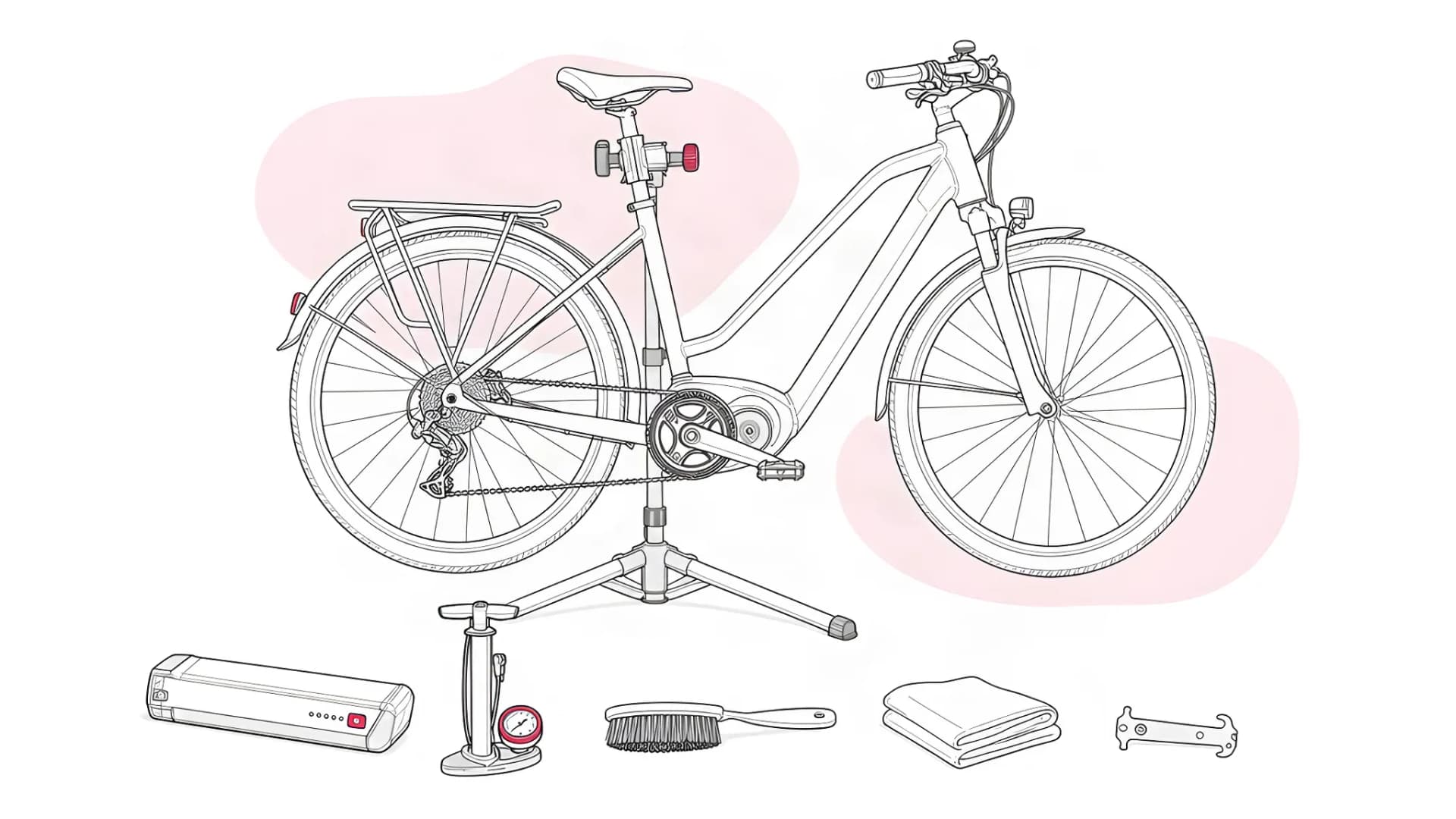
Short answer: electric bike maintenance covers the same parts as a normal bike, checked more closely, plus a few checks on the electrical system. Weight, speed and motor torque load the chain, cassette, brakes and tyres harder, and Bosch asks for an expert check at least once a year. You can clean, lube, check pressures, contacts and the speed sensor, and install app updates yourself. Motor, battery and controller faults go to an authorised service centre.
What maintenance does an e-bike need?
An e-bike needs the same maintenance as any bike, with more attention on the parts that carry the extra load. BikeRadar's workshop guide puts that load down to the motor's power output, the higher speed and the bike's weight. It says the drivetrain in particular, meaning the cranks, chain, cassette and freehub, is subject to greater forces and increased wear.
Where the extra load shows up:
- Chain, cassette and chainring. A mid-drive motor pushes through the same chain as your legs. Canyon's chain guide says the higher loads can lead to faster chain wear, and BikeRadar warns that a worn chain then wears the chainrings and cassette.
- Brakes. A heavier bike at assisted speed asks more of the pads and rotors. Bosch's spring-check advice has the dealer test hydraulic brakes under pressure, look for discoloured discs and check pad wear.
- Tyres and wheels. Schwalbe says loads and average speeds on a pedelec are mostly higher than on an ordinary bike. BikeRadar's safety check adds bolts and axles at the maker's torque settings and a test for loose spokes.
More load does not mean every job comes round sooner. Bosch's own adviser says an e-bike chain needs lubricating neither more nor less often than a pedal bike's, and that off-road riding and rough shifting are what stress it. Measure chain wear with a chain checker instead.
E-bike maintenance schedule and checklist
An e-bike maintenance schedule works on triggers rather than a fixed mileage: every ride, every wet or gritty ride, once a month, after storage and once a year. Shimano's manual for its e-bike systems says the interval between maintenance depends on use and riding conditions.
Before every ride
Shimano's pre-ride list covers smooth shifting, loose or damaged parts, secure components, abnormal noises and battery charge. Add four quick checks:
- Brakes. Squeeze both levers. They should bite firmly before the lever reaches the bar.
- Tyres. Look for cuts and embedded glass, and press each tyre.
- Battery. Pull on the pack to confirm it is locked in its mount.
- Lights. Shimano's safety notes ask you to make sure the head and tail lights turn on.
After a wet, gritty or muddy ride
Bosch's winter advice is to remove the salt from road spray after riding and let the bike dry well. Wipe the chain dry and lube it once it is dry, and wipe mud off the motor housing and battery mount.
Fazua asks for the connector plug and the charge port to be dry and clean before the battery or charger goes in.
Once a month
- Lube the chain. Bosch's spring-check advice says a good chain lube should go on at least once a month.
- Set tyre pressures with a gauge. Bosch says a tyre loses about one bar a month and that a thumb test is not enough.
- Measure chain wear and look at the brake pads and rotors.
- Check the bolts that hold you up. Bosch singles out the saddle, stem and handlebar.
- Check for software updates in the system's app, where it has one.
After storage
Bosch singles out the end of a long winter break for a tyre pressure check. Pump the tyres, look for cracks, run the pre-ride checks and charge the battery. Where to keep the bike is in our bike storage guide.
How often should an e-bike be serviced?
Bosch asks for an e-bike to be checked by an expert at least once a year, covering the mechanical parts and the system software. Bosch's dealer advice adds a first inspection after about four weeks or 300 kilometres.
Shimano ties the interval to use and riding conditions, and its displays show a spanner icon when the bike is due for maintenance. Fazua publishes no interval and sends service and calibration questions to a dealer or a certified Fazua partner.
A service has a mechanical side, which any competent bike mechanic can do, and a system side: a diagnostic read-out and software check with the maker's dealer tool, such as the Bosch DiagnosticTool.
Tyred's service packages on the pricing page cover the mechanical side. Standard is a full safety check with brakes and gears adjusted and the chain cleaned and lubricated. Essential adds cable replacement, wheel truing and a hydraulic brake fluid check, and Premium adds new tyres and brake pads.
Before you work on an e-bike
Switch the system off and take the battery out before any maintenance, including work on the chain. Bosch's motor manual makes this a safety rule, because switching the system on by accident can cause injury.
A battery built into the frame stays in. Bosch says a permanently installed battery is removed only by an authorised dealer, and asks you to make sure the bike cannot be switched on while you work.
Three more rules from the manuals:
- Keep the bike upright. Shimano says not to turn an e-bike upside down, because the display and switch unit can be damaged. Use a workstand rated for the weight, or lean the bike against a wall.
- Let the motor cool. Bosch warns that parts of the motor housing can exceed 60°C after long climbs or heavy loads at low speed.
- Keep your fingers clear of the chainrings. Bosch says the pedals can turn when push assistance is in use. Shimano warns that its EP801 and EP600 motors with FREE SHIFT enabled can turn the chainrings without anyone pedalling.
The kit is short: a track pump with a gauge, a soft brush, cloths, a mild cleaner, chain lube, a chain checker and Allen keys. No electrical tools are needed.
How to clean an electric bike
Clean an electric bike with a bucket, a soft brush and gentle water, with the system off and the battery out where it is removable. Bosch rates its Performance Line CX motor IP54, and its manual says the motor is designed to be watertight to rain and non-pressure hose washing. The same manual rules out pressure washers and submersion.
- Switch off, take the battery out, and remove or cover the display. Bosch's care advice is to cover fixed displays and remotes with a cloth or film.
- Rinse gently. Bosch says high-pressure water can get into the bearings of the motor, hubs and rear frame.
- Wash with a mild cleaner. Bosch accepts bike shampoo or washing-up liquid that is not strongly degreasing, and Shimano rules out thinners and harsh solvents. Brush the mud out from around the motor housing.
- Wipe the battery and plastics with a well wrung-out cloth, as Shimano asks. Bosch's manual wants the battery and mount contacts kept clean.
- Dry the bike, contacts first. Bosch says the mount is designed to drain if the mount and plug area are kept clean.
- Lube the chain and run a function check. Bosch's check is three questions: battery engaged, drive working, buttons responding.
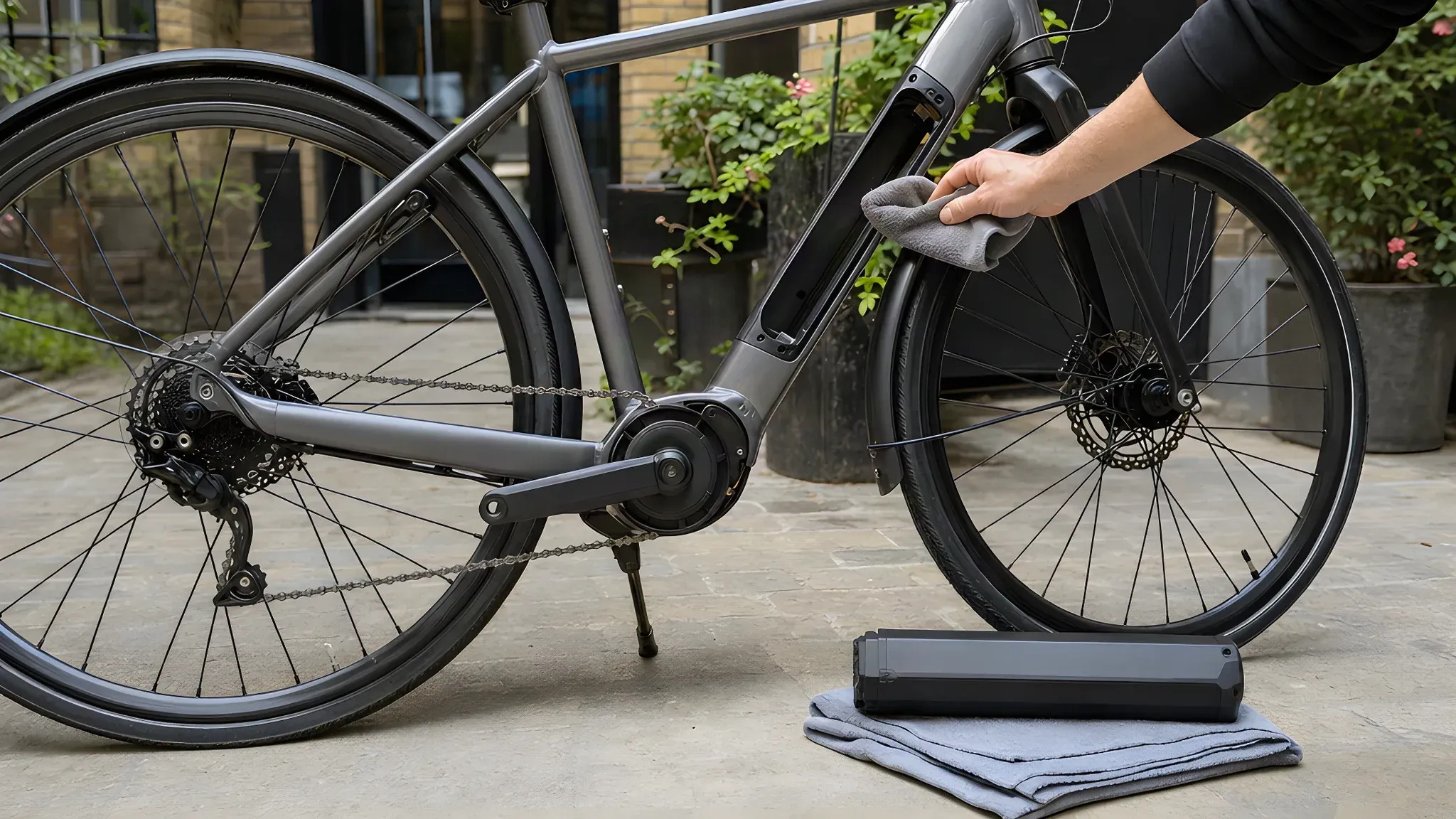
The full method and the brake precautions are in our guide to cleaning a bike.
Chain, cassette and belt drive on an e-bike
A mid-drive e-bike's chain carries the motor's torque as well as yours, so shift gently and measure wear. Bosch's motor manual advises easing pressure on the pedals briefly for each gear change, which helps the shift and reduces drivetrain wear.
Cleaning and lube. Shimano says a clean, lubricated chain extends the life of the chain, chainrings and sprockets, and warns that acid- or alkali-based rust cleaners can make the chain break. Bosch's rule is to apply lube where the chain runs freely, away from the disc.
The full method is in our chain cleaning guide.
Turning the chain. Switch the system off and turn the cranks backwards by hand. Never use walk assist or a throttle to drive the chain through a rag. On many mid-drives the chainring freewheels from the cranks, so turning the cranks backwards may not move the chain. Lift the rear wheel and turn the pedals forwards instead.
Wear and replacement. Replace the chain at the wear limit, before it takes the cassette and chainring with it. Our chain repair guide explains how to measure it.
Parts around the motor are a mechanic's job. Bosch says the chainring, cranks and pedals must be identical or approved replacements, to protect the motor from overload. Fazua says chainrings must follow the bike maker's specification, and describes a calibration in its Toolbox software after work on the chainring or cranks.
Belt drives. Gates says to wash a Carbon Drive belt with water, not to lubricate it, and not to crimp, twist or backbend it. Too little tension lets the belt skip and too much damages the hub bearings, so leave tension to a mechanic with a gauge.
Brakes, tyres and wheels on a heavier bike
On an e-bike, the brakes, tyres and wheels carry more weight at higher average speeds, so check them by eye whenever the bike is clean.
Brakes
Look into each calliper for pad thickness and along each rotor for discoloured patches. A lever that travels further towards the bar than it used to needs checking before you rely on it.
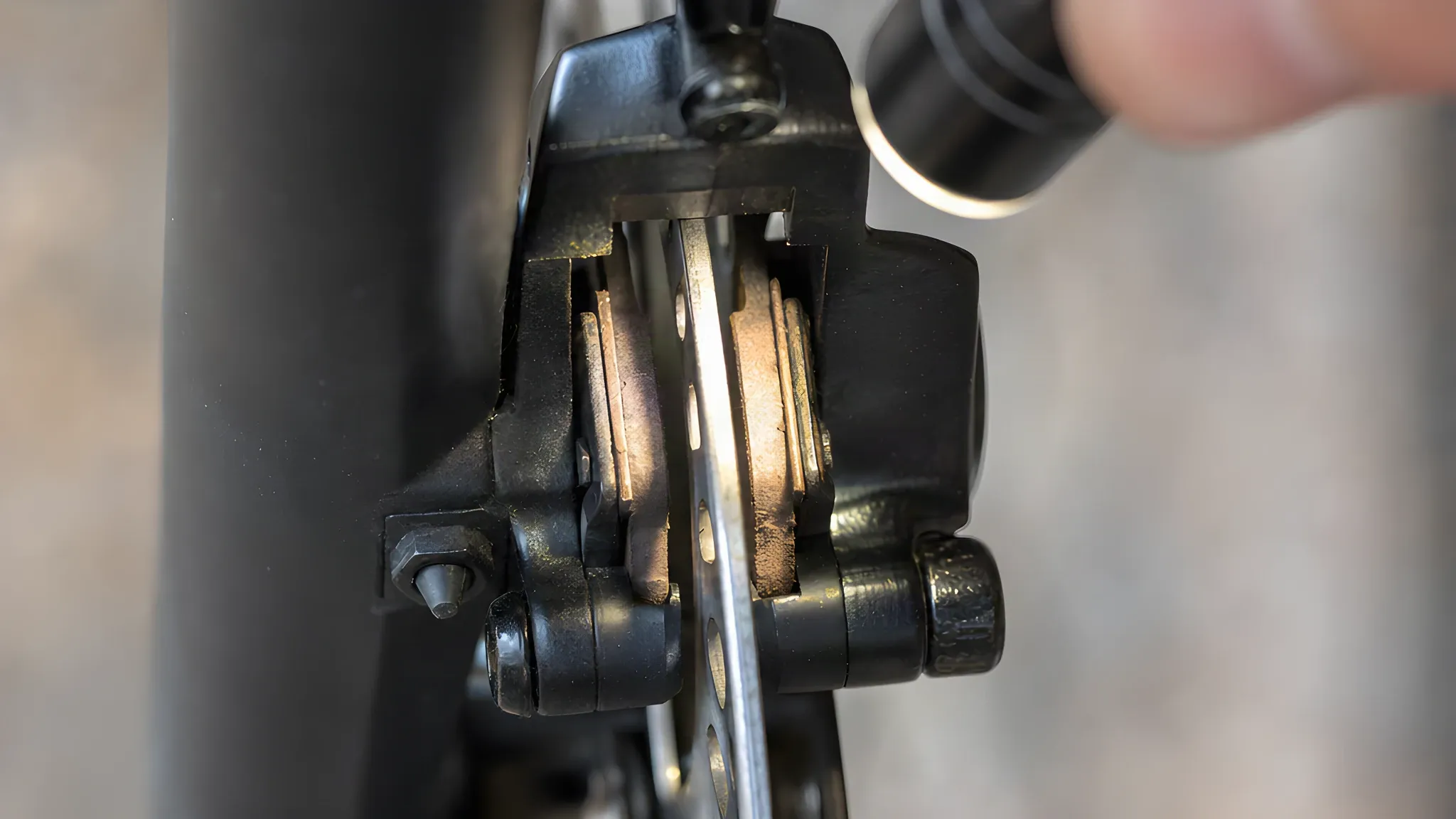
Bosch's spring-check advice has the dealer replace worn pads and refill and bleed the system as necessary. Pad limits and adjustment are in our brake adjustment guide.
Tyres
Set e-bike tyre pressure with a gauge, inside the range printed on the sidewall. Bosch asks for tyres to be checked for brittleness, cracks and tread depth too.
The maximum printed on the sidewall is the upper limit for the tyre. Our tyre pressure guide and tyre pressure calculator give a riding pressure for your weight and tyre width. Shimano notes that the wrong pressure can make the display's speed and distance readings inaccurate.
Fit a replacement tyre rated for e-bike use. Schwalbe says a 25 km/h pedelec has no legal requirement for a special tyre, but recommends its tyres marked "E-Bike Ready 25" or "E-Bike Ready 50" for pedelecs.
Wheels and bolts
A wheel that wobbles, or a spoke that ticks or feels loose, needs looking at before the next ride; our wheel truing guide covers both. Bosch's manual says not to ride if you suspect something is loose.
When the rear wheel comes out, Bosch asks you not to damage the speed sensor or its bracket, and to route the sensor cable so it is not under tension or kinked. On a hub-motor bike the motor cable and any torque arm come into it too, as our puncture guide explains.
Do e-bike motors need maintenance?
E-bike motors need no maintenance from the rider inside the casing, because the motor is a sealed unit that is not meant to be opened. Bosch's manual says not to open the drive unit, and Fazua says no component of its Ride 60 system can be repaired by the user.
What the motor and its electronics need is care on the outside:
- Housing and mounts. Clean off the mud and look for cracks or missing bolts. Bosch says not to paint any part of its drive system.
- Cables and connectors. Look for chafed or kinked cables and loose plugs, without pulling connectors apart. Shimano asks for dummy plugs in unused E-TUBE ports.
- Battery contacts. Keep them clean and dry. Bosch says the contacts are coated against corrosion, and technical vaseline may be used if needed. Never spray anything into a port.
- Speed sensor and magnet. Bosch's smart system manual sets the gap between magnet and sensor at 2–15 mm. The magnet sits on a spoke or the brake rotor, and Bosch's rim magnet needs no separate sensor.
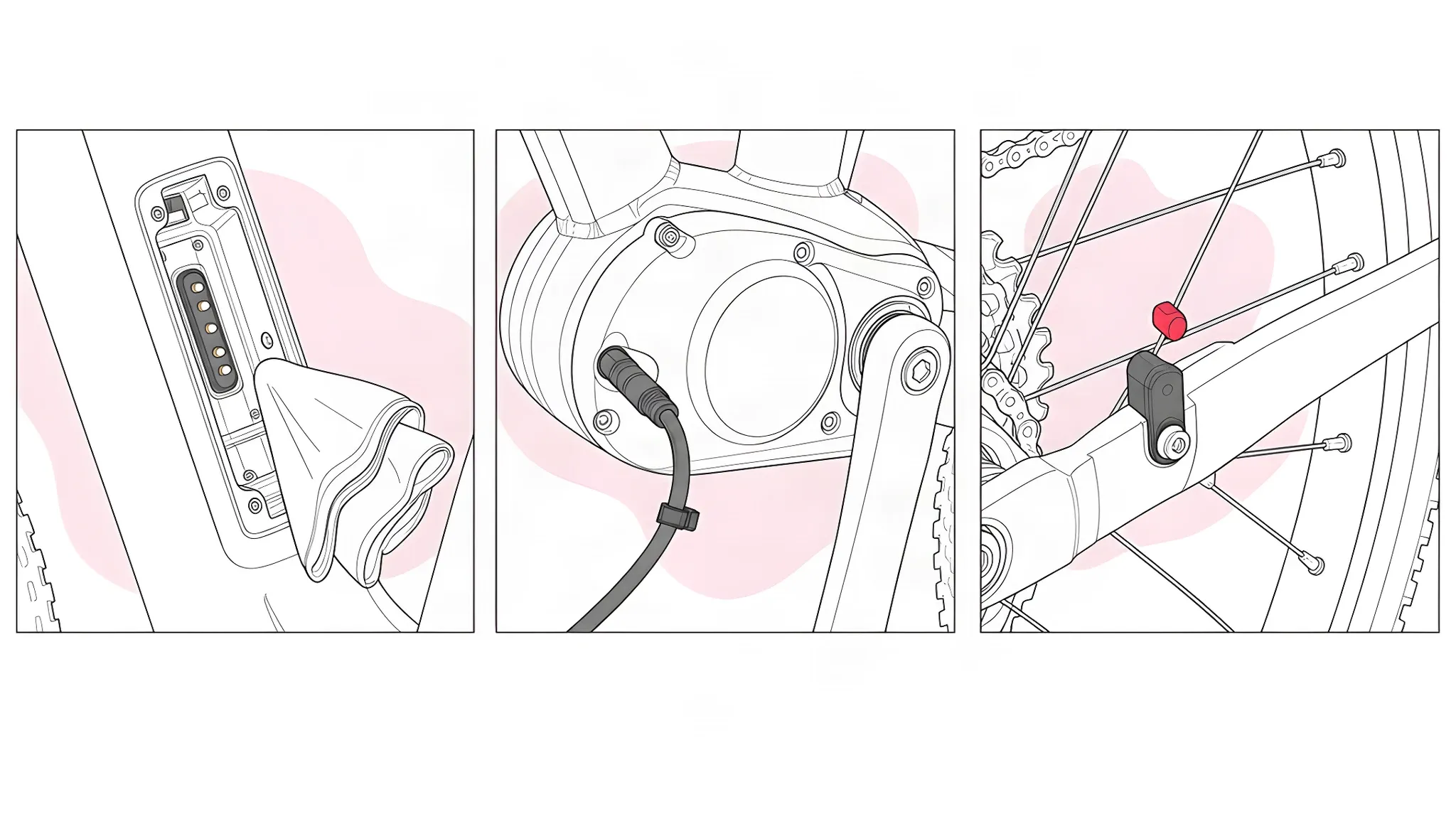
A magnet knocked out of line stops the speed reading. Bosch's older motor manual sets its gap at 5–17 mm and lets riders loosen the spoke magnet's screw and reset it, while Shimano sends the job to the place of purchase.
Hub motors are sealed in the same way. Their outside checks are the axle nuts or through-axle, the torque arm where fitted, and the motor cable where it leaves the axle.
How to update e-bike firmware
Update e-bike firmware through the maker's app where the system supports it, and through a dealer where it does not:
- Bosch smart system. The eBike Flow app checks for updates and sends them to the bike over Bluetooth.
- Older Bosch systems. A Nyon display from model year 2021 on checks for updates over WiFi and installs them itself. Other older units are updated by a dealer with the Bosch DiagnosticTool.
- Shimano EP and STEPS. The free E-TUBE PROJECT Cyclist app updates components with Bluetooth LE. Otherwise Shimano sends you to the place of purchase.
- Fazua Ride 60. Fazua's Toolbox software runs on a computer and connects to the bike with a USB-C cable.
BikeRadar notes that some brands recommend an authorised dealer for updates, and that an update may boost torque or add features on some systems. An update changes the software only, so a worn part, a damaged cable or an ageing battery still needs its own fix.
E-bike error codes and loss of assistance
An error code tells you which part of the system has found a fault, so write it down with the bike's make and model first. The fixes the makers allow riders are short:
- Switch off and on. Shimano's first step for its E010 drive unit error is a power cycle. If the error persists, Shimano says to stop using the bike and contact the place of purchase.
- Feet off the pedals. Shimano's W013 warning means sensor initialisation failed. Switch off, then on again without your feet on the pedals.
- Reseat the battery. For no assistance at all, Shimano says to remove the battery and refit it after a few seconds.
- Speed sensor faults. Shimano's W011 and E014 codes and Fazua's yellow soft-fault flashes point at the speed sensor or magnet.
- Hard faults. Fazua's LEDs flashing red three times every three seconds mean the bike cannot be ridden and must go to a specialist workshop.
Do not clear a fault by tuning or bypassing the system. Bosch says a product that raises the motor's performance makes the bike an illegal mode of transport. GOV.UK classes an e-bike assisted above 15.5 mph, or over 250 watts continuous rated power, as a motorcycle or moped that must be registered, taxed and insured.
E-bike battery care in brief
Check the battery casing for cracks, dents or swelling whenever you clean the bike, and make sure the pack clicks firmly into its mount. Charge it with the supplied charger or one the manufacturer recommends, let it cool after a ride, and unplug it when charging finishes.
The London Fire Brigade asks you never to charge a battery unattended or while you are asleep, and never to charge or store it on your escape route. If a pack is swollen, leaking or extremely hot, turn it off, unplug it and contact the manufacturer or retailer.
If a battery smokes or catches fire, get out, call 999 and do not tackle it. Charging temperatures, storage charge and lifespan are in our e-bike battery care guide.
What you can do, what a mechanic does, and what goes to a service centre
E-bike work splits three ways. Routine checks, cleaning, lube, tyre pressure and app updates are yours, as far as your tools and confidence go.
Mechanical work any competent mechanic can do:
- Brake pads, rotors and hydraulic bleeds.
- Gears, cables, and chain, cassette and chainring replacement with approved parts.
- Wheel truing, spokes, tyres and punctures, including hub-motor wheels.
- Bearings outside the motor, and bolt torque.
Tyred mechanics handle the mechanical work on Bosch, Shimano STEPS, Fazua, Brose and other systems: brakes, gears, wheels, tyres, chains and general servicing, as the e-bike repair page sets out.
Work for an authorised service centre:
- Anything inside the motor, battery or controller.
- Error codes that return after the rider steps above.
- Dealer-tool diagnostics, and updates on systems without an app.
- Removing a battery built into the frame.
A Tyred mechanic diagnoses these faults and refers the bike to an authorised service centre when the repair is outside Tyred's scope.
What not to do
- Do not pressure wash an e-bike. Bosch and Shimano both rule it out, because water is forced into bearings and components.
- Do not use walk assist or a throttle to turn the chain. Shimano warns that fingers caught in the drivetrain can be seriously injured.
- Do not open the motor or the battery. Bosch and Fazua both say the units are not for the rider to open.
- Do not refit or charge a wet battery. Fazua asks for the connector and charge port to be dry and clean first.
When it is a job for a mechanic
- Brakes that fade, a lever that travels further than before, or discoloured rotors. The pads, rotors and hydraulic system need checking on a bike this heavy.
- A new chain that skips on the old cassette. The cassette, and possibly the chainring, wore with the old chain.
- A wobbling wheel, a loose spoke, or a rear puncture on a hub-motor bike, where the motor cable and any torque arm come into the job.
- Grinding or knocking from the bottom bracket area. A mechanic can rule out the cranks, chainring and pedals before the motor is suspected.
- An error code that returns after a power cycle, or assistance that cuts out with the battery seated. A mechanic rules out the mechanical causes and the battery seating; a fault that stays in the system is referred to an authorised service centre.
- A chafed cable, a damaged connector or a cracked battery casing. Stop riding and charging until it has been looked at.
A mechanic comes to you with a fully stocked workshop, 9am to midnight, seven days a week, across London.
Book a repair · About mobile e-bike repair →
Related guides
- How long does an e-bike battery last? Charging, storage and care
- How to clean a bike: wash, dry and lube it properly
- How to clean a bike chain
Sources and further reading
- BikeRadar: electric bike maintenance (James McKnight, published June 2025, updated June 2026), the causes of extra load, greater forces and wear on the drivetrain, knock-on chain wear, bolt and spoke checks and firmware updates.
- Bosch eBike Systems: Performance Line CX drive unit manual, smart system (MY24), battery removal before work, built-in batteries, housing temperature, push assistance, assistance level off, shifting, approved drivetrain parts, loose parts, not opening, painting or tuning the drive, IP54 and hose washing, the annual expert check, the 2–15 mm speed sensor gap and wheel removal.
- Bosch eBike Systems: Performance Line drive unit manual (MY19), realigning a spoke magnet and calling a dealer if the speed still does not show.
- Bosch eBike Systems: care of eBikes (Harald Sterzl), washing preparation, no high-pressure water, cleaners, the battery mount and contacts, chain lube frequency and placement, winter salt and the function check.
- Bosch eBike Systems: get your eBike ready for springtime, brake, disc and pad checks, monthly chain lube, the one bar a month pressure loss, tyre condition and bolt checks.
- Bosch eBike Systems: dealer service, the first inspection after about four weeks or 300 km, and the DiagnosticTool for diagnosis and updates; with Bosch: updates and software versions for updates through the eBike Flow app.
- Shimano user's manual EP8 / EP6 / EP5 (UM-7K70A): notice, no high-pressure washing, not turning the bike upside down, cleaning products, dummy plugs, E-TUBE PROJECT Cyclist and software updates; with the safety information (maintenance intervals, FREE SHIFT, lights, chain solvents) and pre-ride inspections pages.
- Shimano: error and warning codes, the E010, E014, W011 and W013 remedies; and the Shimano e-bike systems FAQ, entries S-6210 (spanner icon), S-6220 (speed display), S-6270 (no assistance) and S-6100 (battery life).
- Fazua: Ride 60 knowledge base, dry connectors, chainrings and calibration, firmware updates with the Toolbox, soft and hard fault LEDs, and no user-repairable components.
- Canyon: how to clean and maintain your bike chain, higher drivetrain loads and faster chain wear on e-bikes.
- Schwalbe: tips for pedelec and e-bike, higher loads and speeds on pedelecs and the E-Bike Ready 25 and 50 marks.
- Gates Carbon Drive owner's manual, no lubrication, belt handling and the effects of wrong tension.
- London Fire Brigade: how to charge e-bikes and e-scooters safely, chargers, cooling before charging, escape routes and unattended charging; with spot the warning signs for damaged batteries and what to do in a fire.
- GOV.UK: riding an electric bike, the rules, the 250 W and 15.5 mph EAPC limits and what applies to a bike outside them.