How to store a bike in a flat, a shed or outside
How to store a bike in a flat, shared hallway, council hangar, shed, garage or outside, with rust, tyre, hydraulic brake and winter storage checks.
By the tyred mechanics
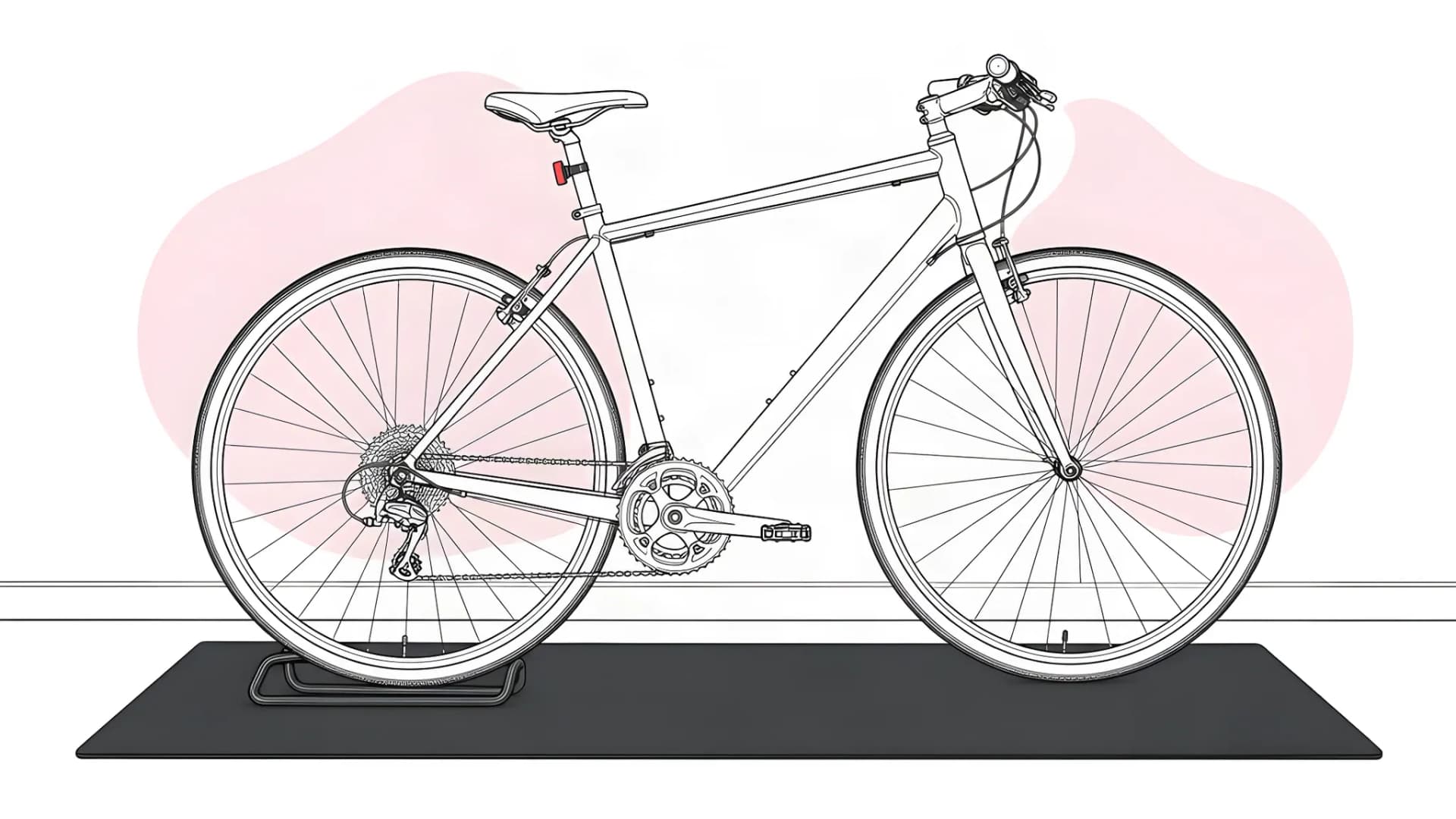
Short answer: how to store a bike comes down to three rules: keep it dry, keep its weight off flat tyres, and keep it out of escape routes. Inside your own flat is best, on a stand or a hook screwed into a stud or joist. A shed, garage or council bike hangar comes next, with the bike locked to an anchor. Outside, put a vented cover over a dry bike, and before winter take any e-bike battery indoors.
Where should you store your bike?
Store the bike in the driest place where you can lock it and reach it without blocking a way out. The options, from best to last resort:
- Inside your own flat or house. The driest and most secure place, on a stand, a wall rack or a ceiling hoist clear of the route to the door.
- Communal bike store in the block. Out of the weather and the corridors. Lock the frame to the rack as you would in the street.
- On-street bike hangar. A locked shelter rented from your borough council and shared with other residents.
- Shed, bike locker or garage. Room for racks and anchors, but neither dry nor secure on its own.
- Outside with no shelter. A locked bike under a vented cover in the most sheltered spot you are allowed to use.
- Shared hallway. Only with the landlord's or managing agent's agreement, for the fire safety reasons below. A balcony is not a storage option in a block of flats.
Before you buy a rack, measure the bike's length and handlebar width, allow for the pedals and for doors opening, and check its weight against the rack's rated load. If you rent, ask the landlord before drilling; the Home Office's flats leaflet asks residents to check that DIY will not affect the building's fire safety measures.
How to store a bike in a flat
In a flat, the bike lives inside your own front door on a floor stand, a wall rack or a ceiling hoist, with a mat under the wheels to catch grit and water. The choice depends on your walls, your ceiling, the bike's weight and how often you ride.
- Freestanding floor stand. Holds the bike upright by one wheel with no drilling. Check it is stable with your tyre width; it still takes floor space the length of the bike.
- Vertical wall hook. Hangs the bike by one wheel, flat against the wall. It needs the bike's length in height, about a metre of wall width, and projects into the room by the handlebar width. You lift the front wheel onto the hook each time.
- Horizontal wall bracket. Holds the bike flat against the wall by the frame, so it projects only by the handlebar width. Rest the frame only where the bike's maker allows support.
- Ceiling hoist or rack. Uses space nobody walks through, but needs fixing into joists, a rated load above the bike's weight and enough headroom. It is slow for a daily commute and hard work with a heavy e-bike.
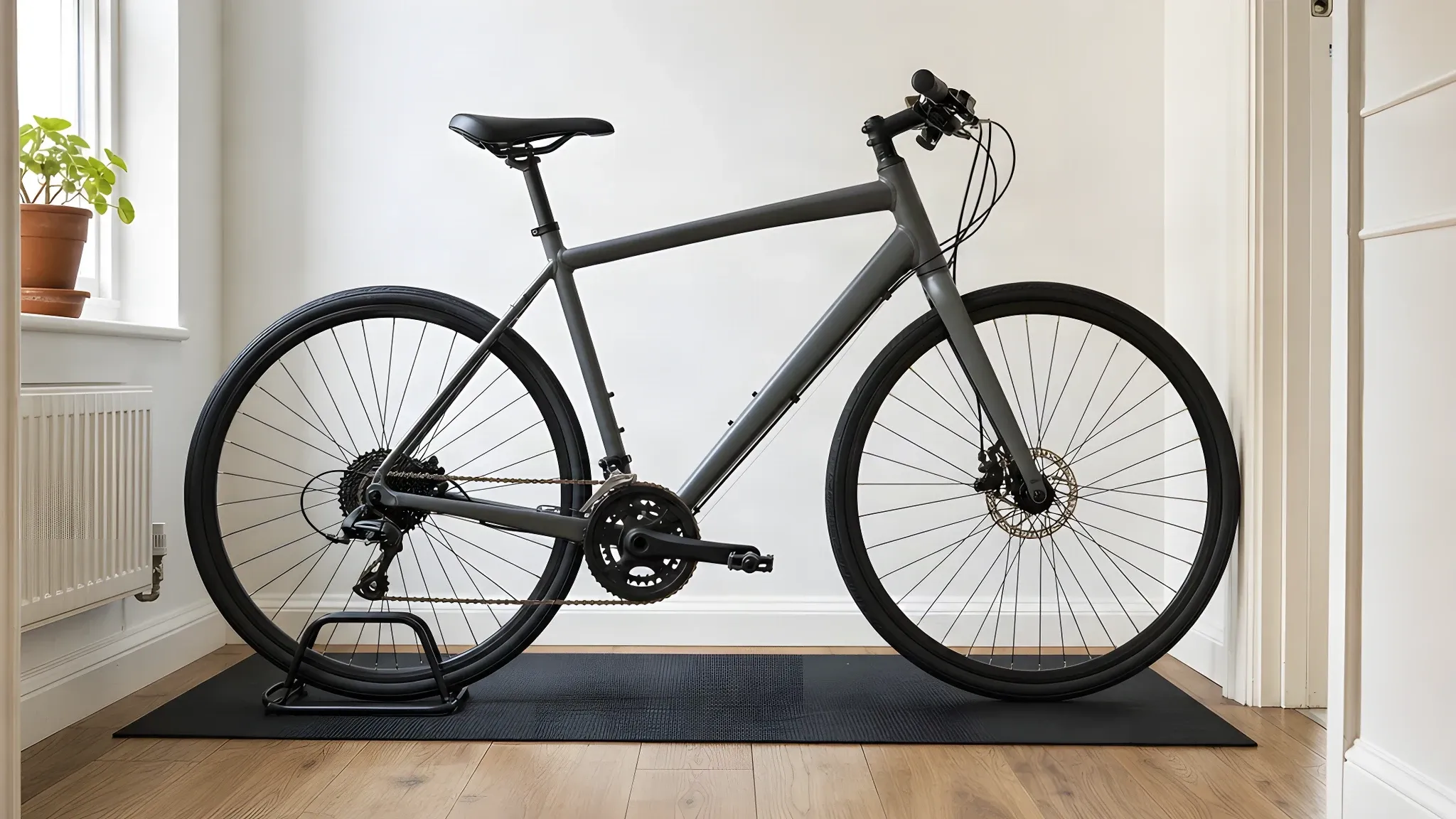
A hook, bracket or hoist is only as strong as what it is screwed into. Park Tool rates its wood-thread storage hook at 52 kg, provided it is securely screwed into solid material, and names ceiling joists, wall studs or any piece of wood that can support the bike's weight. Plasterboard on its own is none of those.
If you rent and cannot drill
A freestanding stand is the simplest answer. Cycling UK's storage guide also describes upright stands that hold two bikes one above the other, including versions that lock between floor and ceiling with no wall fixings.
A bike leaning on a wall needs a mat under it, and the gears facing out so the rear derailleur is not pressed against the plaster. A folding bike folds into a cupboard. Turning the bars to make an ordinary bike fit is fine if the stem bolts go back to torque before you ride.
Storing two or more bikes
Cycling UK's guide suggests hanging bikes "nose to tail", alternating front and rear wheels, so the bars of one bike hang next to the saddle of its neighbour. Space the hooks so each bike comes off without lifting the next, and check that handlebars and pedals do not lock together.
Can you keep a bike in a shared hallway or on a balcony?
Only with the permission of the landlord or managing agent, and never where it narrows the escape route. The Home Office's "Fire safety in flats" leaflet tells residents not to store prams, bicycles or mobility scooters in communal areas without that permission.
The London Fire Brigade's guidance note on fires in communal areas says escape routes should be kept completely clear of items including prams, buggies and bicycles. Before anything is stored there, the landlord should agree and the fire risk assessment should be reviewed.
An e-bike adds the risk of its battery. The Brigade's advice is never to block your escape route with an e-bike, and to store and charge it away from a main through-route or exit. Inside your flat, that rules out the hallway by the front door; our e-bike battery care guide covers where and when to charge.
The same Home Office leaflet says to keep balconies clutter free and not to use them for storage, because a balcony can be an escape route for residents or an access point for firefighters. That rules the balcony out for a bike in a block of flats; use one of the other options above.
How do council bike hangars work?
A bike hangar is a lockable shelter on the street, rented space by space from your borough council. Islington's terms describe a hangar opened with a key and shared with up to five other people, one bike per lettered space. Each borough sets its own price, rules and waiting list:
- Islington. £107.25 a year, with a refundable key deposit of £27.75, and a £75 rate for residents receiving Council Tax Support from 1 January 2026. The terms say hangars are not suitable for cargo bikes, tandems, tricycles or most other types of cycles.
- Southwark. £60 a year, with a £35 key deposit, on the council's "Rent a space" page. You can join the waiting list for up to five hangars, hold up to two spaces per household, and have 14 days to accept an offer.
Southwark's hangar pages also explain how to request a hangar in a new street. Islington's terms say the bike is parked at your own risk and the council does not insure it. Check that your policy covers a bike in a hangar; Tyred's cycling insurance page explains how cover works.
How to store a bike in a shed or garage
Keep the bike off wet floors and away from damp walls, lock it to an anchor fixed into concrete, and air the space on dry days. A roof keeps the rain off, but a shed or garage is not dry or secure by default.
GOV.UK's guidance on damp explains that moisture in the air condenses onto colder surfaces, more so where it cannot escape. In an unheated shed or garage, the cold steel of the chain, cassette and bolts is such a surface, so open the door on dry days and check for orange bloom.
Cycling UK's winter guide still says that keeping a bike indoors, "even in a shed", prevents rusting and aluminium corrosion. Stand or hang the bike so nothing rests on the rear derailleur or pinches the brake hoses, and keep it out of the swing of a car door.
Security in a shed or garage
Cycling UK's guide puts it plainly: "Simply locking your shed or garage door isn't a good enough way to secure your bike or bikes." It advises an anchor fixed into a strong solid surface, ideally concrete, rather than the thin wooden wall of a shed, which can be easily broken off.
Secured by Design, the police security initiative, recommends a purpose-made shed shackle and padlock, or a ground anchor fixed to the shed base with a security rated lock. It notes that e-bikes are increasingly targeted from garages.
In the Crime Survey for England and Wales, 42% of bicycle thefts in the year to March 2025 happened in semi-private areas of the home. The ONS defines these as outside areas on the premises, and garages or car parks around but not connected to the home.
Lock grades and anchors are in our guide on how to lock your bike, and where London bikes are stolen is in our London bike theft guide. Policies differ on sheds, detached garages and communal stores, so check your policy wording.
How to store a bike outside without it rusting
Outdoor storage cannot be made rust-free, but the rust can be slowed: dry the bike before it is covered, keep it off wet ground, lock it to something solid, use a fitted cover with vents, and check under it after wet weather.
1. Choose the most sheltered spot you are allowed to use
Pick a place against a wall or under eaves, on paving rather than grass or soil, and out of any puddle. A bike locker in a front garden may need planning permission; Secured by Design advises checking with your council, for example in a conservation area.
2. Lock it to something that cannot move
Cycling UK's guide says to lock a bike kept outside to a floor anchor or another solid fixing such as railings. It recommends two different Gold-standard locks: one through the frame and front wheel, one through the frame and rear wheel.
3. Take the removable parts indoors
Cycling UK names lights and computers. An e-bike's battery comes in too, as set out in the winter checklist below.
4. Dry the bike before you cover it
A cover over a wet bike holds the water in, and a sealed plastic sheet gives it nowhere to go. Wipe the frame, the chain and the bolt heads with a dry rag first, and let the bike stand until they are dry to the touch.
5. Fit a vented cover and strap it down
Use a cover made for bikes, with vents and a strap at the bottom. The vents let some of the trapped moisture out, and the strap stops the wind lifting the cover off the bike.
Put the lock through the frame and into the anchor before the cover goes on.
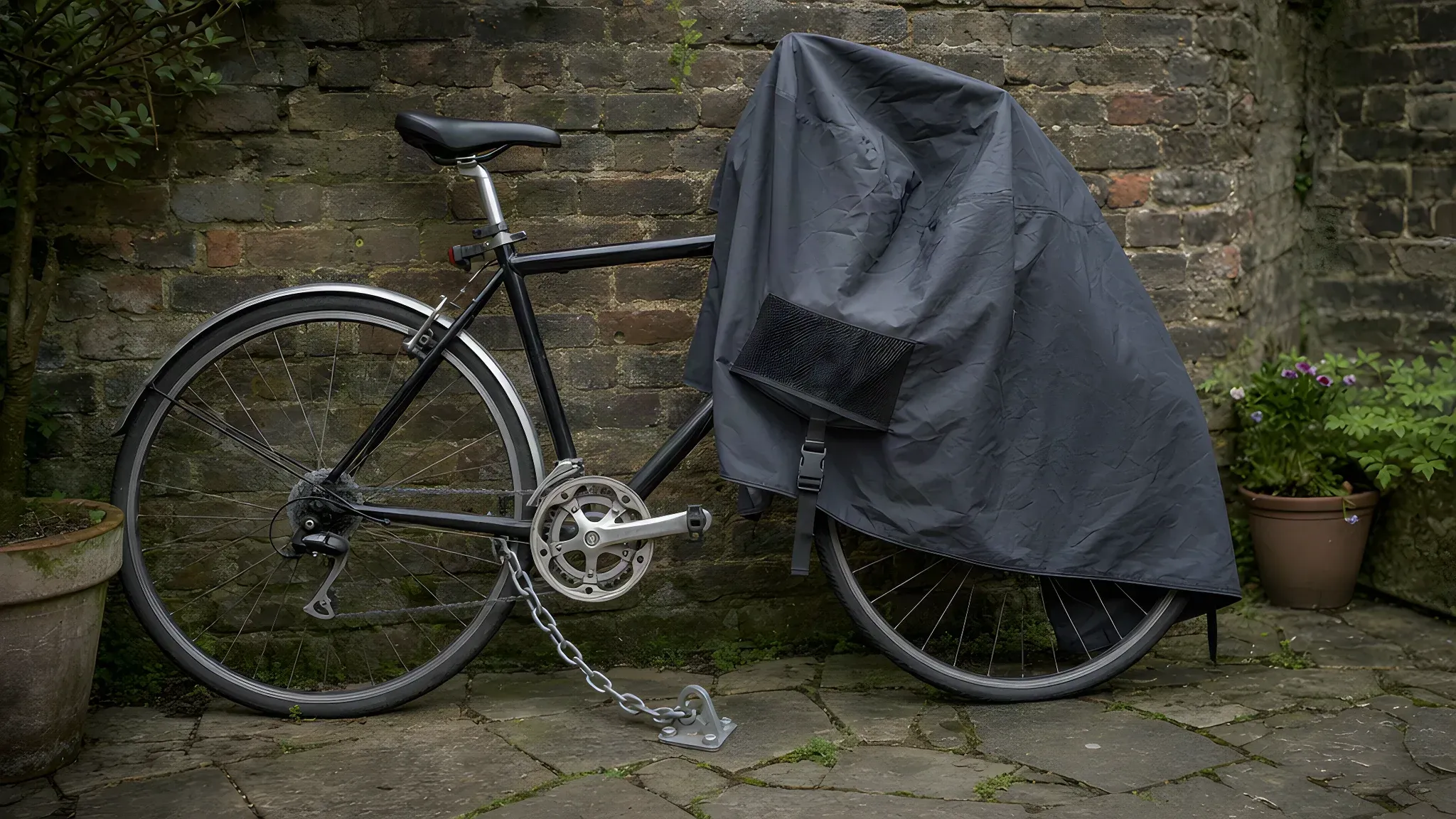
A cover also keeps sunlight off. Hunt's user guide says excessive UV light can degrade the epoxy resin in carbon rims over time, and Schwalbe says stored tyres keep best in a cool, dry and above all dark place.
6. Keep the chain lubed and look under the cover
Cycling UK's winter method for the chain is to wipe it down, add a little oil, then wipe that off as well. Keep lube off disc rotors and rim braking surfaces.
After a wet spell, lift the cover, let the bike air and look for rust on the chain, cables and bolts. Light orange bloom comes off with the methods in our guide on removing rust from a bike.
Can you hang a bike by its wheel?
Yes, from a coated hook rated for the bike's weight and screwed into a stud or joist, if the wheel is sound and its maker does not advise against it. The hook carries the whole bike on one rim and tyre:
- The wheel. Carbon rims are built in different ways, so check the wheel or bike maker's manual before hanging one. Never hang a wheel with a broken spoke or a dented rim.
- The hook. Coated and wide enough for your tyre. Park Tool describes its hooks as plated and vinyl dipped for scratch-free service.
- The contact point. The hook goes round the rim and tyre, never round a spoke.
- The load. Check the hook's rating against an e-bike's or a cargo bike's weight.
Hydraulic disc brakes: vertical, upside down or on its side
Shimano's service instructions for its hydraulic disc brakes say the system is not designed to be turned upside down. With the bike upside down or on its side, air bubbles in the reservoir can move towards the calipers, and Shimano warns that the brakes may then not operate.
After the bike has been in either position, Shimano says to operate the lever a few times and check the brakes work normally before riding. For a sluggish lever, Shimano's procedure is several gentle squeezes so the bubbles return to the reservoir, then topping up the reservoir with mineral oil, then a bleed if the lever is still sluggish.
Shimano's instructions do not mention hanging a bike by a wheel, so squeeze the levers a few times before you ride; the check takes seconds. Other brake makers publish their own instructions, and our brake adjustment guide explains why a hydraulic lever that stays soft means a bleed.
How to store a bike for winter or a long break
Before a long break, clean and dry the bike, lube the chain, fix any faults, keep the tyres inflated or the bike hung up, and take any battery indoors. Then check it while it is stored and again before the first ride.
1. Clean off the salt, dry the bike and lube the chain
Cycling UK's winter guide says the salt on gritted roads speeds up corrosion and rusting. Wash and dry the bike using our guide on how to clean a bike, then lube the chain with the wipe, oil and wipe method above.
2. Fix faults before the bike goes away
A soft brake lever, a stiff chain or a slow puncture is easier to sort out now than on the first morning you need the bike. Tyred's Standard service, for example, includes a full safety check, brake and gear adjustment and a chain clean and lube; the service packages list what each level covers.
3. Keep the weight off flat tyres
Schwalbe's technical guide says a tyre fitted to a rim should always be inflated, or the bike hung up, for storage. A bike left on flat tyres for an extended period, it says, may damage the sidewalls. Pump the tyres to their normal pressure and top them up during storage; our tyre pressure guide has the figures.
Stan's says its Original tubeless sealant stays liquid inside the tyre for 2–7 months, so check a tubeless tyre's sealant before the first ride after a long break. Our tubeless puncture repair guide covers what sealant can and cannot seal.
4. Take the battery and electronics indoors
Bosch's winter advice is to take the battery off an e-bike kept in a carport or unheated shed and keep it at room temperature. Charge level and storage temperature differ by battery maker and are in our e-bike battery care guide.
5. Check it during storage and before the first ride
While the bike is stored, look at the tyres, the chain and bolts for rust, and any hook or stand that has worked loose. Before the first ride, pump the tyres, squeeze both brake levers hard, check the wheels are fastened tightly, and turn the cranks to see the chain runs freely.
What not to do
- Do not park the bike in a communal corridor, or an e-bike by your own front door. The Home Office leaflet keeps communal escape routes clear; the London Fire Brigade keeps e-bikes and their batteries away from exits.
- Do not cover a wet bike in sealed plastic. Dry it first and use a vented cover.
- Do not leave the bike standing on flat tyres. Schwalbe says this may damage the sidewalls.
- Do not store a hydraulic-brake bike upside down or on its side. Shimano says the system is not designed for it.
- Do not screw a hook into plasterboard alone. Park Tool's load rating assumes solid material.
- Do not rely on a locked shed or garage door. Lock the bike to an anchor inside, as Cycling UK and Secured by Design advise.
When it is a job for a mechanic
- A hydraulic brake lever that stays soft or sinks after a few squeezes. Shimano's fix is a bleed, which needs the right fluid and kit for your brake.
- Rust past orange bloom, a chain with stiff links, or cables that drag after storage. The parts need assessing, and some replacing.
- Cracked tyre sidewalls after a winter on flat tyres, or tubeless sealant that has dried out. The tyres need checking before you ride.
- An e-bike that shows an error or will not wake after storage. The system needs diagnosing before it is charged and ridden.
- A bike coming out of long storage for daily commuting. A full safety check covers the brakes, gears and chain in one visit.
A mechanic comes to you with a fully stocked workshop, 9am to midnight, seven days a week, across London.
Book a repair · Service packages and prices →
Related guides
- How to lock your bike
- How to remove rust from a bike
- E-bike battery care: charging, storage and winter
Sources and further reading
- Cycling UK: a guide to bicycle storage and security at home (Matt Lamy), floor anchors and two Gold-standard locks outside, locked shed doors, anchors into concrete, nose-to-tail hooks, floor-to-ceiling stands and removing accessories.
- Cycling UK: making your bike winter ready (Christina Bengston), indoor storage "even in a shed", salt and corrosion, and the wipe, oil and wipe chain method.
- Home Office: fire safety in flats (22 July 2022), bicycles in communal areas only with the landlord's or managing agent's permission, and balconies not used for storage.
- London Fire Brigade: guidance note GN84, fires in communal areas (version 3, August 2023), escape routes kept clear of bicycles, landlord agreement and the fire risk assessment; and how to charge e-bikes and e-scooters safely, escape routes and storing e-bikes away from exits.
- Islington Council: bike hangar terms, the shared hangar, the £107.25 fee, £27.75 deposit and £75 reduced rate, unsuitable cycle types and parking at your own risk; and Islington Council: cycle parking, the reduced rate from 1 January 2026 and the waiting list.
- Southwark Council: rent a space in a cycle hangar (10 September 2026), the £60 fee, £35 deposit, waiting lists for up to five hangars, two spaces per household and the 14-day offer; and Southwark Council: cycle hangars FAQ, requesting a hangar in a new street.
- Secured by Design: bike security, shed shackles and ground anchors, e-bikes targeted from garages, and planning checks for front garden storage.
- ONS: nature of crime, bicycle theft, year ending March 2025, Table 2, where bicycle thefts happened, and the definition of semi-private areas.
- GOV.UK: understanding and addressing the health risks of damp and mould in the home, how condensation forms on colder surfaces and why ventilation matters.
- Shimano service instructions SI-8JZ0A-004: disc brake system, the warning on turning the bike upside down or on its side, the lever check before riding and the procedure for a sluggish lever.
- Schwalbe Tech Info, cool, dry and dark storage for tyres, and inflated tyres or a hung-up bike to protect the sidewalls.
- Park Tool: 451-2 storage hook, the 52 kg limit in solid material, joists and studs, and the vinyl-dipped coating.
- Hunt Bike Wheels: user guide, keeping carbon rims out of direct sunlight because UV can degrade the epoxy resin.
- Bosch eBike Systems: safely through the winter with the eBike (December 2016), the battery off a bike kept in a carport or unheated shed and stored at room temperature.
- Stan's: Original tubeless sealant, sealant staying liquid inside the tyre for 2–7 months.